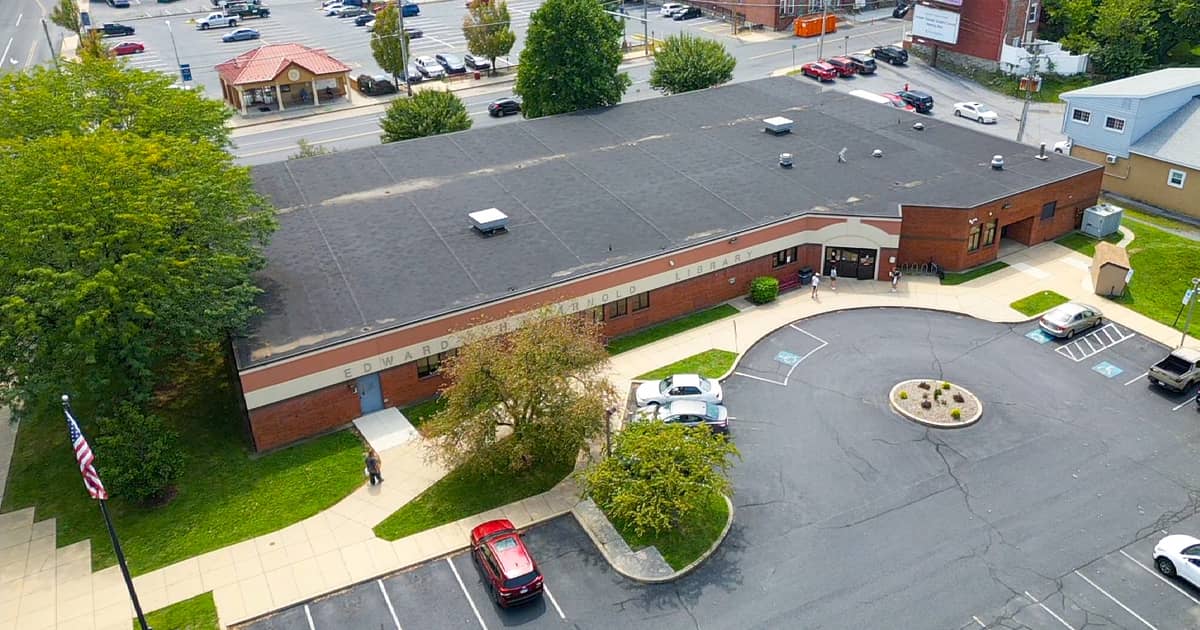
A local institution combining the tradition of the printed word with modern technology will celebrate its 100th anniversary in October.
The Edward Arnold Lebanon Community Library has had several locations before settling in at 125 N. 7th St. in October 1985. Approximately 95,000 volumes across a wide range of subjects — from fiction and nonfiction to genealogy and local history to sports and home improvement and beyond — fill its shelves. Children’s, Spanish language, and large-print sections provide added literary depth. Patrons can go online in an area with desktop computers neatly positioned in a semi-circle enclosure.
There is no more flipping through a card catalog – once the touchstone of any library. The catalog is now online and accessible through designated computers in the library, and can also be accessed from home or via the library app.
POWER Library
POWER Library is the online portal to all that Pennsylvania libraries offer. The Lebanon library is part of a statewide 24-hour network staffed by real people, not AI. A library card is needed to access all categories, providing access to books, newspapers, magazines, journals, historical documents and photos, online databases, eBooks, and research materials.
Computers also provide access to Lebanon County’s five other libraries. (A library card issued by one local library allows a person to take out a book from any one of the six.) Research material are available through the library catalog, its online databases, or the POWER Library from Pennsylvania’s state library. Databases include newspapers, encyclopedias, and genealogy.
Above all, the library’s mission is dedicated to lifelong learning. “Everyone can still learn through life,” says Michelle Hawk, who is in her 14th year as executive director of the library. “Our mission is to provide resources to inspire lifelong learning for all.”
The library’s vision statement goes hand in hand with its mission: Empowering individuals, enriching community, inspiring curiosity. Hawk emphasizes that “we are open to every demographic – economic and racial. Our target audience is our community.” As part of that mission, Hawk sits with host Laura Lebeau on WLBR radio’s “Library Chat” at 7:45 a.m. on the first Tuesday of the month to discuss current events and programs offered at the library.
Melissa Mann, director of fundraising, explains further the concept of learning for all. “We need to get people to know that the library is more than books,” she says, referring to programs and events that encourage personal interaction and strengthen a sense of community. “Creativity. We stoke it. Ideas come from people who utilize the library.”
Programs and more programs
- Summer Learning Program helps fill summer vacation with “Unearth a Story” for kids between the ages of 2 and 10 and “Dig It Up” aimed at kids in grades 5-9. In addition to reading, kids participate in 12 weekly activities, four times a week, such as Dinosaur Discovery, a storytelling science adventure, and Reptile Explorers (with real reptiles in the library).
- Paws to Read: children read to a certified therapy dog.
- Tech Help: free computer help, courtesy of the Bishop Fund.
- Book clubs: The Haunted Horror Book Club, Detective Agency Book Club, the Cook Book Book Club, and others.
- Basics of Phone Photography.
- Board Game Night.
- Writers Group.
- Trivia Night.
- Free wi-fi and computer use for research and gaming.
- Audio and e-books including children’s titles.
- Learn to play pinocle or mahjong.
Other programs include presentations by Penn State Health, Gardening 101 with Penn State’s Lebanon County Extension (always a waiting list), and Cooking in the Garden by Penn State’s Medical College.
How it all began
If you wished to borrow a book in Lebanon in the 1800s, you more than likely went to a retail store or even a pharmacy that offered a lending shelf. The idea of a functioning library in Lebanon surfaced in 1870 with the formation of a joint school/public library. Then on Nov. 11, 1926, the Woman’s Club of Lebanon along with various service organizations and the Chamber of Commerce formed the Library Advisory Board of Lebanon. Thirteen months later the board opened a public library at 38 S. 8th St. and raised more than $1,900 to provide the library with its first budget.

Twenty-six years later, the library had a new home at 624 Chestnut St. through the benevolence of Harvey C. Grumbine, who in his will left $235,734.24 to the Community Library Association for the purpose of establishing improved quarters. The building, once a synagogue, was named the Harvey C. Grumbine Free Public Library.
Due to overcrowding, the children’s department was moved in 1967 to a site on South 8th Street between Cumberland and Chestnut streets, eventually prompting the association to consider enlarging the 8th Street location or finding a site for a new building.
Enter local businessman Edward H. Arnold, who donated $400,000. With matching state funds, construction began on a new building. More than $1,600,000 was raised and the library opened for perusing and lending at 7th and Willow streets in October 1985.

Keep ’em coming
Visits are electronically recorded at the front door. Last year, 92,000 people visited the library. Hawk expects that total to increase to 100,000 visits in 2026.
Books-to-Go
A reading service provided for individuals who are home-bound or are in retirement facilities. Those folks select their favorites, call the library to request them, and library volunteers deliver the books. Patrons have approximately a month to read them before a library volunteer picks up the books on the last Wednesday of each month.
Meanwhile, each book, audiobook, periodical, and DVD is digitized with bar codes. When a patron checks out an item, it is scanned at the circulation desk, and the patron receives a printout containing information including the patron’s library card number, check-out date, and due date.
Also in 2025, 47,791 print books were borrowed, plus 21,904 in eContent and 42,742 children’s items. There were 8,036 sessions on public computers and 30,767 sessions on the public wi-fi.
“We track everything: people, circulation, check-outs, fiction, and nonfiction,” Mann says, “Library funding is based on use.”
To increase use and to keep those visits coming, the library offers free programs and events that appeal to a wide range of interests and ages and to enhance community awareness. Hawk says attendance “goes up year after year,” and she credits the continuing increase to topics that inspire curiosity with a measure of creativity. The only requirement is to sign up for a program in advance.
One thought-provoking example from this past summer’s reading program, “Unearth a Story,” came courtesy of Lancaster County Parks. Focusing on Pennsylvania paleontology, the program – made possible by The Friends of the Library and the Bishop Fund – provided evidence of fossils of undersea creatures that once thrived where Lebanon stands today.
Can I help you?
Help is always at the library’s patron’s beck and call, most commonly by stopping by the circulation desk.
A circulation desk person must have a high school diploma or equivalent. Customer service also factors in. “A love of helping people is more important than a love of books,” says library executive director Michelle Hawk. “If they have both, that’s a plus.”
Volunteers must be willing to do everything from shelving or repairing books to calling patrons to let them know a requested title is available. Basic customer service is important because, as Hawk says, “they’ll be out in the public area and may be approached with questions.”
Friends of the Library
A lot of volunteer effort keeps the shelves stocked and helps to maintain a presence for the library in the Lebanon community.
Friends of the Library is a volunteer group that provides for many of the library’s needs not covered by the general budget. Friends president Doug Stump and vice president Maxine Storch have both been involved with the group since the early 1980s.
“I’m a firm believer that a free library and free education made this country’s middle class very strong,” says Storch. “We have to make sure that libraries are always available and free for everyone.”
“People come in for so many different reasons,” Stump agrees. “Just watch the adults at the bestsellers board or going down the new books list, or doing research, playing games on a computer, or just reading the newspaper. You see the same thrill as with kids.”
The Friends conduct fundraisers throughout the year “to stretch the budget,” Stump says. Proceeds are targeted for specific sections or structural needs.
They procured funding for the computer center enclosure as well as section signs and new shelving. Through their efforts along with the Bishop Fund, summer learning programs such as “Unearth a Story,” “Explorer Afternoons,” and “Kids in Nature” are made possible. Proceeds of $1,600 from a recent in-house sale of 1,500 to 2,000 DVDs went into the summer reading program.

A hallmark fundraiser is the Friends’ annual September Book Sale, which takes place at the former Reading Railroad station in Lebanon on Saturday, Sept. 19, from 9 a.m. to 3 p.m. The Friends stock tables with more than 3,750 books from the library ranging from cooking to history and fiction to children’s titles transforming the station into a book shopping bonanza. Hardbacks go for $2; softcovers, $1. There is also a sale preview on Friday, Sept. 18, from 5 to 6:30 p.m.; admission is $5.
“When we held the book sale on the library’s lawn, we’d bring in about $4,000,” says Stump. “At the station we do approximately $5,000 in sales. In the 25 years of the event, we’ve tallied $100,000 for various projects or departments.”
For the 2025 summer program, the Friends purchased 200 credit coupons for free ice cream cones at Patches Creamery for participants. The Friends also contribute $2,500 per year to the library staff’s fundraiser benefiting the children’s department.
“We have a very well-oiled machine,” says Storch. “Getting people is not much of a problem.”
“The same volunteers are always available to us,” adds Stump. “They expect a call. We’re not shorthanded for the book sale.”
Those same volunteers often call friends to lend a hand, he says, creating the potential for increased participation.
Board of Trustees
Bryan Smith is president of the Lebanon library’s nine-member, nonprofit board of trustees. In keeping with the library’s mission and vision statements, he says, “We are all lifelong learners and recognize learning is what we do for all our lives.”

The board meets at the library at noon on the last Wednesday of each month. Its strategy is to maintain and raise awareness of the library in the community by diversifying its resources to meet a multitude of needs.
“The challenge is to reach all the people with the message that the library is for all the people,” Smith says. “We are not just books. We have incredible resources to access the world and we provide a safe environment and learning for all.”
Managing those resources is a crucial part of the strategy in addition to reviewing and evaluating library staff and its interaction with patrons.
“We recruit good people for our staff and as volunteers,” Smith says. “I’ve seen our volunteers engage with kids who come in and are overwhelmed by the library. They show them how to use the library and its resources.”
There also is a fiduciary responsibility that Smith says “weighs heaviest. We must comply with library law. Every year there are new materials that we must make sure meet the needs of the community.”
Pennsylvania annually provides just over 50% of the library’s operating budget. According to Smith, that’s $500,000, with some of the balance furnished by local and county sources.
Smith points out that under the Public Library Code, 12% of the library’s operating budget must go to the library’s collection or circulation. “If it’s a hot book or if it’s on the New York Times bestseller list,” he says, “then we need to get it on our list to keep current with what’s not just selling but also being read.”
Also according to state regulations, a public library must provide an organized and currently useful collection of printed items and other materials, including free lending and reference services, along with the services of a staff trained to recognize and provide for these needs. Any money appropriated for the establishment or maintenance of a local library remains under the exclusive control of the board.
Hawk says the library submits an annual report to the Office of Commonwealth Libraries including a financial audit and details on library usage and finances.

Lebanon is part of the Lebanon County Library System, which includes the Annville Free Library, Matthews Public Library in Fredericksburg, Myerstown Community Library, Palmyra Public Library, and Richland Community Library. Hawk says the six libraries use a formula to distribute state, county, and other local funds. Funding is based 70% on use (defined as circulation, visitor count, program attendance, wi-fi use, and public computer use) and 30% on population.
Other monies flow from leveraged resources such as endowments, bequests, and fundraising. “Fundraising took a hit during COVID,” Smith says, “when activities and get-togethers were curtailed. Many organizations are still feeling the hit.”
Fundraising plus
The library also turns to its own staff to develop ways to meet budget shortfalls. Led by fundraising director Melissa Mann, their efforts serve a two-fold purpose: raise money and drive patronage through awareness.

On the fundraising side, she puts together events such as Trivia Night, where for $15 per ticket, teams have their knowledge of useful and not so useful knowledge tested. The top three teams receive “coveted” goody bags, she adds. Pizza, sodas, and snacks are included courtesy of Greek Town Pizza in Lebanon.
“Attendance keeps increasing,” Mann says. “We’re raising some money but equally important we’re getting folks to come to the library to participate in a community-based fun-filled activity.”
Other events on the schedule include bingo (returning in 2027), Book Fairs Forever (Oct. 1 at Lebanon Valley Mall), and the library’s Century Gala on Oct. 15 at Lebanon Country Club. Ongoing programs include Shelf Sustainers, $1 for 100 Years (based on the premise that a $1 donation from each of the library’s 92,000+ visitors could help reach a goal of $100,000), and the annual Buy a Book Campaign, which has so far raised $31,915 toward a goal of $50,000. “We are trying to build more estate planning and legacy gifts,” she adds.
Overall, Mann says fundraising events give people a reason to come out and invest in their public library. “Every fundraising event gives us an opportunity to show people what we have cooking at the library. It’s also a reminder that this incredible resource is available to everyone in the community — absolutely free.”
Man behind the name
The Lebanon Community Library also bears the name of Edward H. Arnold — and for good reason. A successful Lebanon area businessman who was president of Arnold Industries and New Penn Motor Express, Arnold, now retired, has been a trustee of the library for 25 years and chairman for five years. He donated $400,000 to the construction of the library in 1985.

“I’ve always been a library person,” he says. “The library is a source of education and entertainment, and reading is good for you. You can increase your vocabulary, and it exercises that muscle called your brain.”
Arnold feels very reassured that the library will continue to meet community needs. He feels that the children’s program is extremely important. “If there is a need, however complicated, they address it,” he says. “I’m impressed.”
He voices concern with the rising price of hardcover and paperback books. “Some people can’t afford them. So, the library performs a valuable service not only as a book source but also as a research asset for a wide variety of needs.”
Arnold was quoted on the role of the library in a 1985 Lebanon Daily News article reporting on the progress of construction of the new building. “A big part of good quality of life is education — and part of education is certainly a good library,” he said.
The Edward H. Arnold Lebanon Community Library is at 125 N. 7th St. Call 717-273-7624 or visit online at lebanon.lclibs.org. Hours of operation are Monday-Wednesday 8 a.m.-8 p.m., Thursday 8 a.m.-7 p.m., and Friday–Saturday 8 a.m.-5 p.m.
Questions about this story? Suggestions for a future LebTown article? Reach our newsroom using this contact form and we’ll do our best to get back to you.

Be part of Lebanon County’s story.
Cancel anytime.
Monthly
🌟 Annual
- Still no paywall!
- Fewer ads
- Exclusive events and emails
- All monthly benefits
- Most popular option
- Make a bigger impact
Already a member? Log in here to hide these messages
Our community deserves strong local news. LebTown delivers in-depth coverage that helps you navigate daily life—from school board decisions to public safety to local business openings. Join our supporters with a monthly or annual membership, or make a one-time contribution. Cancel anytime.