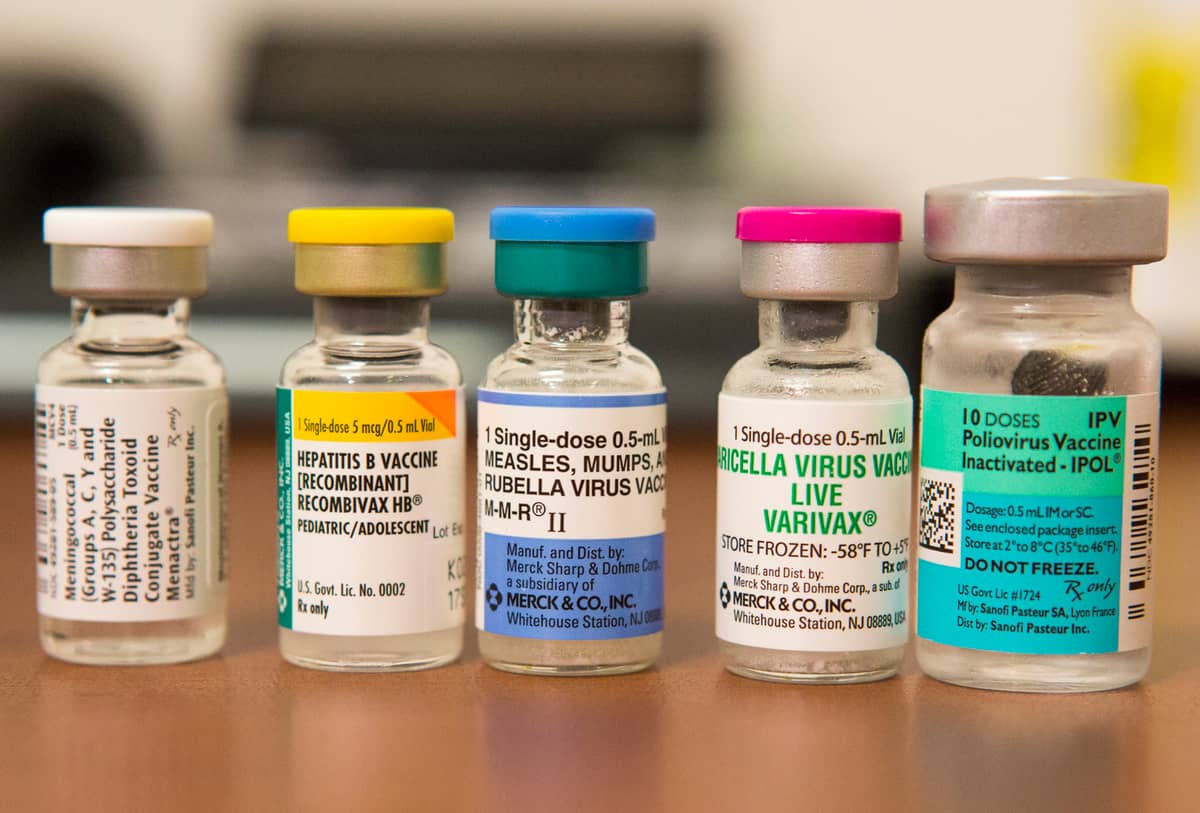
Retired local medical doctors Duncan MacLean and Thomas Overholt think the virtual elimination of measles in the U.S. between 2000 and this April may, in a counter-intuitive way, actually be hampering the fight against the current outbreak across the United States.
Pennsylvania leads the nationwide outbreak with more than 1,100 cases as of Oct. 9.
MacLean practiced medicine until his retirement seven years ago, and was board certified in family medicine and geriatrics. Overholt, retired for two years, was board certified in pediatrics and internal medicine. Together, they have well over half a century of experience.
The measles vaccine has been widely available to Americans for six decades, causing a steady decline in cases, to the point where the Centers for Disease Control and Prevention declared the disease eliminated domestically in 2000. Since then, outbreaks, defined as three or more linked cases, have been rare.
Generations of doctors, nurses, and medical students, as well as members of the public who aren’t senior citizens, have likely never seen a case of domestically transmitted measles and the serious and permanent harm the disease can do.
As a result, “there is no community memory of this disease,” Overholt said when he and MacLean sat down with LebTown earlier this month. “The measles vaccine is so effective that you are now more likely to know somebody who may have had a problem with the vaccine than you are to know somebody who lost a child to the disease or had damage from the disease.”
A similar amnesia could also apply to polio, which was eradicated by a vaccine after putting tens of thousands of young people on crutches and in iron lungs in the 1950s, the doctors said.
The current measles outbreak began in April. Until then, “there hadn’t been any measles [in the U.S.], except for cases that had been imported, effectively since the turn of the century,” Overholt said. “That alone should … alarm everybody that we now have it again.”
Apart from the actual medical aspects of measles, the doctors gave their opinions on the real-world challenges of treating a highly communicable and sometimes deadly disease, the benefits of immunization versus natural “herd immunity,” school vaccination rates, and how to discuss immunization with patients who are vaccine resistant.
Outbreak began in April
State health officials say the current outbreak is the largest in Pennsylvania in over 30 years.
Before the measles vaccine became widely available in 1963, the disease caused roughly 50,000 annual U.S. hospitalizations and as many as 500 deaths. However, widespread immunization led to the elimination of measles by 2000, other than occasional cases introduced by visitors from foreign countries.
Measles is a highly contagious viral disease that is spread through the air by coughing or sneezing. The virus can remain in the air or on infected surfaces for up to two hours after the infected person leaves.
Symptoms, including visible red rashes, usually do not appear for 7 to 14 days — sometimes up to 21 days — after infection, meaning an infected person can infect others without knowing it.
Children under 5, the elderly, and pregnant women are especially susceptible to serious consequences, which include pneumonia, encephalitis, even death.
As of Friday, Oct. 9, 1,136 cases of measles (157 in the preceding seven days), six “measles-associated” deaths, and 219 hospitalizations had been confirmed in Pennsylvania across 39 counties, according to the Pennsylvania Department of Health. Of those, DOH said less than 1% were fully vaccinated and 33% were under 18 years old.
The six measles-associated deaths are the first in Pennsylvania in over three decades. Three were in Lancaster County, including two infants too young to be vaccinated. The other three – a 40-year-old woman in Jefferson County, an 18-year-old man in Mifflin County, and a 39-year-old Franklin County woman – were unvaccinated.
DOH said Lancaster County led the state with 415 cases diagnosed from April through Oct. 9. Lebanon County had 21 over the same period.
Vaccination rates are critical to stem outbreak
Measles vaccination rates have been declining, statewide and throughout the country, since the start of the COVID-19 pandemic in 2020.
According to MacLean, the general consensus among medical professionals is that a given community, such as a town or a school, needs to have at least 95% of its population receive the MMR (measles, mumps, rubella aka “German measles”) vaccine to get and maintain “herd immunity.”
MacLean said that based on his analysis of DOH data, the overall MMR vaccination rate for Lebanon County schools was below 95%, which he says is the minimum needed to stop an outbreak.
“That threshold is the vaccination rate that epidemiologists have found will stop person-to-person transmission,” said MacLean. “Since there is no cure for measles, achieving a sufficient vaccination rate is the only way to stop (or prevent) an outbreak.”
The dataset for Lebanon County schools is incomplete and some schools are not represented. The dataset also does not include all grades, instead focusing on kindergarten, 7th grade, and 12th grade. About 93% of students in those grades are represented in the dataset, including all public school students. Of those students represented, a LebTown analysis showed 94.97% as vaccinated for MMR.
Based on a review of local districts in the state dataset, Lebanon had the highest MMR vaccination rate with nearly 99%, followed by Annville-Cleona with nearly 98%. Approximately 96% of Cornwall-Lebanon students were vaccinated, 94% in Palmyra, 90% in ELCO, and 89% of Northern Lebanon students.
Is the measles vaccine harmful?
Based on the misconception that vaccines can cause the disease they’re meant to prevent, or other harm such as autism, some parents incorrectly believe that building immunity by letting their children be naturally exposed to measles, instead of vaccinating them, is safer.
Overholt says this is wrong. A few recently vaccinated children may contract measles because they were exposed to the virus shortly before being vaccinated. The MMR vaccine needs up to two weeks to build the body’s defenses.
And Overholt says that trying to get natural immunity isn’t as certain as getting immunity through vaccination.
“I’ve heard that getting the virus is better immunity,” Overholt said. “At certain levels it is, but immunization [via vaccination] is almost perfect immunity. Which one is better? Both of them prevent future disease, but in order to get the wild type immunity, you have to get the disease, and some kids don’t survive it, and they can get sacrificed.”
Both doctors pointed out that any association between the vaccine and autism has been debunked. A recent study of over 2.5 million children under 2 years old failed to find any link between the MMR vaccine and autism.
A smaller study suggests a possible link between rubella and autism, suggesting that the MMR vaccine could in fact protect against autism in newborns, Overholt said. “Rubella, German measles, causes multiple deformities in babies. Some of them die, but certainly heart disease and deafness. It’s terrible and totally preventable.”
Dealing with vaccine hesitancy
MacLean had some thoughts on how to discuss vaccinations with parents who for one reason or another are reluctant to have their children immunized.
“I don’t want to deny their experience. I would ask them what bad things have they experienced, what have they heard, where is this coming from – the internet, or do you know somebody?” MacLean said.
Then, he said, he’d ask them where they stand on a scale of 1 to 5, “where 1 is greatly opposed and 5 is wholeheartedly in favor. … If the answer was ‘Well, I’m kind of a 2, I’m not totally opposed,'” MacLean said he’d follow with, “Okay, why are you a 2 and not a 1?”
Whatever the answer was, he said, “that was the parent’s motivation, and that’s what I’d address.”
Questions about this story? Suggestions for a future LebTown article? Reach our newsroom using this contact form and we’ll do our best to get back to you.

Join our community of local news champions.
Cancel anytime.
Monthly
🌟 Annual
- Still no paywall!
- Fewer ads
- Exclusive events and emails
- All monthly benefits
- Most popular option
- Make a bigger impact
Already a member? Log in here to hide these messages
Trustworthy local news is built on facts. As Lebanon County’s independent news source, LebTown is committed to providing timely, accurate, fact-based coverage that matters to you. Support our mission with a monthly or annual membership, or make a one-time contribution. Cancel anytime.