
A Dallas company made news recently for claiming to have “de-extincted” dire wolves using DNA from a 13,000-year-old tooth and a 72,000-year-old skull.
If the pups the company is showing are truly what they say they are – and some skeptical scientists say that’s less than a maybe – they would be the first dire wolves in North America in about 12,500 years.
That’s a far way back. But it’s not Swatara State Park brachiopod far back.
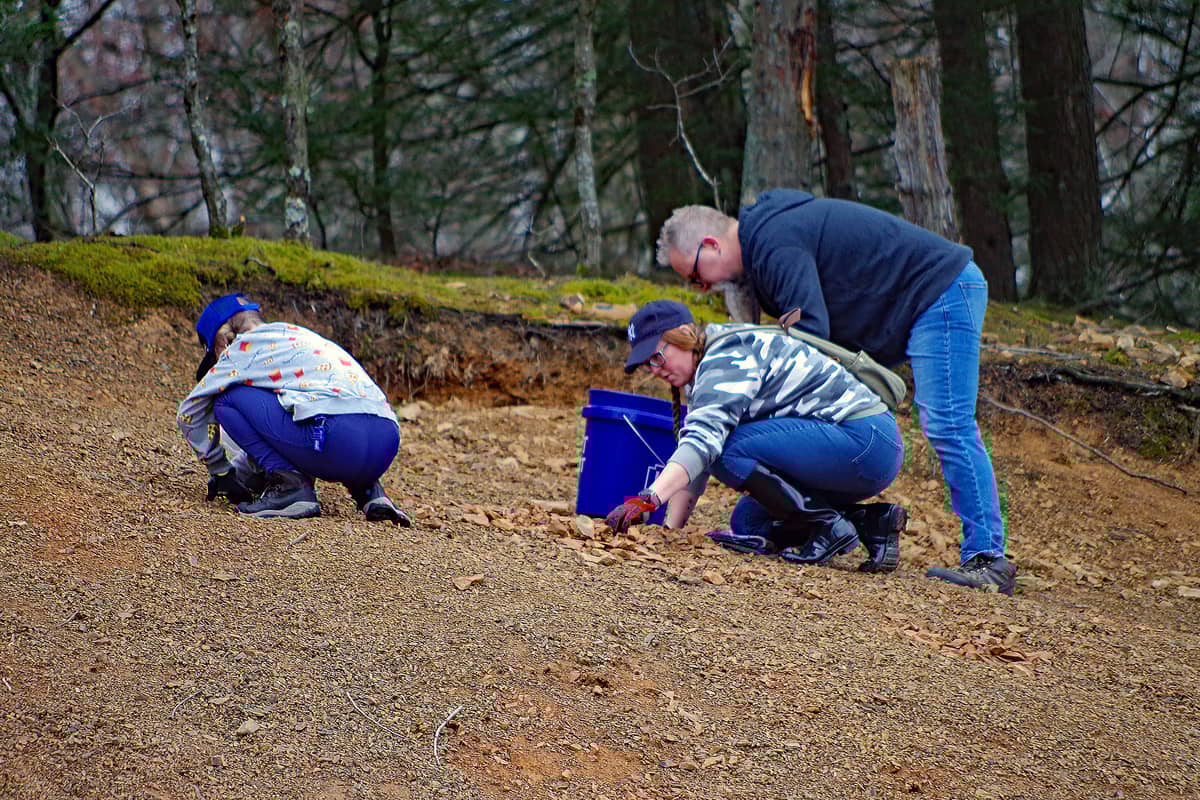
Visitors to the park in Lebanon and Schuylkill counties explore a fossil pit just off Bear Hole Trail and reasonably expect to find – and even take home – evidence of life dating back about 390 million years.
That’s way, way back.
Read More: Unraveling age-old mysteries of Swatara Creek: A journey into geologic time
“The way I like to explain it, the amount of time that would have elapsed between these fossils being deposited and dinosaurs evolving is greater than the amount of time between dinosaurs going extinct and the present day,” said Chris Oest, senior geoscientist in the Pennsylvania Department of Conservation and Natural Resources’ Bureau of Geological Survey.
Continents were still shifting and taking shape at that time. What is now Pennsylvania was then a shallow sea located about 30 degrees south of the equator.
“It was a really interesting time in Earth’s history because the things that make the Earth look like it does today are just starting to come into existence at this point,” Oest noted. “If you were walking around on land, and you weren’t in a shallow marine environment where these fossils are found, you don’t really have plants to speak of. There are just mosses and little stubby ferns. Plants are just starting to develop after these rocks were deposited.”
The animal life that existed – while certainly plentiful – was equally primitive.
Inhabiting that “marine environment that has long since gone away” were seashell-looking animals called brachiopods, which Oest described as filter-feeding organisms. There were crinoids, which resembled like little sticks and are related to modern sea lilies, along with trilobites and stelleroids, the latter a kind of starfish. Early fish were evolving.
The fact that ancient world is visible, even handy, in fossil form at Swatara is a function of time and circumstance, with a healthy dose of luck mixed in, Oest said.
To get preserved in rock, organisms must first have parts susceptible to fossilization: shells, bones and scales hardier than soft tissue, for example. Those must meet the right temperature and pressure conditions, sometimes 10 to 15 kilometers, or 6 to 9 miles, below the surface. Finally, they need time.
When asked how much time, Oest said fossilization can be almost instantaneous or occur over a very long period.
“Picture being at beach,” he said. “You pick up seashell. The form of that shell might be represented in the sand, sort of like a mold. In instances like that, fossils can form almost right away. But in other cases, material that makes up the shell or whatever hard part is being preserved gets replaced with other minerals. That can be a much longer process.”
Even then, before anyone can find and touch a fossil, it must work its way back to the surface.
“Find a fossil and you have to think of the unbelievable journey that this little invertebrate organism went on to get to the point where you’re picking it up in a state park,” Oest said. “It’s really gone through it.”
Those at Swatara State Park are no exception, though some got there with a little help.
The park always had fossils of its own. But there was a second site nearby, albeit outside the park, near one of the bridges carrying I-81 over Swatara Creek. People collected so many fossils there that they were undercutting the bridge, said Quinn Heist, an environmental education specialist at Swatara. So PennDOT dug that material up and moved it to the fossil site within the park.
Now, the site has so many fossils that “it’s pretty hard not to find any,” Heist said.
“Fossil hunting is kind of a developed skill. But at Swatara, once you start seeing them, you pretty much can’t stop seeing them,” Heist said.
Hunting them is certainly popular. Families, individuals and school groups come from all around the region – even from out of state – to look on their own or take part in one of the park’s many organized fossil-hunting events, Heist said.
“Last year, there was a family that came all the way from Jersey City for a fossil program, which is quite a way,” he added.
One big draw is that people can do more than just look for fossils at Swatara.
“We are one the rare state parks that actually allows fossil hunters to keep the fossils they find,” said Courtney Troutman, manager of the Memorial Lake State Park Complex, which includes Swatara. “So we’re pretty unique in that sense.”
Finding fossils at the park doesn’t require any special equipment. Visitors can dig through the fossil pit – it’s shale-like rock, set on a fairly steep slope – with gloved hands, though having a small shovel, hand trowel or pick can help.
“It can help to have something to do a little prying to break things out,” Heist said. “But we try to limit impact on the area, so we ask people not to bring anything too big, like crowbars or big hammers or power tools.
“Most of the time you can just pick up rocks and turn them over and find something interesting in there.”
The park likewise asks fossil hunters not to keep too many so there’s some for everyone. Depleting the site seems unlikely, though, Oest said, even though it’s hard to say just how many fossils are there.
“Knowing this formation, we’re not running out of them any time soon,” he said.
Another great thing about Swatara’s fossil pit is that it’s accessible year-round. Freeze-thaw cycles can sometimes bring newer material to the surface, Heist said. But that’s not necessary for success. People can visit it at any time of year and expect to find something.
“Fossils aren’t like animals,” he added. “They don’t go and hide in the wintertime. So as long you’re willing to go out, they’re there to find.”
And who knows what finding a few might bring? Visiting Swatara’s fossil pit as a student at Temple University convinced Oest he was on the right career path, for example.
“This is the perfect place to get people interested in fossils and understanding the implications of that material because it is so accessible and preserved in a state park,” Oest said. “It is a nice little gem that we have in central Pennsylvania.”
If you go…
To reach Swatara State Park’s fossil site, park at the Swopes Valley Trailhead lot (40.522343,-76.469334) just off Swopes Valley Road. Walk south (left, if the parking lot is at your back) roughly a quarter mile.
If walking that far is an issue, call the park to request accommodations, said environmental education specialist Quinn Heist. Or take part in one of the park’s Bear Hole Trail driving tours. They’re held on certain Fridays and Saturdays from March through October. Information is available here. Dates and times of guided fossil exploring opportunities are posted at that same events calendar and on the Memorial Lake State Park Complex Facebook page.
In the meantime, if you’d like to learn more about fossils in Swatara and Pennsylvania in general, check out this “Trail of Geology” publication (PDF) or “Common Fossils of Pennsylvania” (PDF).
Questions about this story? Suggestions for a future LebTown article? Reach our newsroom using this contact form and we’ll do our best to get back to you.
Be part of Lebanon County’s story.
Cancel anytime.
Monthly Subscription
🌟 Annual Subscription
- Still no paywall!
- Fewer ads
- Exclusive events and emails
- All monthly benefits
- Most popular option
- Make a bigger impact
Already a member? Log in here to hide these messages
Quality local news takes time and resources. While LebTown is free to read, we rely on reader support to sustain our in-depth coverage of Lebanon County. Become a monthly or annual member to help us expand our reporting, or support our work with a one-time contribution. Cancel anytime.