At age 23, Rodney Allen of Bensalem already wears many hats in his career.
He’s a realtor, emergency management technician, part-time nursing student, and a member of the 108th Area Support Medical Company, 213th Regional Support Group, Pennsylvania Army National Guard. The company is based in Allentown.
This past week and next, Allen’s focus is on the healthcare profession while his company conducts medical training exercises at Fort Indiantown Gap. On Friday, Allen and about 50 fellow Guardsmen participated in a realistic mass casualty exercise training event at the military installation in northern Lebanon County.
“One of the biggest things I feel like I’ve learned this week is one team, one fight. That’s something that I’ve known since I joined the military, but it’s been instilled in us again,” said Allen, a 68 Whiskey Combat Medic Specialist. “It’s been great to come together as a unit and see how we all operate and how we would operate under different scenarios and different stressors.”
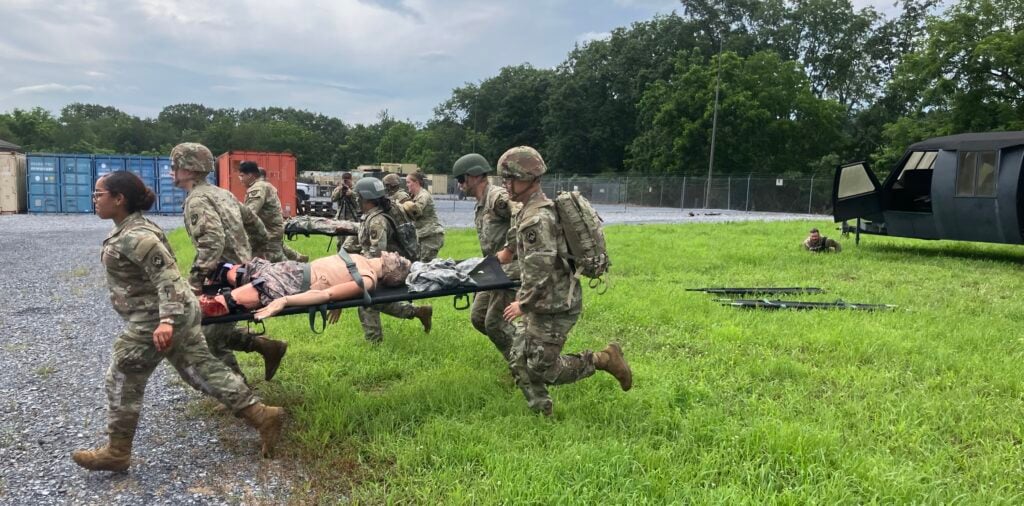
The downed-helicopter scenario presented to Allen and the rest of the medical company members was stressful and, at times, chaotic as they labored to provide expedient care to their colleagues.
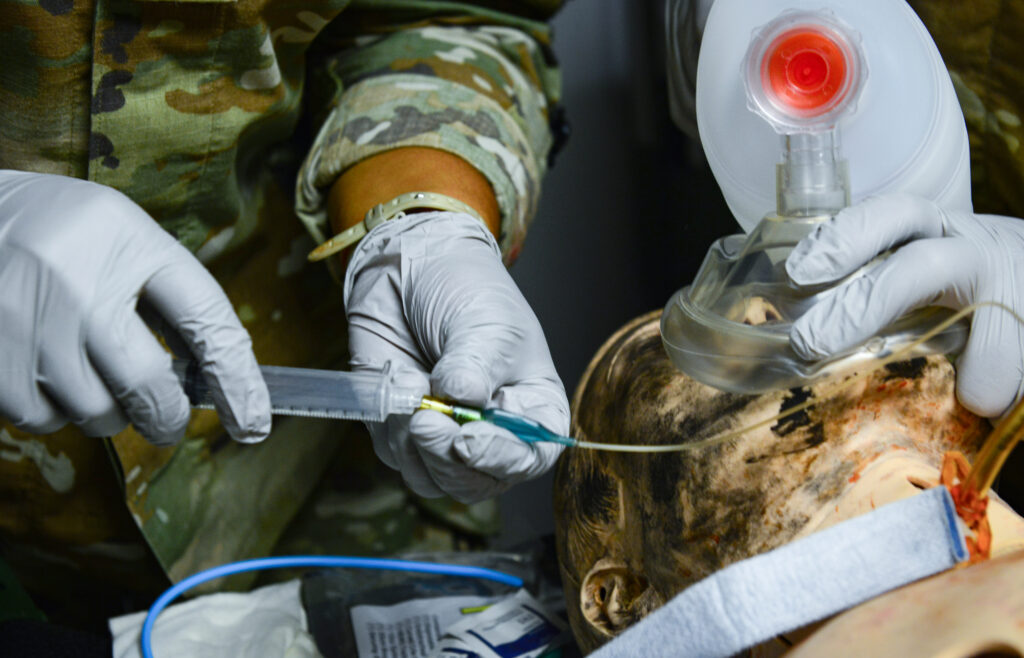
The one-hour exercise was intended for the personnel “to demonstrate critical battlefield care under simulated combat conditions, including on-site triage, emergency medical procedures and casualty evacuation,” according to a press release.
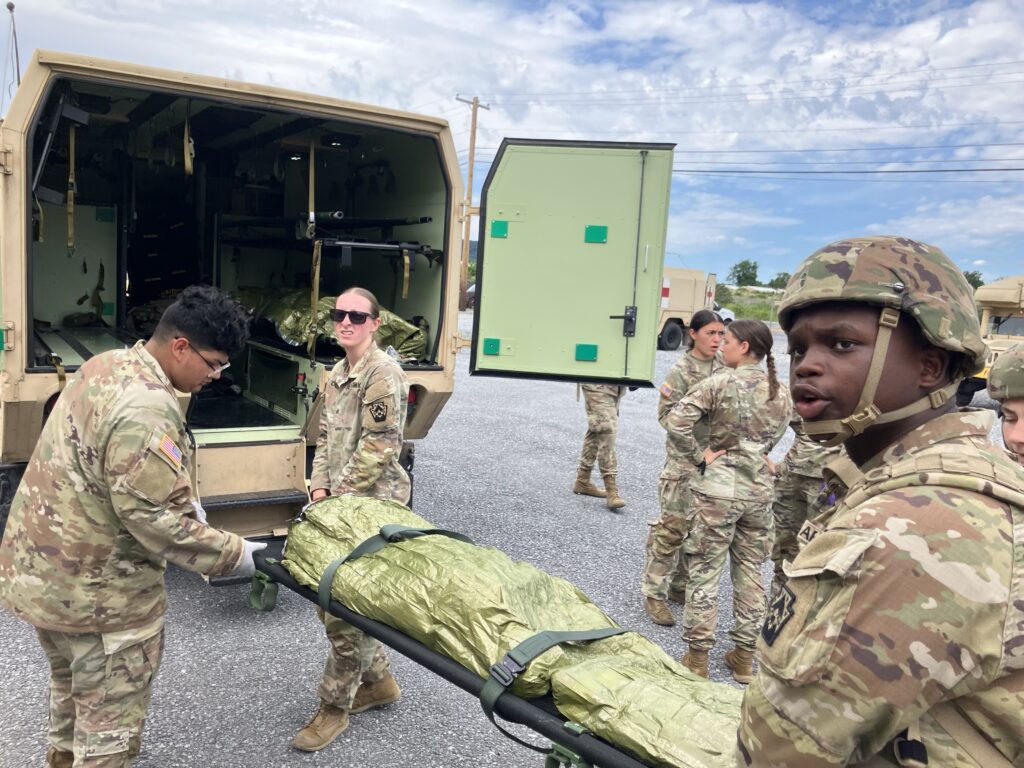
Trainees were sent in ambulances to a helicopter landing site to transport wounded soldiers who would receive advanced medical treatment away from the combat zone. On the way to the site, however, the scenario suddenly changed.
The military medics, many of whom work in various fields within the medical profession as civilians, were notified via radio that the helicopter had crashed while attempting to land.
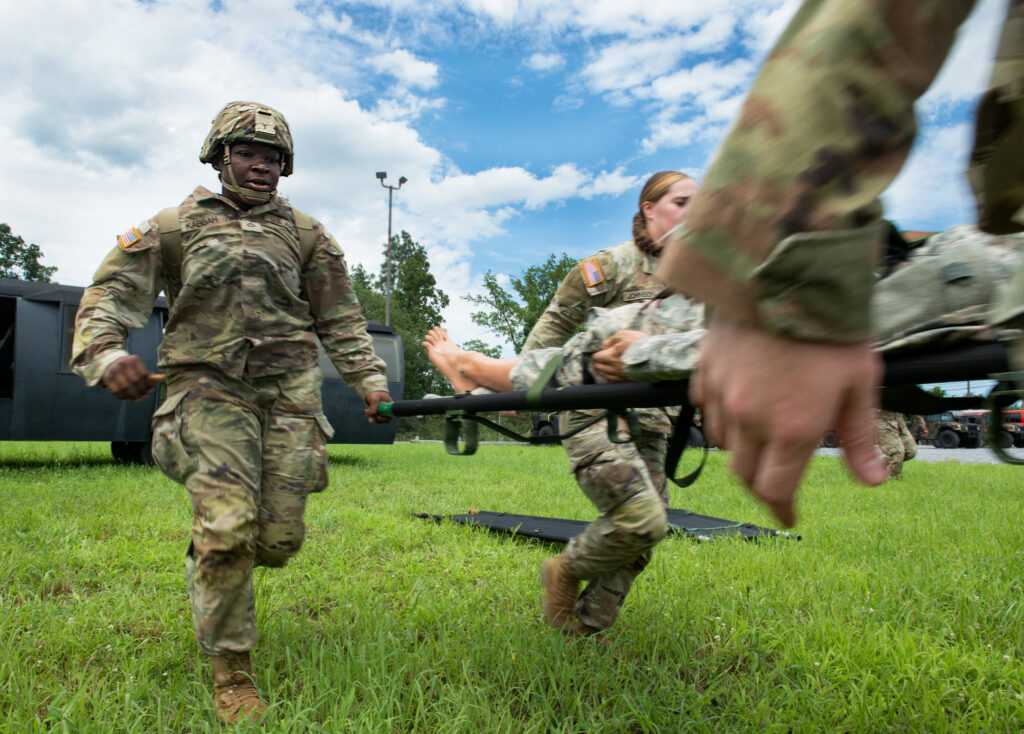
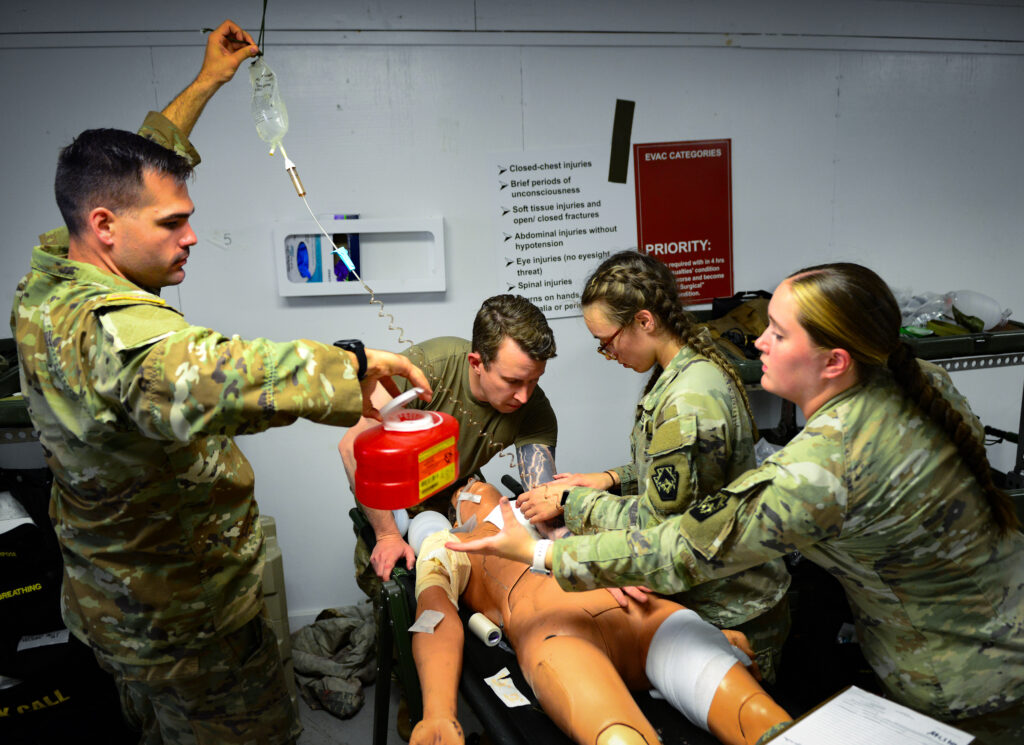
What had appeared to be a simple transport suddenly morphed into a life-and-death situation as soldiers had to deal with a variety of injuries suffered by their colleagues when the copter crashed. (The “injured” who needed additional medical services were actually mannequins.)
The medics arrived to find smoke pouring from the helicopter and a number of injured colleagues, whose injuries were exacerbated by the crash and needed additional medical care.
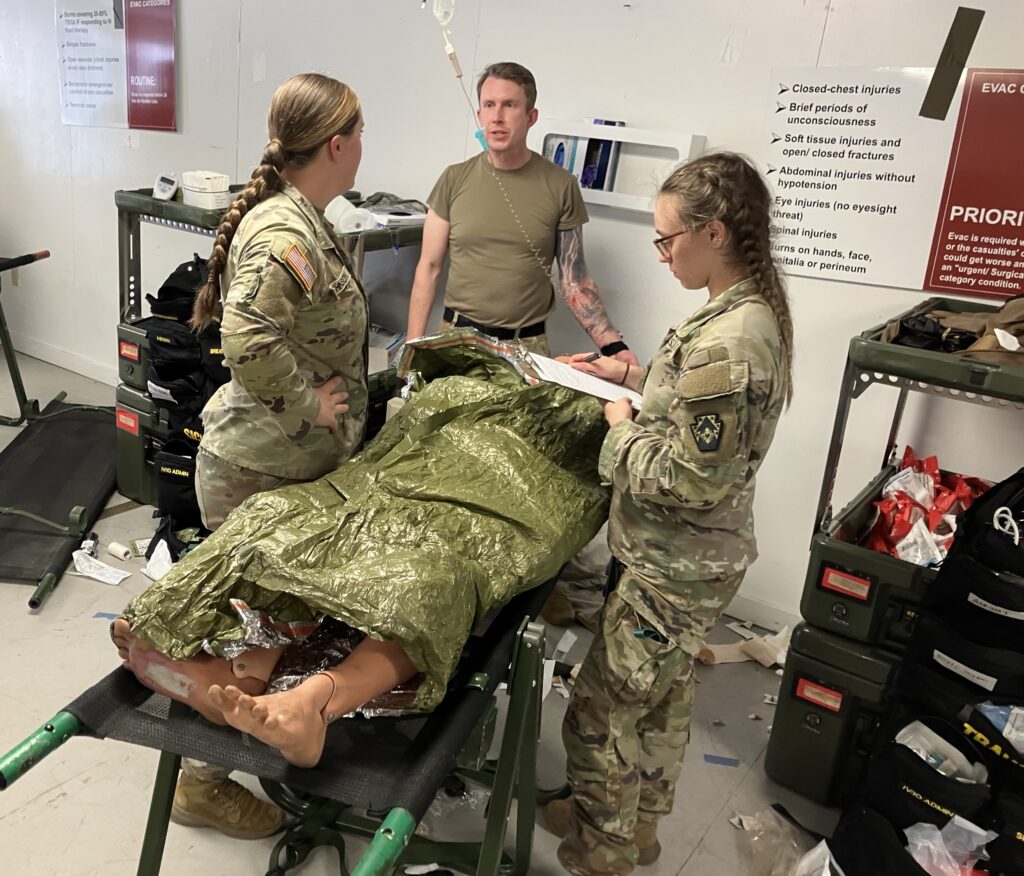
Instructors belted out the injuries and various medical scenarios to the trainees. As they worked to get the wounded stable and onto stretchers, such instructions as, “He is now in total unresponsive,” “Your tourniquets are not working,” and “Find the entire track on that wound” were provided to the trainees to see how they would respond to rapidly changing medical conditions.
LebTown asked Allen what he felt what went right and if there were things the company could do better.
“I feel like my answer is going to be like a double-edged sword. So I feel like communication was something that we all did pretty well on, but it’s also the thing that we could definitely improve on as well. And I feel like there’s always room to improve on communication,” he answered.
Major Kyle Freeman, commander of the 108th Medical Company, gave the same responses during a press conference with the media.
“One thing that we can always improve on in any organization at any echelon is communication. We did that, we trained on that a couple times this week or most of the week. Using our radios, putting our people in different locations so I can’t just yell across the training area to you,” Freeman said. “You’re miles away and there are mountains between us. We have to be able to communicate effectively. So that’s one thing that we did fairly well, but we definitely need to continue to work on.”
Freeman was asked how the unit measures success following a day of training.
“I told our soldiers before we came out here, if you guys come out and you just blow the roof off of this training event, but you’re not safe while you do it, we’ve failed, right?” Freeman said. “So No. 1 is keeping our soldiers safe, returning them home to their families after annual training. That’s our No. 1 measure of success.
Although the unit is not currently scheduled for deployment, Freeman explained how it’s determined that they’re ready to be deployed.
“In order to be able to deploy, the Army gives us metrics that we have to meet. Our mission essential task list, and it’s pretty well-defined,” he said. “Even a guy like me can figure it out. So I go down through that checklist as we’re training, and did we accomplish this? Yes or no. And it’s pretty clear whether we’ve succeeded or not.”
He then provided his own “report card” for his unit.
“We’re not getting evaluated to be ready to deploy this year. So it’s more of my, as the commander, my personal assessment of the unit’s success. And I’d say we’re walking right now. If we talk about a crawl, a walk, and a run, we’re in that walk phase, but we still have enough time if we stage things right that we can get to where we need to be before we have the call to deploy,” added Freeman.
He said training exercises like the one conducted Friday are an excellent tool to prepare the medical personnel for scenarios on and off the battlefield.
“If you made the wrong choice in the moment, that patient is going to trend in the negative direction and you’ll see the consequences of a good or bad choice. It’s really great training for our medics,” Freeman said. “We can simulate all day long with the mannequins that aren’t hooked up to those resources, but having that kind of intensity and realism goes a long way to preparing them for real-life scenarios.”
1st Lt. Joe Love, who was one of the military training instructors and a physician assistant in civilian life, said a variety of skills are learned during the two weeks of training for Guardsmen who come from all walks of life.
“The beauty of the National Guard is that we get all kinds of people from all different walks of life who are trained in all different kinds of professions. So my combat medic for the Guard might be an accountant, might be a lawyer, might be an EMT, might be something that’s entirely not what they do. They join the Guard for their reasons to further their confidence, to have just a more rough and tumble lifestyle outside of their normal office job,” Love said. “They all join for different reasons.
“So as far as specific skills, as a medic, you’re learning medic skills. In general, you’re also learning military skills, leadership skills, organizational skills, logistical skills. A big factor in military medicine is getting the people and equipment to the areas that they need. So logistics is very much a part of medicine.”
The mission statement for the company notes that they “ensure rapid, efficient casualty flow, enhancing trauma care continuity, demonstrating field medical proficiency and reinforcing our readiness to support both combat and domestic emergency operations.”
Allen said he’s grateful for the medical training that he’s obtained in the military, including some lessons learned this week.
“I actually got my EMT license in the military and they prepared us mentally, physically, and emotionally to care for soldiers and care for individuals that are inside and outside of the military,” he said. “I feel like the mentality that the mission comes first. I feel like sometimes in life, especially on the civilian side, we can continue to push ourselves past our limits sometimes. But being here and having other people who are going through it just with us, it really empowers us and gives us life and energy.”
Questions about this story? Suggestions for a future LebTown article? Reach our newsroom using this contact form and we’ll do our best to get back to you.
Support Lebanon County journalism.
Cancel anytime.
Monthly Subscription
🌟 Annual Subscription
- Still no paywall!
- Fewer ads
- Exclusive events and emails
- All monthly benefits
- Most popular option
- Make a bigger impact
Already a member? Log in here to hide these messages
You know us because we live here too. LebTown’s credibility comes from showing up, listening, and reporting on Lebanon County with care and accuracy. Support your neighbors in the newsroom with a monthly or annual membership, or make a one-time contribution. Cancel anytime.