
What began as a 5- to 7-year project has turned into a nearly 30-year labor of love for John Wengert and Lebanon Valley Rail Trail volunteers.
“For those of you that may not be as familiar with what we’re doing, LVRT is a 501(c)(3) nonprofit that was founded in 1996, which means next year is our 30th anniversary,” said Wengert, LVRT president, at the recent 110th annual Convention of Municipal Officials held earlier this month at the Lebanon Valley Expo Center. “It’s hard to believe. When we started we were thinking it was going to be a 5- to 7-year project. And now we’re (at) 30 years.”
Wengert told the gathering of municipal government officials from across the Lebanon Valley that the first section of trail was purchased in December 1999. He also reviewed its history and provided an update on its latest activity.
Although LebTown recently reported the project would end in 2027, Wengert said at the meeting that it will probably be at least into 2028.
Read More: Lebanon Valley Rail Trail set for completion in 2027
“The trail itself is owned by the county. However, we generally purchase the right-of-way and then give it to the county, that being LVRT,” Wengert said. “The first five-mile section of the trail opened in the year 2000.”
At the start, the trail was completely funded through non-governmental sources.
“Interestingly, it was funded entirely with private donations. The idea being we wanted to get something on the ground for people to see what we were talking about. ‘Cause back then, the concept of a rail trail was pretty foreign to most people,” Wengert said. “Maybe you heard of it, and maybe you saw one in Lancaster County, but it wasn’t really as commonplace as it is today. Now everybody knows what the rail trail is.”
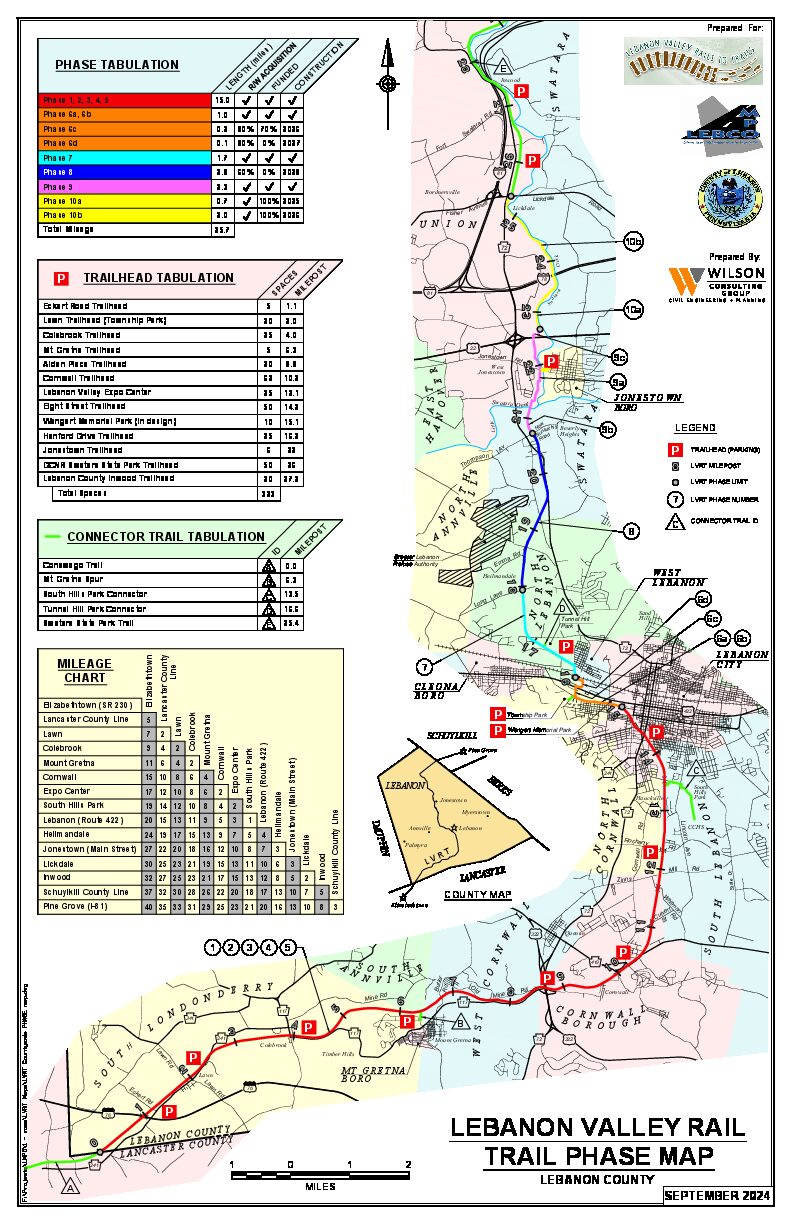
He noted the goal is to stretch cross-county from the southern to northern end.
“So we got that first five miles open, and then just did various extensions over the years. Our vision is a 25-mile, cross-county trail stretching from the north end of the county up near Swatara State Park all the way to Lancaster County,” Wengert said. “And that trail will connect with, in Lancaster County it connects with the Conewago Recreational Trail, which goes five more miles to E-town (Elizabethtown).”
He also highlighted what happens at the northern section in the upper section of Lebanon County.
“And, of course, the Swatara State Park Rail Trail goes all the way to Pine Grove. So when that’s all finished, it’ll be a 40-mile regional trail,” he added. “Pretty major, pretty major.”
Wengert noted connectors to LVRT, including Horseshoe Trail, the Appalachian Trail, historical features like Cornwall, its iron furnace, developments like North Cornwall Commons, Cedar Crest and Lebanon high schools, South Hills Park, downtown Lebanon, the new Wengert Memorial Park, Lonergan Woods Park, and Union Canal Tunnel Park, among others.
Read More: Wengert Memorial Park dedicated in memory of dairyman, community leader
“So there’s a lot of connectivity that makes this a great resource,” Wengert added.

Wengert noted that the southern end of the trail from the Lancaster County line to the area around Mount Gretna was the first section that was built there and then was extended, between 2000 and 2012.
“That was completed and goes through a lot of municipalities,” Wengert said, who cited six municipalities in that vicinity. “So these are all trailheads – you have various trailheads along the way and those get pretty heavily used.”
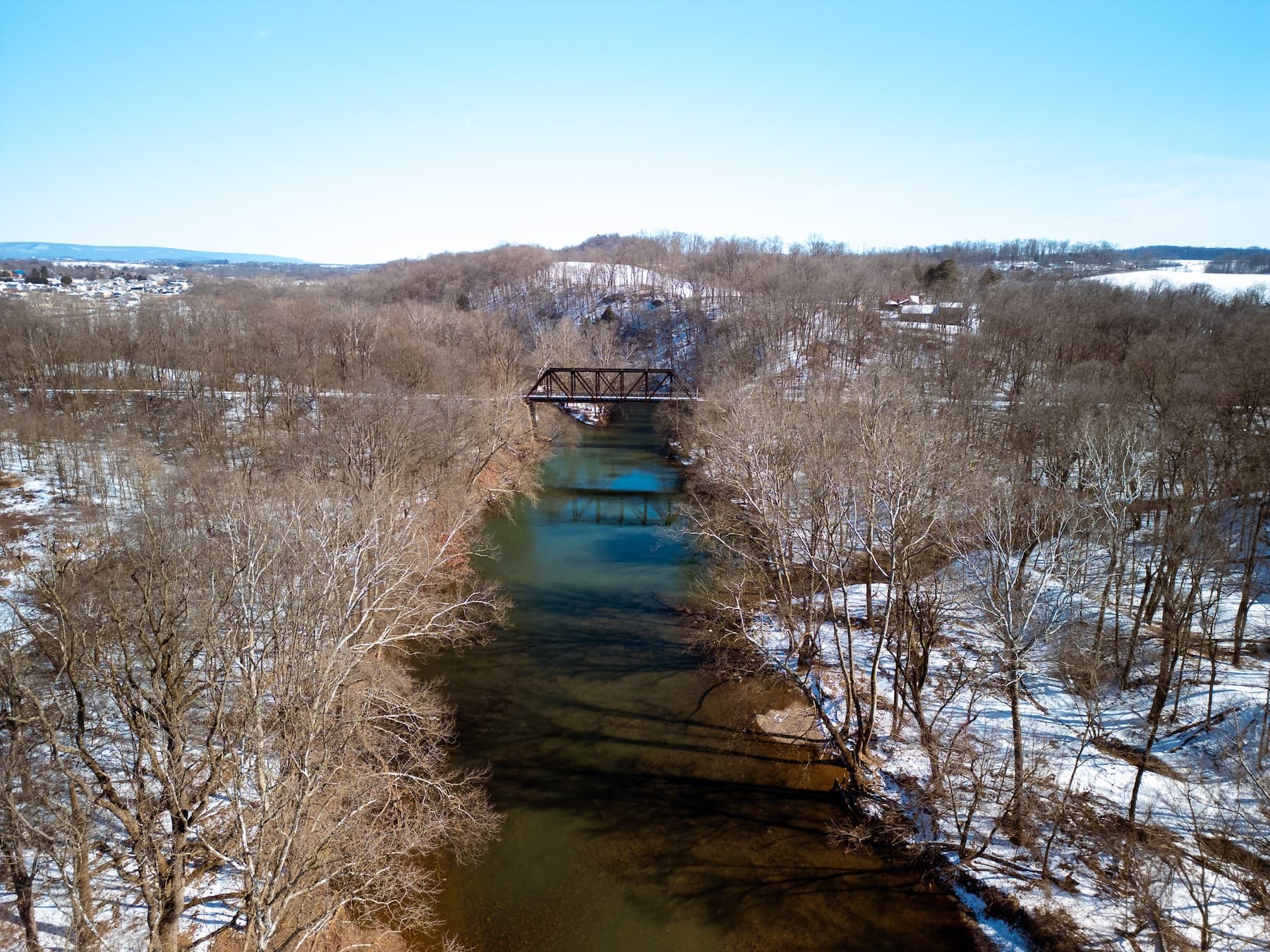
Wengert showed the audience some landmarks, including the rare quadrilateral truss bridge, then asked if they knew where the Root Beer Barrel was originally located. An audience member said Route 72 and received a prize for their effort.
Read More: Spanning time and water: Inwood Iron Bridge finds new home on Swatara Creek
Wengert said the northern section of the trail will be one of the last to be completed.
“So right now, phase 10A, which is finished, and this purple section is actually completed from Jonestown all the way up to Route 22. This next section of construction will be from – it’s a short section, it’s not even quite a mile – but 10A has a bridge that’s pretty substantial that has to be replaced,” Wengert said. “So that’s a very fairly expensive project because of that.”
Wengert said the bridge is 30 by 30 feet, and added that Phase 10B will go out for bid next spring.
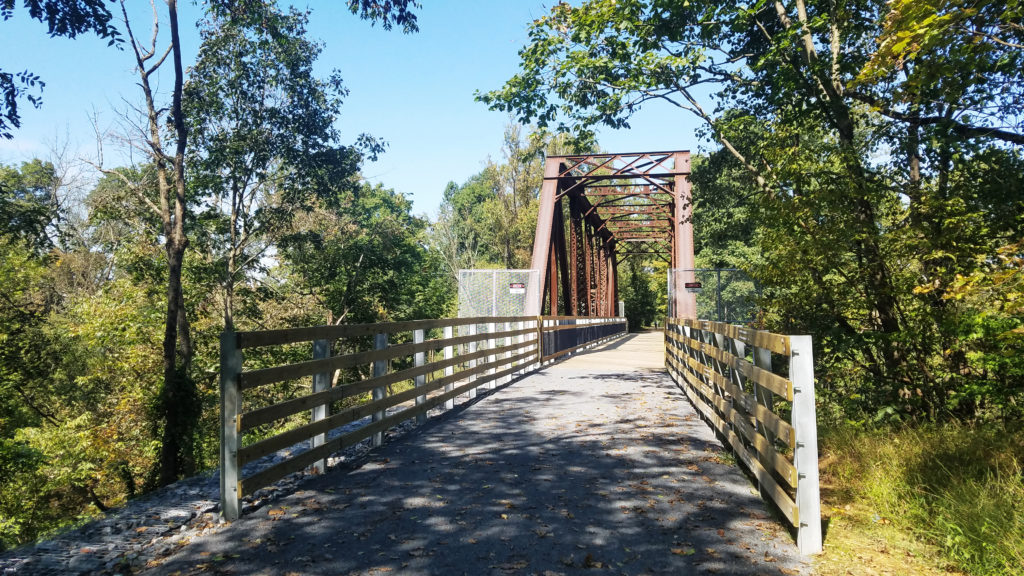
“It’s a little bit more complicated than 10A, so we kind of split it off into two different phases, but the final design, final engineering on that 10B is currently being completed,” Wengert said. “A lot of wetlands issues, a lot of complicated factors up there on that section, but I will tell you that 10B, that 10B section parallels the creek, the Swatara Creek, and it’s going to be one of the most scenic sections of the trail. It’s absolutely incredible up there. You feel like you’re out in Montana or something. It’s just totally remote.”
Read More: Work on 2-mile addition to Lebanon Valley Rail Trail begins in 2025
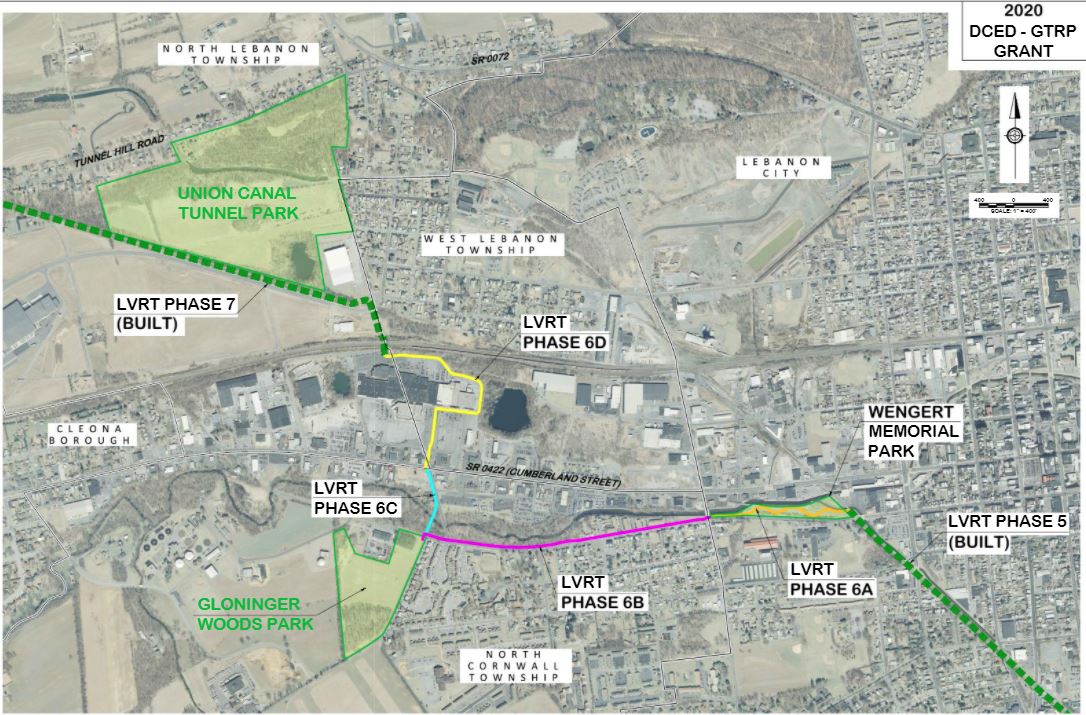
Near Lebanon city, he said Phase 6 was split into A, B, C, and D sections.
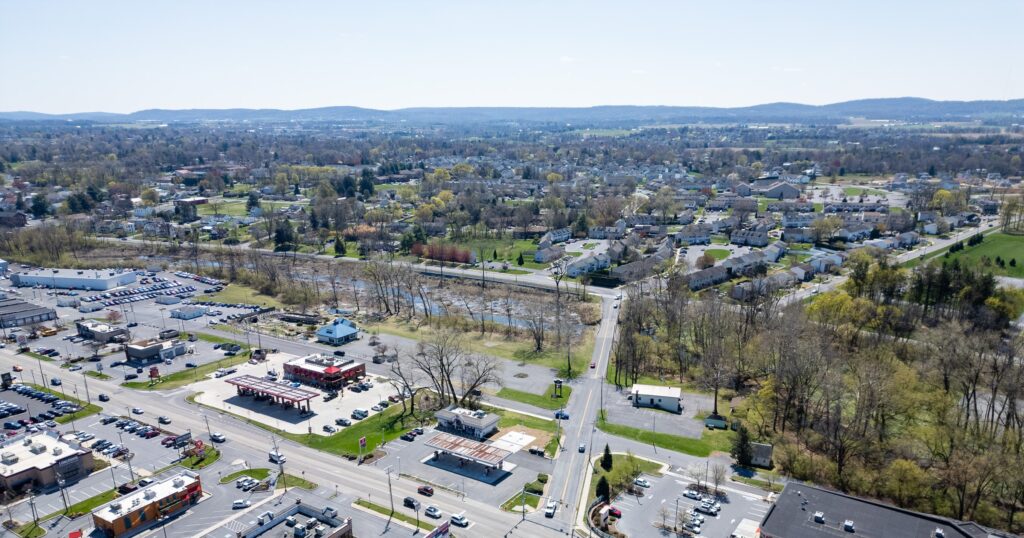
“A and B are completed, and that’s including the (Wengert) Park. 6B runs right through Wengert’s Park. 6C is going to be the new bridge at 22nd Street heading over towards the mall. So that’s a huge project. That whole bridge gets relocated to the west to line up with 22nd Street and then the trail will be built on the side of the new bridge,” Wengert said. “That’s fully funded and is in – been pretty close to – final design at this point.”
Read More: Federal Highway Administration bridges funding gap for 22nd St., rail trail project
He said Phase 6D will take the trail around the mall to where it ties into the existing trail at 25th Street at the underpass.
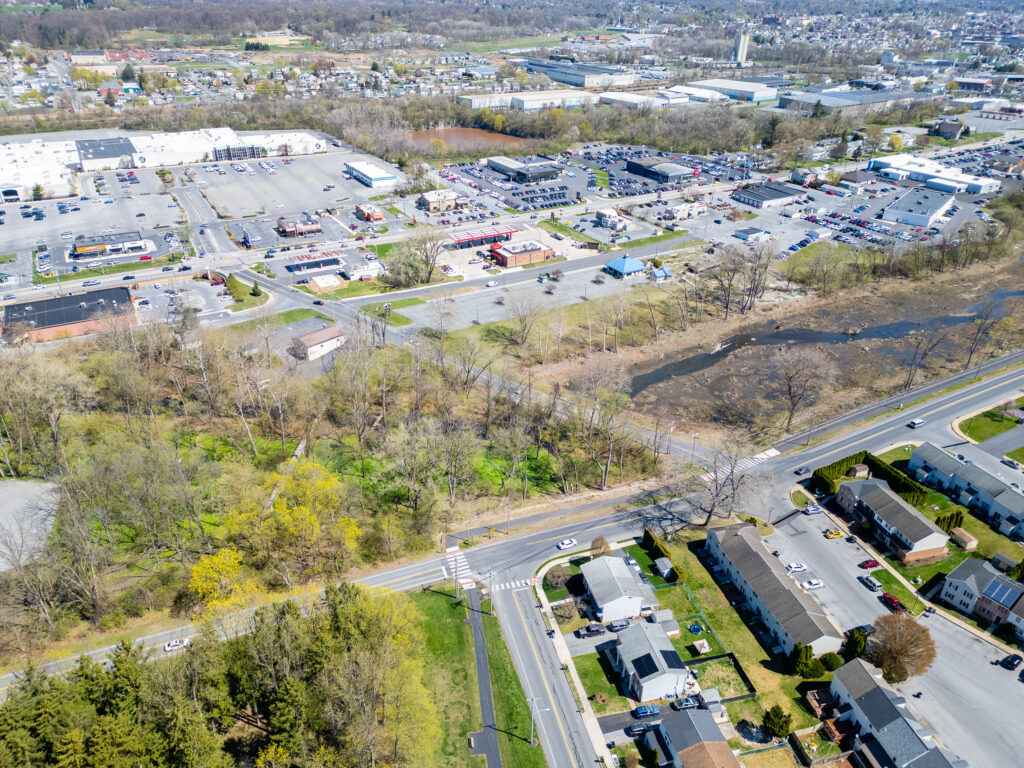
“So that only leaves Phase 8, which that’s probably going to be the last section of the trail that gets completed. We don’t own all the right-of-way on Phase 8. So we’re in negotiations with a number of landowners. But depending on how those go, there’s some detours that we could possibly take off the railroad bed.”
He added that’s not an ideal situation.
“But depending on how things evolve on Phase 8, that’ll be down the road. That’s going to probably be, I would say, three years, probably 2028 at the earliest, to get that completed,” said Wengert. “Then the whole thing’s done, and I can retire.”
That elicited laughter from the audience before he clarified that he was retiring from his second job, as president of LVRT, and not his first one.
He showed a graphic of what he called the Rails to Trails Triad, which is the partnership that exists between the trail organization, Lebanon County Commissioners, including its planning department and MPO, and various state agencies. The latter – including the state departments of Conservation and Natural Resources, Community and Economic Development, and Transportation – are mostly responsible for funding the project over the years, according to Wengert.
He also recognized Wilson Consulting Group for doing the trail design for 26 of the 29 years the project has existed.
“So Wilson will come up with a very, very good robust plan, and then we have board members on LVRT that do the grant writing. So Tom Kotay is one of our board members. He used to work at PennDOT. He does almost all the grant writing,” Wengert said. “And then we submit those to the County Commissioners for their approval. And then the match has to be constructed.”
Wengert said the organization uses matching funds from LVRT, which are private donations, to what the county provides as part of a match.
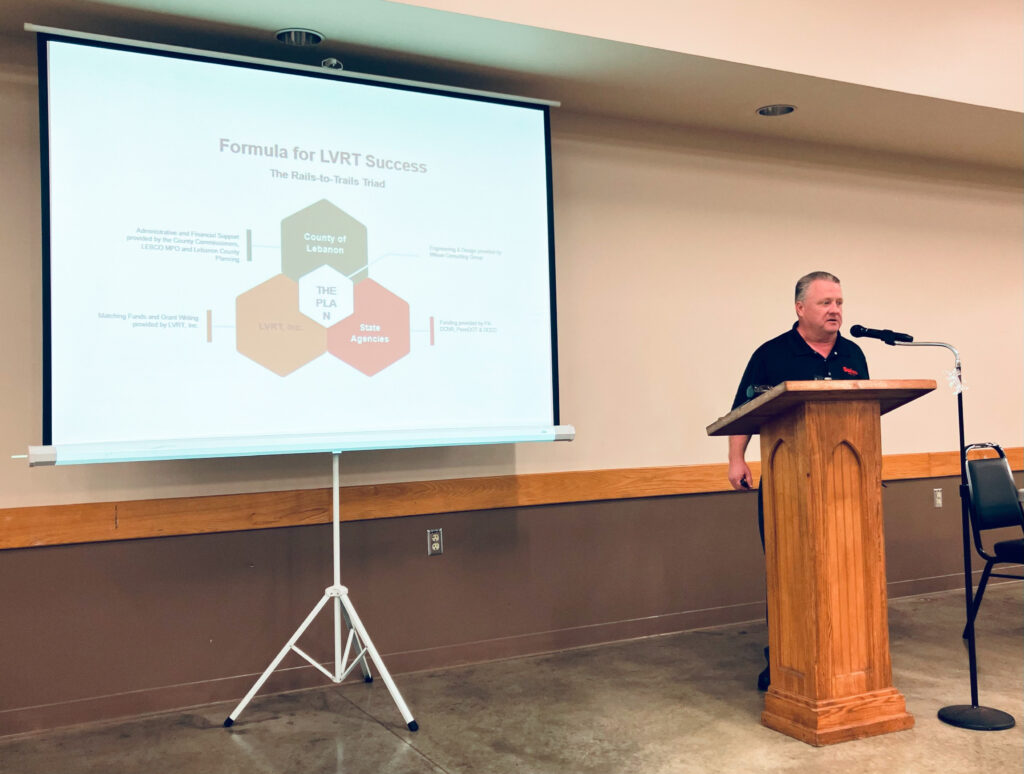
“Typically, they match that with whatever they choose to use at the time. It could be hotel tax dollars. It could be – there’s still some ARPA money that’s being spent. So we’ll have an LVRT and county match together that constitutes the overall match for the grants that are going to the state. That formula works really well because the state likes to see that there’s partnership at the local level,” said Wengert.
He also recognized state elected officials, who are integral in helping to secure funding through state agencies.
“We need their support once these grants are submitted, whether it’s DCNR or DCED. Their support’s critical because these grant programs are so competitive,” Wengert said. “And we’re a relatively small county. We’re competing with the Philadelphia suburbs and the Pittsburgh suburbs for basically every grant round. So that’s where the support of our senator and our state reps is critical.”
Earlier in his presentation, Wengert mentioned the trails’ popularity, which was cited in the trail’s growing use over the past five years. Trail use exploded at the beginning of this decade, he said.
“300,000 (users) from this is like double what it was, I’d say five years ago. We used to go by 100,000, that’s kind of what we were figuring,” Wengert said. “But then COVID hit, and when COVID hit, it really changed because that’s what people wanted to do. They had to get to stay home and use the rail trail more and more because it was close to home and it was basically all they could do for a while there. So that’s where the numbers really took off and they really haven’t gone backwards since then.”
Read More: Outdoors lovers enjoying activities on Swatara Creek in record numbers
Questions about this story? Suggestions for a future LebTown article? Reach our newsroom using this contact form and we’ll do our best to get back to you.
Support Lebanon County journalism.
Cancel anytime.
Monthly Subscription
🌟 Annual Subscription
- Still no paywall!
- Fewer ads
- Exclusive events and emails
- All monthly benefits
- Most popular option
- Make a bigger impact
Already a member? Log in here to hide these messages
An informed community is a stronger community. LebTown covers the local government meetings, breaking news, and community stories that shape Lebanon County’s future. Help us expand our coverage by becoming a monthly or annual member, or support our work with a one-time contribution. Cancel anytime.