
This article was funded by LebTown donors as part of our Civic Impact Reporting Project.
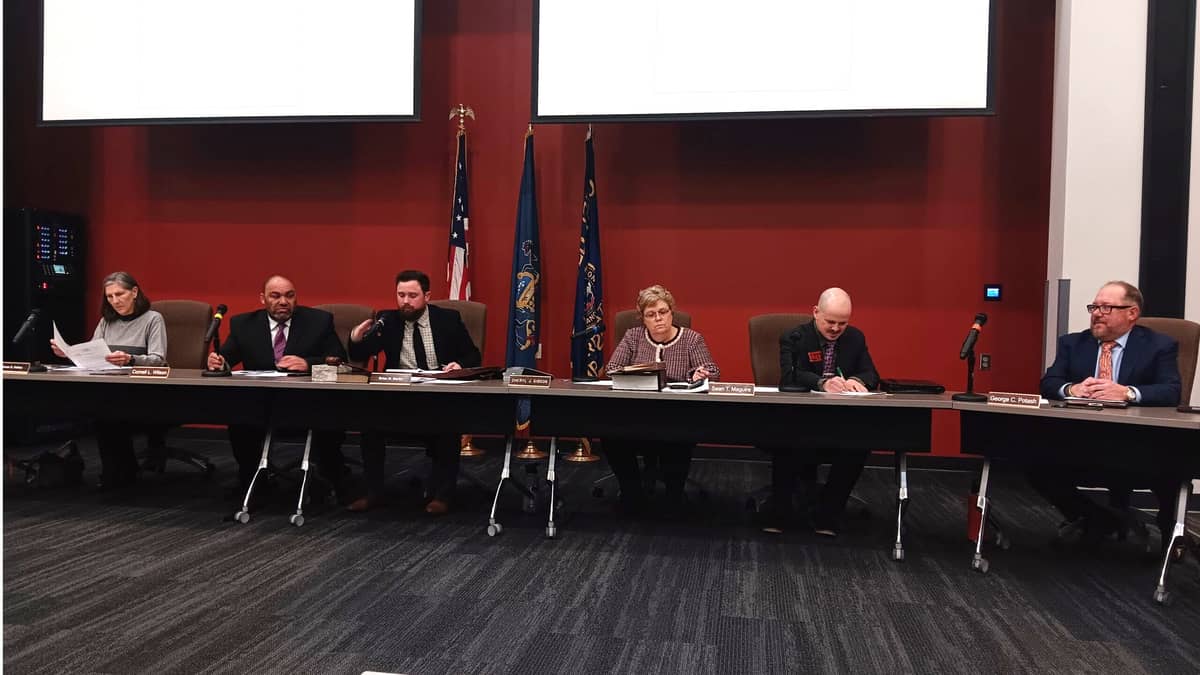
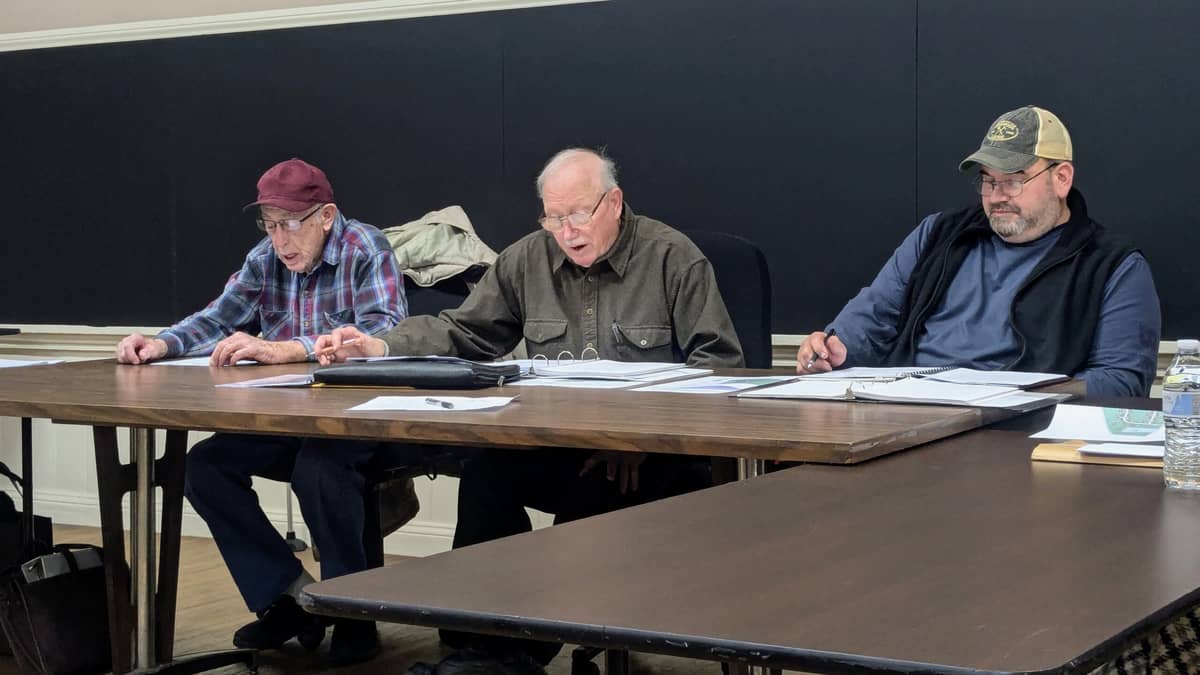
The South Annville Township Zoning Hearing Board on Jan. 15 unanimously rejected a variance request to reduce sidewalk requirements for “The Grove.”
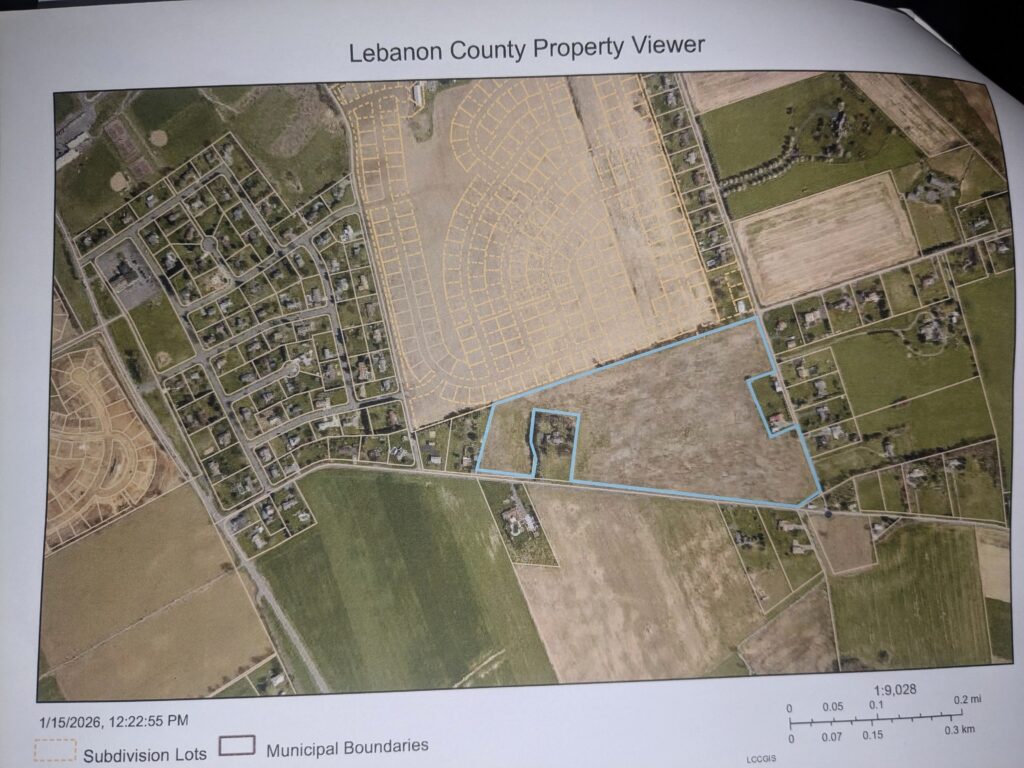
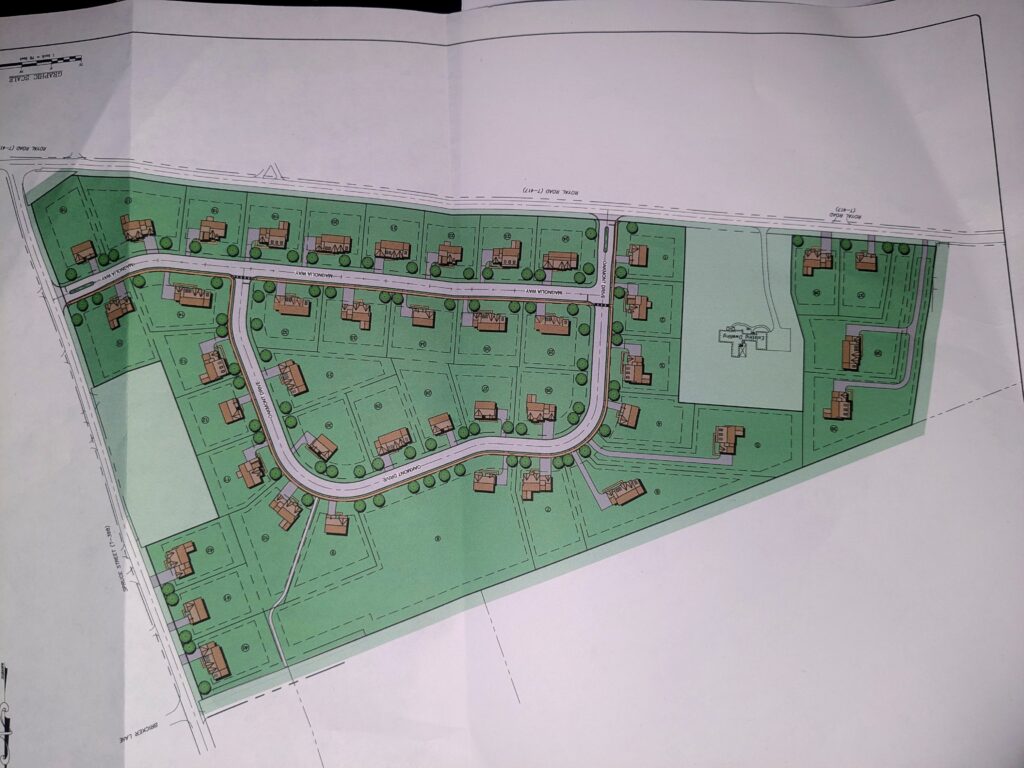
Developers had sought permission to include sidewalks on only one side of streets in the 42-home subdivision at Royal Road and Spruce Street.
Seats were full, with around 25 attendees as the board considered the request. Residents who commented were universally opposed to the request. Dale Hoover, chairman of South Annville supervisors, was also present and communicated the board’s opposition to the variance.
Zoning ordinance 1426.4 for the R1 district requires developers to include sidewalks on both sides of the street. Developer Ninety Seventeen LLC sought relief from the requirement, claiming there would be little through-traffic on the two roads going through the development, and residents could cross the street to use sidewalks.
Ninety Seventeen attorney Claudia Shank explained that, as the plan does not make use of the neighborhood greenway overlay (which allows for higher-density development in exchange for more open space areas), modifications from the zoning ordinance must go before zoners instead of supervisors.
“We think this has a number of benefits for the community and that it will not have any negative impact on pedestrian connectivity,” said Shank.
Developer representatives went on to cite low expected pedestrian usage and population density, lower impervious area, preferred aesthetics, and future hardship on property owners (who will be responsible for maintaining sidewalks on their property) as reasoning for the requested variance.
“Really, in this type of subdivision, it’s about density, and we only have 42 lots and 30 acres,” said engineer Ethan Gehenio of Steckbeck Engineering, representing Ninety Seventeen. “We have 20,000-square-foot lots minimum, so that’s close to half an acre lot for all of these, so really the density doesn’t justify sidewalk from both sides of the streets. It’s just not necessary for the amount of pedestrian activity that you’re going to have in this kind of development.”
He said the proposed sidewalks had 5-foot widths and a 4-foot grass buffer strip, more than the ordinance requirement of 4-foot wide sidewalks and 3-foot grass buffer strips. He also referenced a trail planned to connect to the Southgate development.
Gehenio said that Oakmont Drive and Magnolia Way, the new roads planned to go through the development and be dedicated to the township, would be 28 feet wide as a traffic-calming measure. This would require a modification from zoning ordinance requirements.
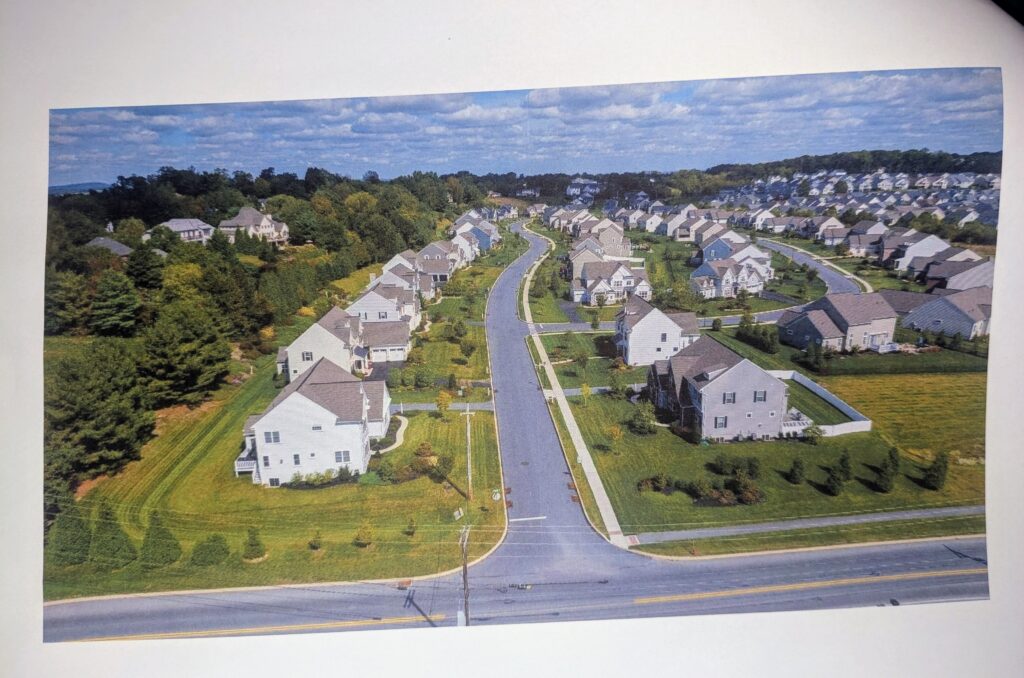
Michael Garman of Pine Hill Building Company, representing Ninety Seventeen, said plans were loosely modeled on Lititz Bend in Lancaster County, which similarly features 28-foot streets and sidewalks on only one side. A photo of that development was submitted as an exhibit to the ZHB.
Thursday’s hearing concerned only the sidewalk issue, as the type of development planned is permitted by right in the R1 district. Of the 42 homes in the 29.62-acre lot, 35 are planned to be accessed from new streets Oakmont Drive and Magnolia Way.
After hearing from Ninety Seventeen representatives, zoning chair Charles Sando said the developer’s presentation did not adequately address a hardship that justifies granting the variance.
“I think it would be disingenuous to say it’s physically impossible to put sidewalks on both sides of the road,” said Shank. “I would suggest to you that we’re looking at a variance in the context of a dimensional variance, not a use variance. So for use variance, you have to prove that there’s a hardship, that the lot can’t be used for any other purpose without the relief that’s requested. When we’re looking at a dimensional variance, that’s not the same standard, we just have to prove that it’s a reasonable modification.”
Sando questioned whether families with kids would prefer to have sidewalks on their side of the street, which developers said was not typically a major concern of buyers. He also questioned whether developers could be sure about low pedestrian usage.
“How can you anticipate what pedestrian traffic will be?” asked Sando. “You’ve got an enclosed development that people could get out and walk, and yet you say in here, the hardship necessitating your request for a sidewalk variance for this site arises from some areas having non-existent pedestrian traffic. How can you know that?”
Sando went on to question whether sidewalk upkeep poses a burden on taxpayers, something he said the variance request states. Garman mentioned cost of upkeep, which Sando said is only necessary every 30 or 40 years if properly maintained.
Zoners then entered an executive session for around five minutes before reconvening. They then heard public comment, with several residents voicing concerns for the safety of kids and disabled people in the development.
The board then unanimously agreed to deny the variance request and adjourned.
Questions about this story? Suggestions for a future LebTown article? Reach our newsroom using this contact form and we’ll do our best to get back to you.
Keep local news strong.
Cancel anytime.
Monthly Subscription
🌟 Annual Subscription
- Still no paywall!
- Fewer ads
- Exclusive events and emails
- All monthly benefits
- Most popular option
- Make a bigger impact
Already a member? Log in here to hide these messages
Quality local news takes time and resources. While LebTown is free to read, we rely on reader support to sustain our in-depth coverage of Lebanon County. Become a monthly or annual member to help us expand our reporting, or support our work with a one-time contribution. Cancel anytime.