
We’re celebrating Lebanon County’s role in American history. Read more here.
It may not be as well known as the Declaration of Independence, but the Lebanon Resolves was a locally produced document spelling out local opposition to British policies prior to the American Revolution.
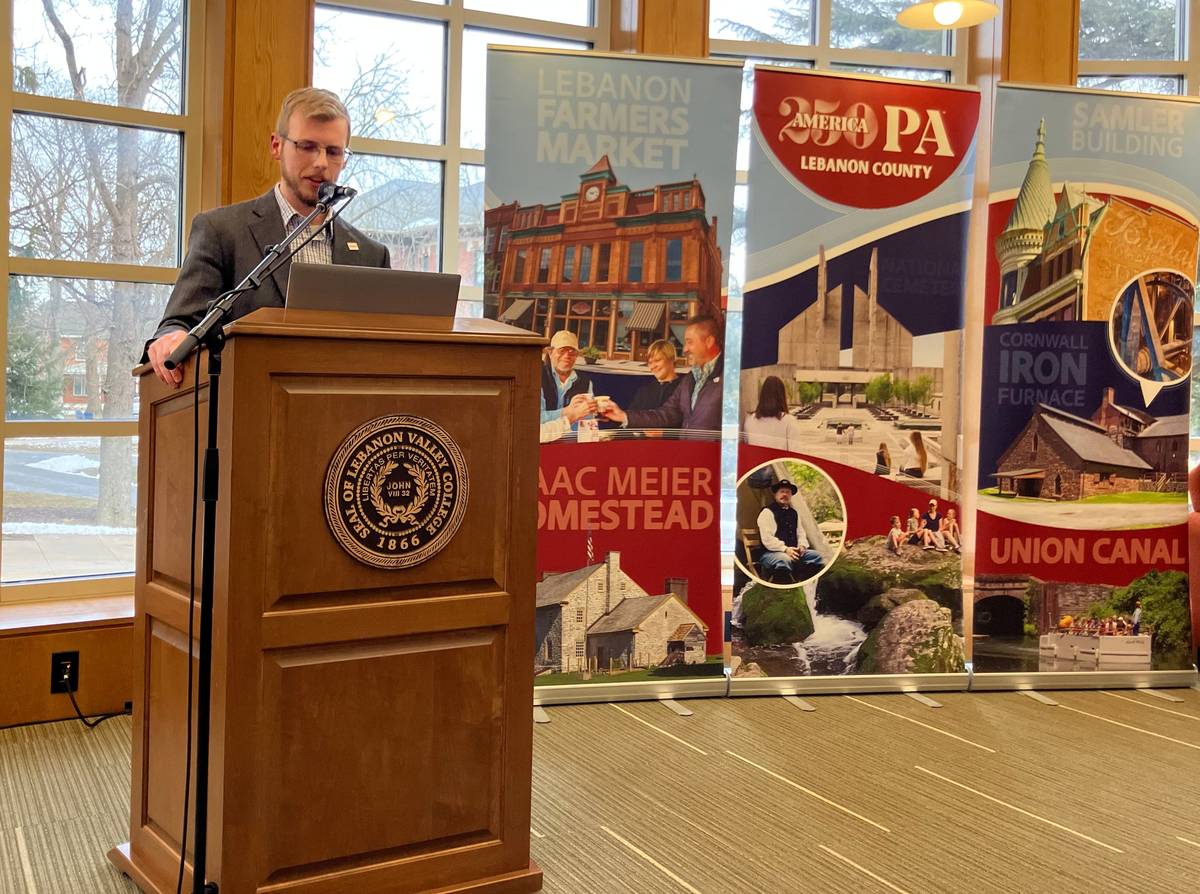
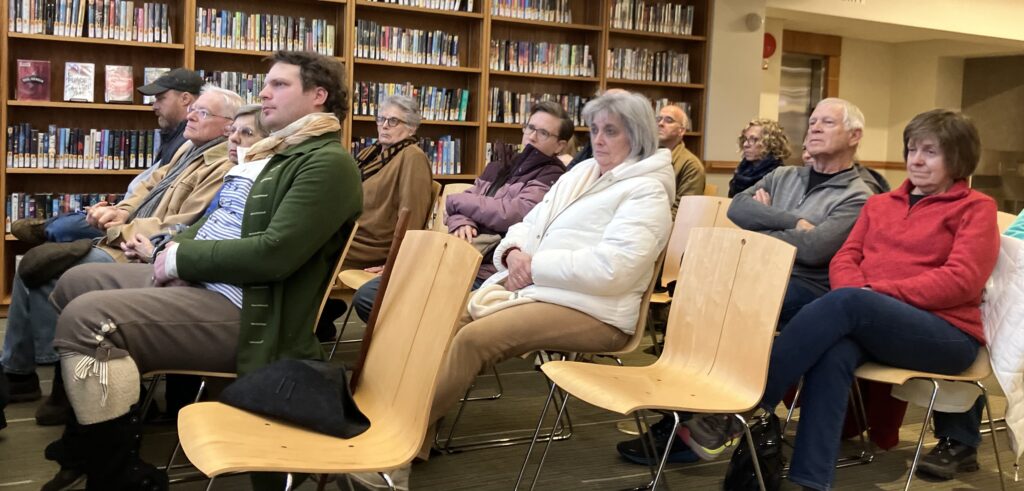
That document and other local contributions leading up to and during the Revolutionary War were highlighted during an America250 Lebanon County event Saturday in Lebanon Valley College’s Bishop Library. The nearly hour-long lecture and Q&A session was presented by Lebanon County Historical Society archivist Shane Keenan before about 40 attendees.
Keenan spoke about the roles that document, local residents, and Cornwall Iron Furnace played in the events leading to the Revolution and the eventual establishment of the United States on July 4, 1776. The event was held as part of local programming to commemorate the nation’s semiquincentennial anniversary celebration on July 4, 2026.
On July 4 in Lebanon County, events are being planned at the Lebanon Valley Exposition Center & Fairgrounds, culminating with the annual fireworks show, which is being moved this year from Coleman Memorial Park to the fairgrounds for the special celebration.
Keenan emphasized at the start of his presentation that Lebanon County was not incorporated until after the war but locals who lived in the area were resolved to gain their freedom from British tyranny.
“We’re going to go over the role of Lebanon County in the Revolution or more properly what became Lebanon County. We’ll be part of Lancaster County at this point and also later part of Dauphin County, with Dauphin breaking off from Lancaster in 1785,” Keenan said. ”But we’re talking about the area that became Lebanon and people from that area. We’re gonna see some examples from the (historical society’s) collection, kind of explore the American Revolution through a local lens.”
Keenan said the reserves document was created as a response to actions predating the war. It contained six provisions and was adopted June 25, 1774, at Col. Philip Greenawalt’s home. These resolves, involving figures like Col. John Philip de Haas and John Light, were part of the pre-Revolutionary fervor in the area.
“These are all responding to the closing of the Port of Boston, the Boston Port Act, which was part of what was called the Intolerable Acts, which was basically the British response to the Boston Tea Party,” Keenan said. “And that included, of course, the Boston Court Act, as well as the Massachusetts Government Act, which banned town hall meetings and basically made it so England would appoint local officials rather than having local elections.”
The document also protested two other moves of the British government. (See pages 5 and 6 of the embedded PDF document to read the six resolves in their entirety.)
“The Administration Justice Act had anyone accused of a crime in the colonies transported all the way back to England. So that would be more favorable to the English crown there. And then lastly, the Quartering Act, which allows for troops to be quartered or housed in private property without permission, especially controversial because it’s, at least supposedly, peace time. There’s a big distinction there versus having quarter troops in peace time versus wartime,” added Keenan.
The resolves is a landmark document. “This is a pretty early mark of unifying the colonies,” he said.
He noted the purpose was to be critical of Parliament, not the king. “That’s going to come later, especially when you get Thomas Paine’s ‘Common Sense,’ which is the full rejection of loyalty as a political system,” Keenan said.
The document, added Keenan, is an appeal to the king “as a check on Parliament’s authority to some degree” because “they still think of themselves, as they say, as loyal colonial subjects.”
He noted that the colonists were allowed, to a degree, to govern themselves. That changed after the French and Indian War, according to Keenan.
“Parliament decides to try and pay for this war, that in their eyes was mostly to defend the colonies, by starting to tax the colonies. And then to their shock, the colonists were very upset at this,” Keenan said. “The British Parliament, since we don’t elect anyone there, does not have the authority to control things in the colonies. Hence the somewhat, or simplified phrase, ‘no taxation without representation.’”
The Congress of Deputies declaration is an important action, too, according to Keenan, within the resolves.
“Lastly, we saw in that document the support for the Congress of Deputies. That is referring to what became the first Continental Congress, which has been the start of trying to further petition against British actions in the last few years,” he said.
Cedar Fire Company
Keenan said guests may wonder why a fire company, the first formed in the area in 1773, was included in a lecture about the American Revolution, adding there is a relationship with its members to war efforts.
“A lot of the members of this fire company, which was Lebanon’s first fire company, were also kind of the local leaders of the ones most involved. And they, for one thing, were heavily involved in making that Lebanon Resolves document as well as being some of the same men that were involved in creating local policies for the war,” he said.
Prominent local leaders
Those individuals included Greenawalt, colonials Curtis and Peter Grubb, and Col. John Philip de Haas, who fought in the French and Indian War and Pontiac’s War. De Haas also purchased land from George Steitz on April 1, 1765, in the area of 9th and Cumberland streets in what is now Snitz Creek Brewery’s parking lot.
“Shortly after that, he was appointed judge by Gov. John Penn, which was a pretty important step for Lebanon,” said Keenan. “If you lived in the area, you had to travel up to 20 miles to get to the area’s courthouse, which doesn’t sound like a lot today when we drive around everywhere, but at this time, best-case scenario, you’re riding a horse. More than likely, you’re walking. This is pretty much a day’s journey. … Then once the revolution starts, de Haas is involved with the Lebanon Resolves and formed a local militia. And then he served as colonel of the First Pennsylvania Battalion in Canada under Benedict Arnold.”
(Refer to pages 12-17 in the above PDF document for more information on local residents and their contributions during this period in time.)
Hebron Moravian Church & Prisoners of War
Keenan noted that the POWs were housed at Hebron Moravian Church in Lebanon.
“A major way that the local area participated in the war was by housing Hessian prisoners of war. It’s important to note we often refer to them as mercenaries. It’s not really the case,” Keenan said. “Hessians were, for the most part, just normal soldiers that were serving under their German princes, usually from the states of Hesse-Casell and Hesse-Penale. And basically these German princes were leasing their armies to the British to pay for their lavish lifestyles, for big parties, fancy clothing and all that.”
He added that at least 340 soldiers were brought to the area, where many of them would settle following the war.
“Many of them, especially after the Battle of Trenton, were taken to Lancaster, Lebanon and Reading. You can imagine why that would be appealing, even in the Pennsylvania-Dutch area, ‘Dutch’ meaning Dutch and German, a lot of the local residents speak German, and therefore communicate with these Hessian prisoners of war,” said Keenan.
Those prisoners became integral cogs of the war machine during that period.
“While these Hessians were in the area, they were also hired out to various local farms and businesses, including Cornwall Iron Furnace. And this was a way, for one thing, to keep them busy, and also to help with the wartime labor shortage,” Keenan said. “As you can imagine, with a lot of the men fighting the war, there were not enough people left at home to tend to the farms and other businesses in the area.”
Another interesting fact is that churches like Moravian and others in the area were used as storage facilities or hospitals during the war.
“Lebanon also served in the war as an armory briefly. So it was used as storage for powder and ammunition, especially during the British occupation in Philadelphia. Sources tell us that a powder magazine was set up in an abandoned building on 10th Street. Unfortunately, it doesn’t tell us exactly where this was,” Keenan said. “Local churches were also used to store powder as well as being used as hospitals.”
Cornwall Iron Furnace
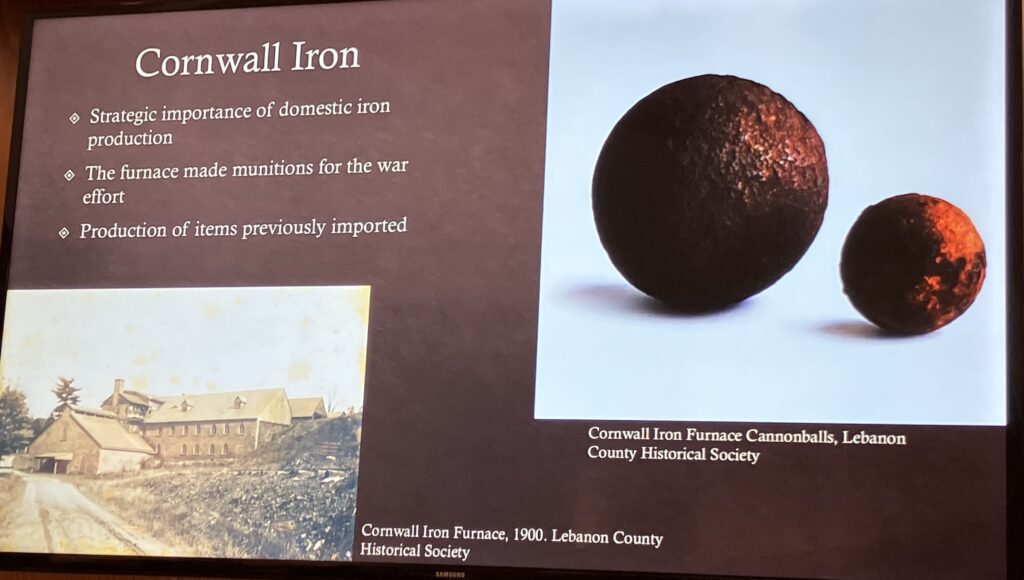
Keenan said the furnace had “strategic importance” for iron production.
“In addition to employing, if you want to say, these Hessian prisoners of Cornwall, also was obviously very important as a domestic source of iron production during the war. If you’re not familiar, Peter Grubb started mining there about 1737 and then started the furnace in 1742,” Kennan said. “His son took over after his death. Now, while a lot of iron was produced domestically in the United States, Cornwall being one of the major mines in the country, a lot of it was exported to Britain. However, a lot of the final products that the iron was made into were made in Britain, and then shipped back to the West, which is obviously going to be a little bit of a problem now that we’re working with them.”
“Cornwall Iron Furnace, to a limited degree, did make things like cannonballs … as well as for a little bit of time they made cannons,” Keenan added.
What’s next
The Lebanon250 Committee will sponsor three showings of the movie “The Patriot” on Feb. 25-27 at 6 p.m. at the Allen Theatre, 36 E. Main St., Annville. Admission is free, but the committee will accept pay-what-you-will donations during the shows.
Editor’s Note: An earlier version of this article repeated a claim from the lecture regarding an apocryphal visit by George Washington to the Cornwall Iron Furnace. Upon further review following the lecture, it was clarified that Washington is very unlikely to have visited the furnace and references to this once-believed event have been removed from signage at the historic site. LebTown sincerely apologizes if this caused our readers any confusion.
Questions about this story? Suggestions for a future LebTown article? Reach our newsroom using this contact form and we’ll do our best to get back to you.
Join our community of local news champions.
Cancel anytime.
Monthly Subscription
🌟 Annual Subscription
- Still no paywall!
- Fewer ads
- Exclusive events and emails
- All monthly benefits
- Most popular option
- Make a bigger impact
Already a member? Log in here to hide these messages
Local news is a public good—like roads, parks, or schools, it benefits everyone. LebTown keeps Lebanon County informed, connected, and ready to participate. Support this community resource with a monthly or annual membership, or make a one-time contribution. Cancel anytime.