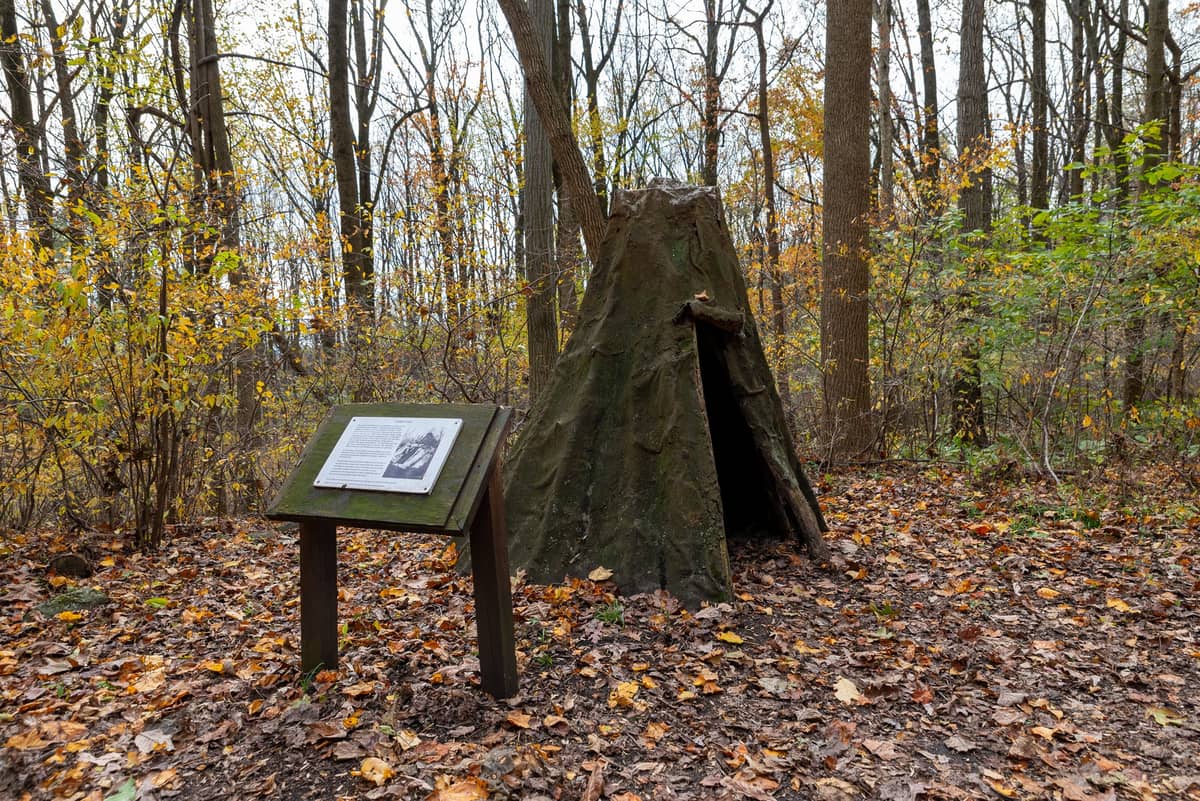

Recent and ongoing research into the enslaved workers at Cornwall Iron Furnace — including the man the southern Lebanon County mountain was named after — has disrupted the commonly held belief that Governor Dick was a collier, or charcoal burner.
Kathy Lindert, economist by profession and historical researcher in her free time, gave a presentation about her findings on March 21 to a packed room in the Lebanon County Historical Society building.
Until Lindert’s research, Lebanon Countians understood Dick to have worked as a collier for the iron furnace, chopping and burning wood on the mountain now known as Governor Dick.
The Clarence Schock Memorial Park at Governor Dick’s website states that “Dick, aged 50,” was purchased out of Maryland in 1776 and identified in a 1780 state-required legal filing registered by the foundry’s owner.
Pennsylvania partially abolished slavery in 1780. Any adults currently enslaved would remain that way through the rest of their lives, and children of enslaved individuals were termed slaves until they were 28 years old. Governor Dick, therefore, would have been forced to live the rest of his life under slavery.
Or he would have, if he hadn’t escaped.
An advertisement in a 1796 edition of Lancaster Newspapers offered $20 for the recapture of “a Negro man called Dick, (alias) Governor Dick.”
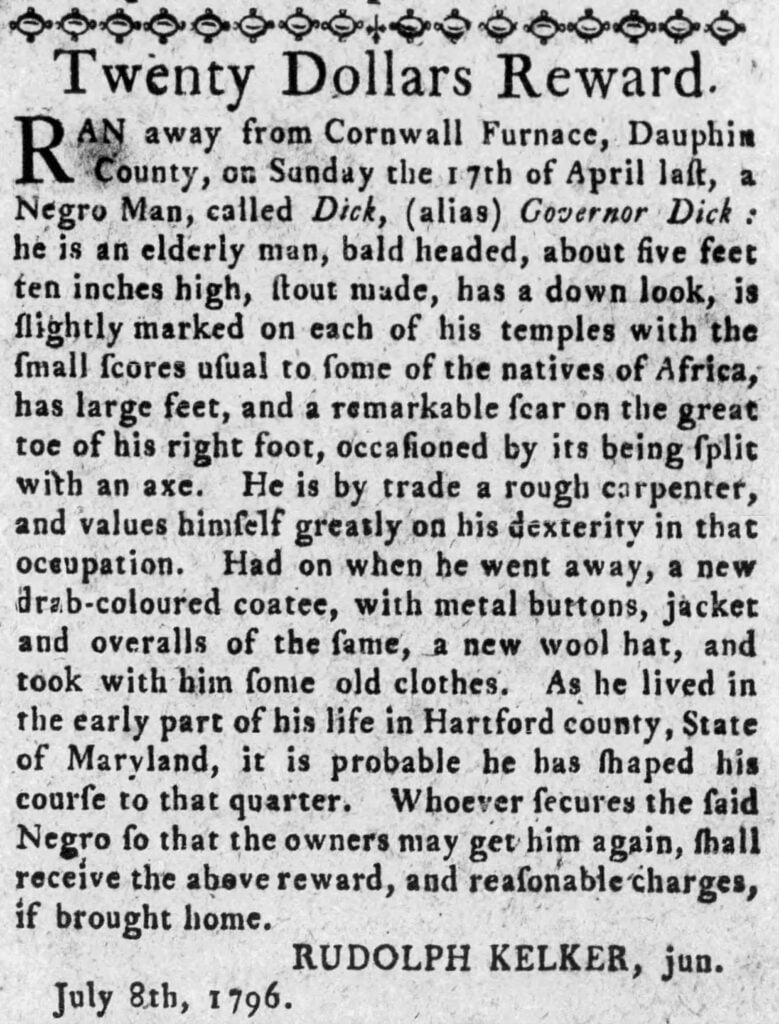
The ad describes Governor Dick as 5 feet, 10 inches tall, bald, and scorings on his temples. The markings could be tribal markings and suggest he may have originated from Africa before being sold into enslavement.
Lindert’s research
Lindert’s research went beyond this established record by scouring thousands of pages of worksheets, payment records, coal and cordwood books, slave registries, local records, and newspapers. She looked at Cornwall Iron Furnace’s enslaved community as a whole to understand the system, and expanded into researching the white paid workers as well.
Lindert noted that all the available information comes from the enslavers.
“This matters because we need to read these records critically, extracting human stories from documents that were never intended to tell them,” she said.
The records include enslaved individuals’ names, and when two people have the same name, they are noted as “Sr” or “Jr.” This doesn’t mean they are related — it denotes an older and younger individual.
This is important because, along with Governor Dick, there was also a Dick Jr. Lindert said one of Dick Jr’s jobs was as a collier, and this was likely how history has remembered Governor Dick as a collier. Through her research, she said she could not find an instance of Governor Dick doing collier labor.
Lindert said Dick’s governor title began popping up in 1781 and was a term of respect. On the slave’s side of the Cornwall Iron Furnace time sheets, Governor Dick, even before being given the title, was written first. This suggests a management role, possibly as someone who managed the enslaved workers and was an interface between the enslaved workers and management or other paid workers.
“The implications are he had some role of seniority, trust, and responsibility — not a single physical manual labor job,” Lindert said. “So what was his role? He was a leader.”
Governor Dick was further responsible for distributing rations and helped care for other workers when they were sick or injured.
Governor Dick’s escape
In the 1790s, the Cornwall Iron Furnace system saw some major changes and strain. Owner Curtis Grubb suddenly died in 1789, and his son, who was meant to inherit it, died the next year. There was about a decade of sorting out the estate before Robert Coleman bought the furnace.
“As this system destabilized, there was also less oversight and less visibility,” Lindert said. “The attention shifted away from oversight of labor towards dealing with debt, expenses, and the resolution of the Grubb’s estate. The managers actually stopped tracking the time of slaves.”
Timesheets tracking the labor of enslaved workers were blank for about four years.
In 1796, Lindert said there were only five slaves left, down from about two dozen at the peak.
Through this uncertainty, Governor Dick kept his title and was listed later after timesheets resumed. In April 1796, he worked every day for several weeks before escaping on Sunday, April 17. Enslaved workers had Sundays off, so he had a 24-hour head start before management would have noticed he was missing.
His absence wasn’t recorded for months, and the escape ad was published in July.
Lindert said Governor Dick, 66 years old at the time of his escape, left during an uncertain time in the furnace’s history because he might have been worried about being sold. In that case, he would no longer have the honor and responsibility that came with his “governor” title and would be seen as an aging enslaved man.
The ad suggests that Governor Dick might have escaped back to Maryland, where he worked before being sold to work in Pennsylvania.
Governor Dick’s legacy
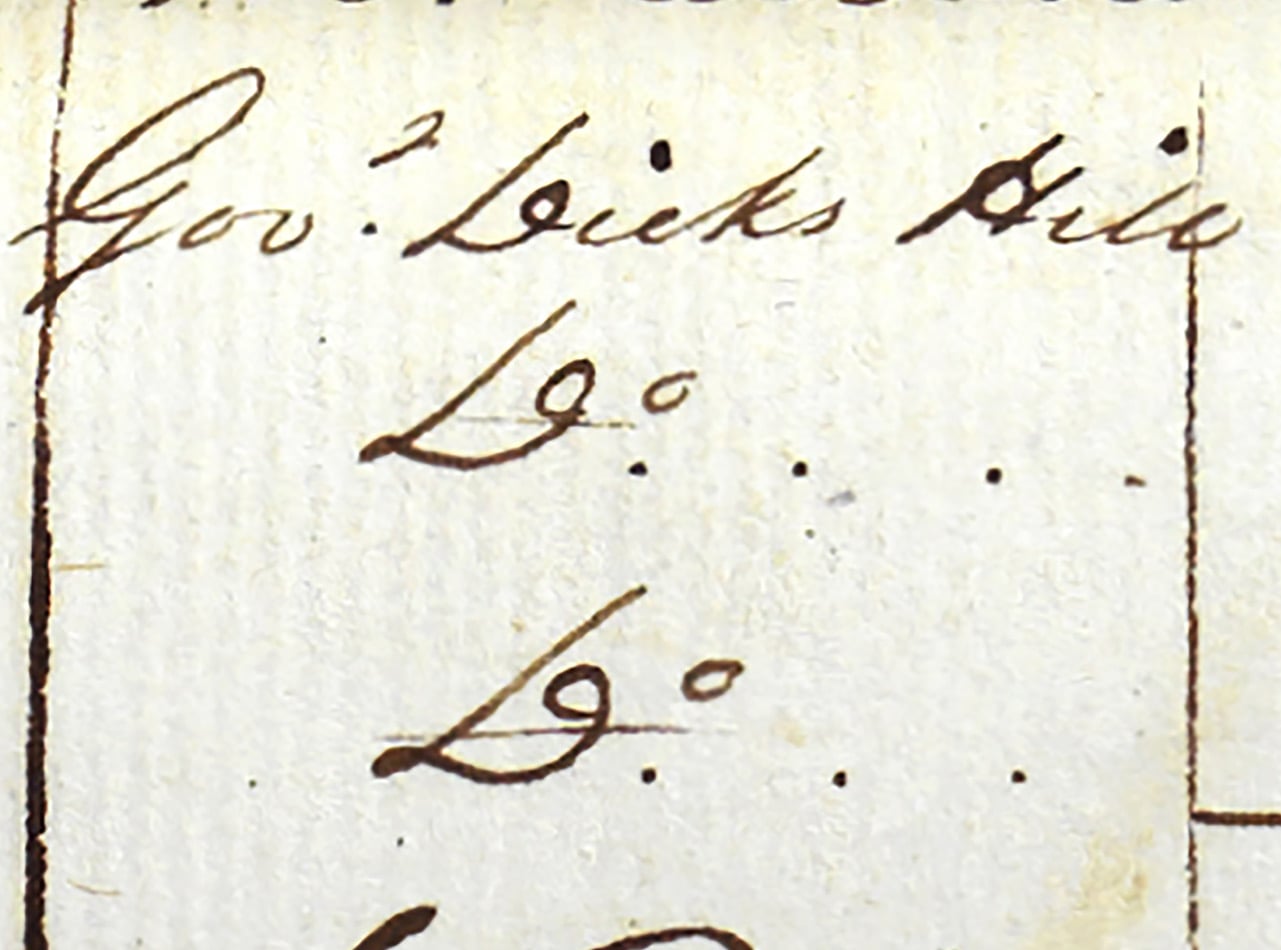
Governor Dick might not have worked on a mountain as a collier, but the name remains. In fact, Lindert’s research found the hill already had its title while the man was still alive and working at the furnace.
An account book from January 1796, three months before Governor’s Dick’s escape, outlines work done at “Gov. Dick’s Hill.”
“I was bawling. I get emotional now, because he had the honor of them calling this mountain that we love today after him, and I think it might be one of the only places in the United States named after a slave while he was in captivity, while he was alive,” she said. “He was there, and he knew it.”
Watch the Feb. 1 presentation by Kathy Lindert and Marcus Walko at the Clarence Schock Environmental Center
Questions about this story? Suggestions for a future LebTown article? Reach our newsroom using this contact form and we’ll do our best to get back to you.
Join our community of local news champions.
Cancel anytime.
Monthly Subscription
🌟 Annual Subscription
- Still no paywall!
- Fewer ads
- Exclusive events and emails
- All monthly benefits
- Most popular option
- Make a bigger impact
Already a member? Log in here to hide these messages
You know us because we live here too. LebTown’s credibility comes from showing up, listening, and reporting on Lebanon County with care and accuracy. Support your neighbors in the newsroom with a monthly or annual membership, or make a one-time contribution. Cancel anytime.