
With fuel prices skyrocketing since the start of the Iran war, it’s more imperative than ever that farmers take a worldwide view of agricultural markets.
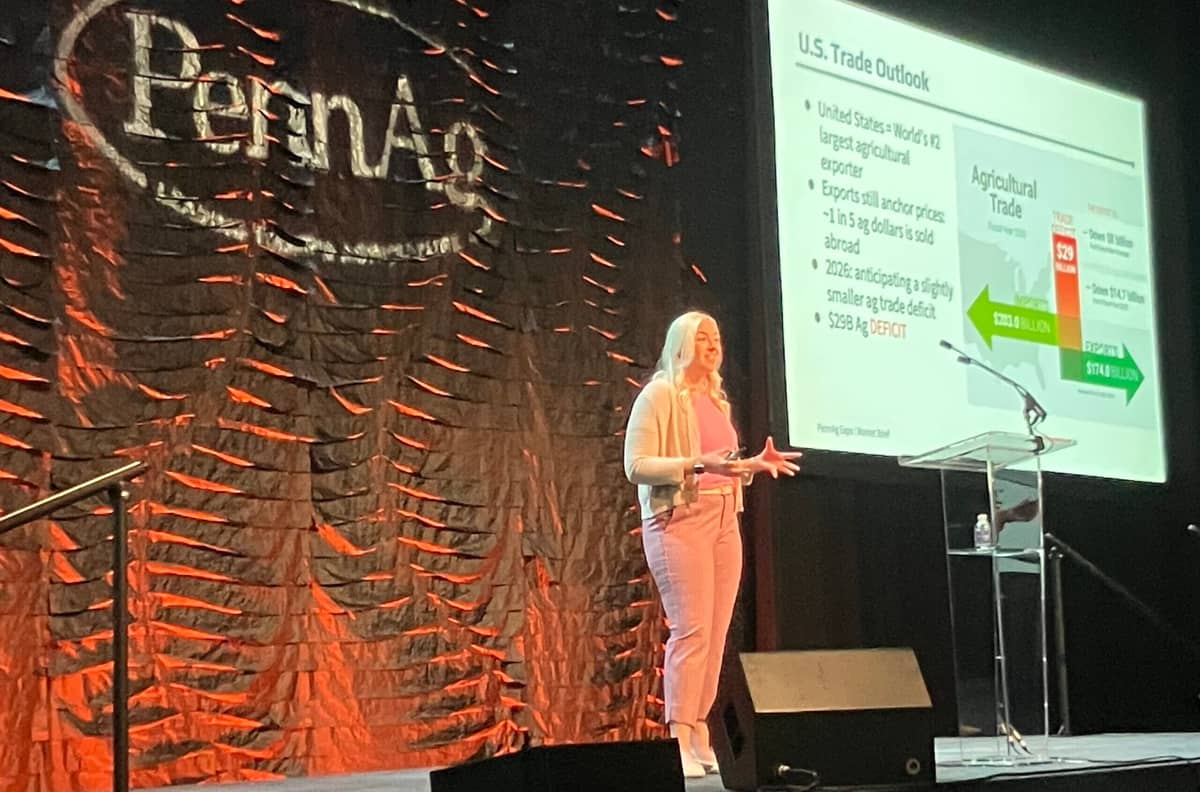
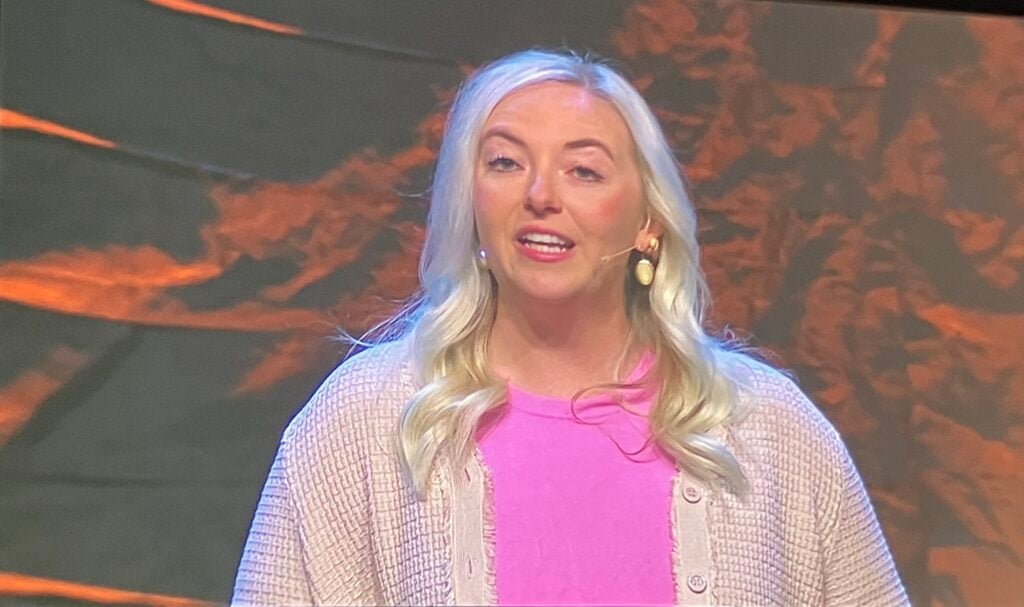
That message of having a global vision about the ag industry was imparted by Delaney Howell, host of the Ag News Daily podcast, during her keynote address Tuesday during PennAg’s Expo event at the Lebanon Valley Exposition Center & Fairgrounds.
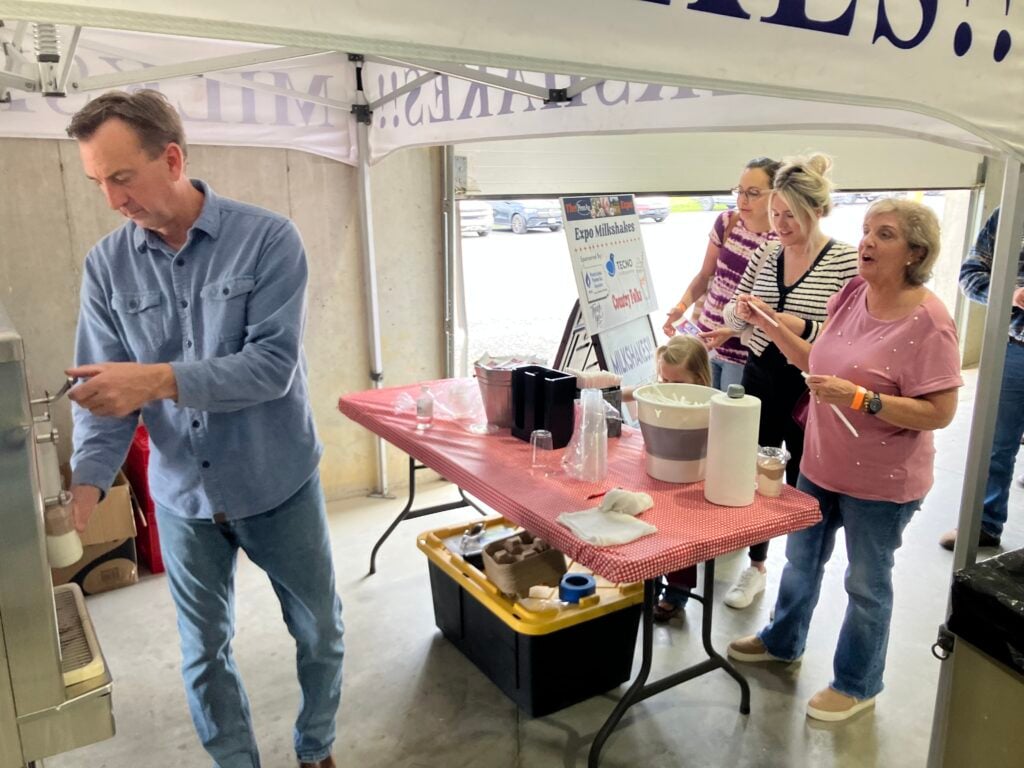
The one-day expo draws about 850 farmers from around the state and over 100 exhibitors, according to executive vice president Christian Herr.
Howell told a story about a Nigerian farmer who received a single-row corn planter, and how that woman, with tears in her eyes, told American officials how that technology would revolutionize the way she farms because she had studied and adopted no-till practices, which are commonly used in the United States.
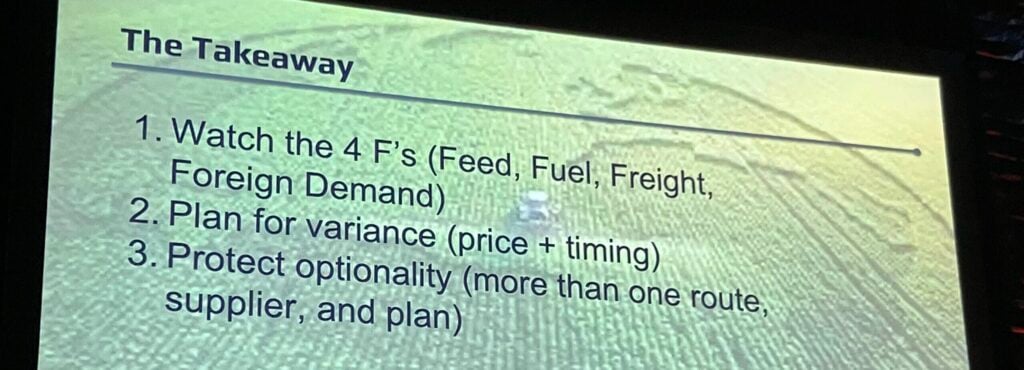
“We need to make sure we’re doing a good job of watching what others are doing as well, because we truly are in a global agricultural system,” Howell said. “So as we look at today’s roadmap for what we’re going to talk about here, we’re going to talk about just a few things, and that is the 4 Fs.”
Howell said near the start of her 45-minute presentation that a farmer’s global roadmap should focus on feed, fuel, freight, and foreign demand. Given current events in Iran, part of her presentation looked at how fuel costs might impact the future of agriculture.
Fuel
Brent crude oil is up 55%, diesel fuel by 42%, U.S. liquefied natural gas by 75% and natural gas by 25%. Media reports on Tuesday noted that Brent crude oil was up 60%, achieving its highest levels since 1988.
Brent crude is a major trading classification of light, sweet crude oil sourced from the North Sea, serving as the primary global benchmark for Atlantic basin petroleum prices.
“All of these factors are starting to culminate now during one of the busiest times of the year for farmers ahead of spring planting, spring calving, transferring birds or pigs to the next facility,” Howell said. “All of that is culminating in just the perfect storm. So we’re seeing diesel and energy prices move quickly with some of these new global risks that are added into the marketplace.”
Pain has also been felt at the gas pump.
“I was reading a gasoline report the other day that the national average of prices at the pump has gone up over a dollar in the last month. So consumers are starting to feel that. They’re gonna continue to feel that at the grocery store because it’s gonna be more expensive to transport their food. And we’re gonna feel that in agriculture as well as we think about all of those fall or fall and spring fieldwork pieces that have to be done.”
Howell said she’s watching – and encourages farmers to follow – what’s happening with fuel prices, especially with logistics and freight challenges the nation faces.
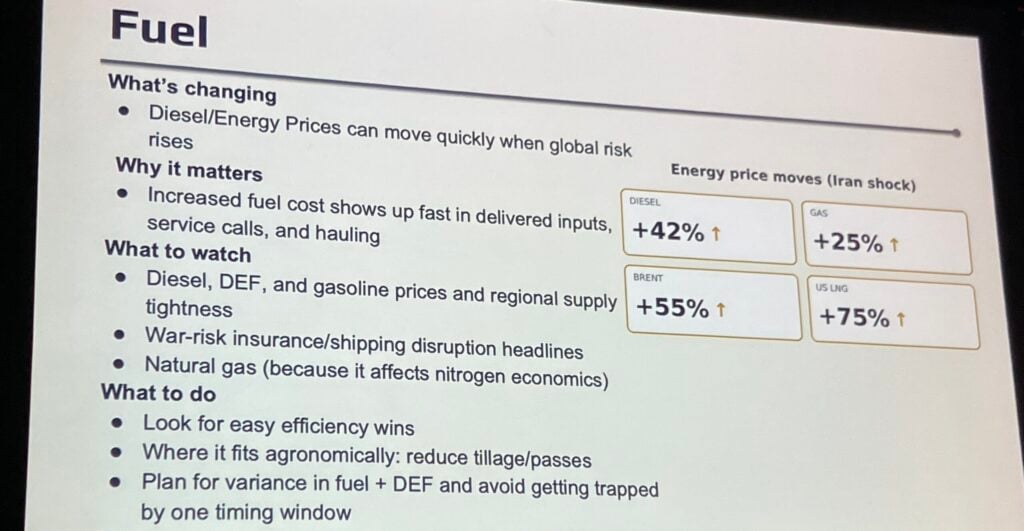
“And ultimately, how is that playing out here for the regional supply as well,” she added. “Maybe you have it now, and ’26 isn’t the year where we’re going to feel that long-term impact. But as we think about this conflict in Iran continuing for maybe multiple months, the impact becomes not just what’s happening in ’26, it’s what about ’27, as we’re booking maybe fall needs or the spring of ’27?”
There’s a reason for being aware of what’s happening now in Iran and the long-term impacts of what’s occurring today will have in the future.
“So longer term, I’m continuing to watch to see how long is this really going to play out, because that’s going to have a lasting impact on the markets. Part of that is because the infrastructure right now in the Strait of Hormuz is absolutely getting annihilated. And it’s not a quick fix,” she said.
Feed
Concerning animal feed, Howell urged diligence on following crop markets and weather reporters here and around the world.
U.S. weather and crop trends impact feed prices, she said. “And so maybe a little bit of what to do for each of these is certainly watching, staying flexible, keeping an eye on other weather patterns in other countries. It’s not a set it and forget it kind of a year.”
The situation in Iran demands that farmers embrace more profitable characteristics.
“This is a year to be agile and nimble as we see more volatility creeping into all of our markets. An opportunity to watch those local basis and spreads and really find a way to make the most out of an extremely volatile year because volatility, while it may indicate a lot of movement and friction, it also gives us that opportunity to price at different points in the marketplace,” she added.
Freight
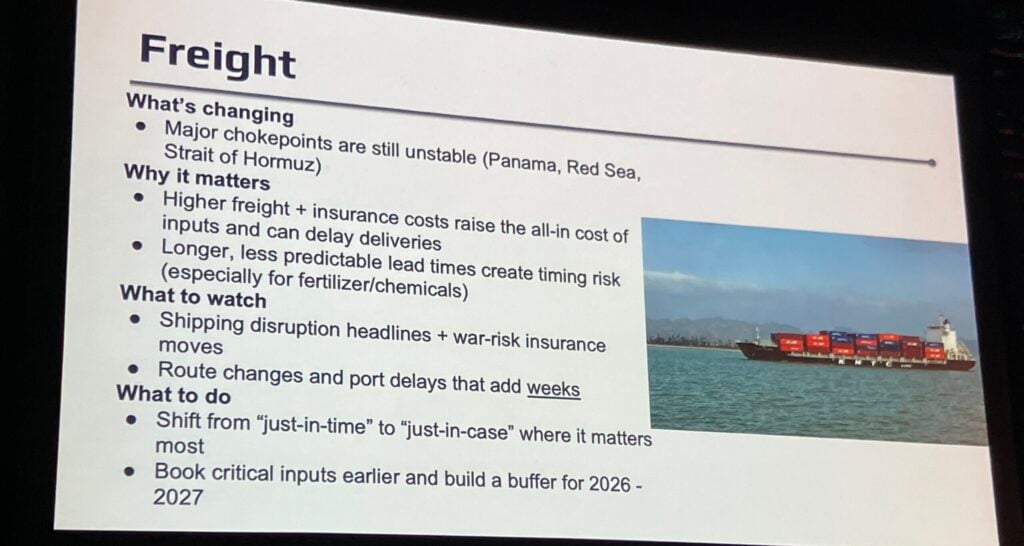
Shipping has become volatile given the situation in Iran and the Strait of Hormuz as well as unstableness in the Red Sea and Panama Canal, according to Howell.
Howell advised farmers to watch for shipping disruptions and changes in war-risk insurance along with potential route changes and port delays that can add weeks to delivery times.
This matters, she said, because higher freight and insurance costs will raise the all-in cost of inputs and can delay deliveries, and longer, less predictable lead times create timing risk – especially for fertilizers and chemicals.
Foreign demand
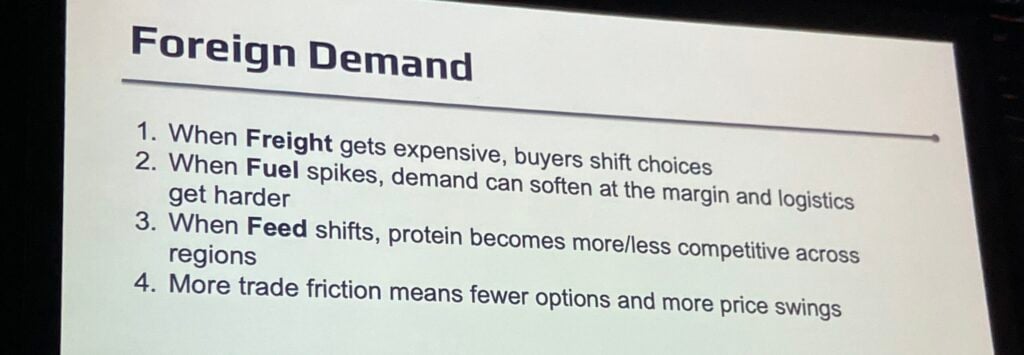
As foreign nations grow their middle class, Howell said there are potentials for export markets to change for American products. Additionally, farmers should follow trade talks in China in mid-May and know how markets are moving around the world.
She noted that a recent survey of European Union members concluded that those countries are planning to become less reliant on China.
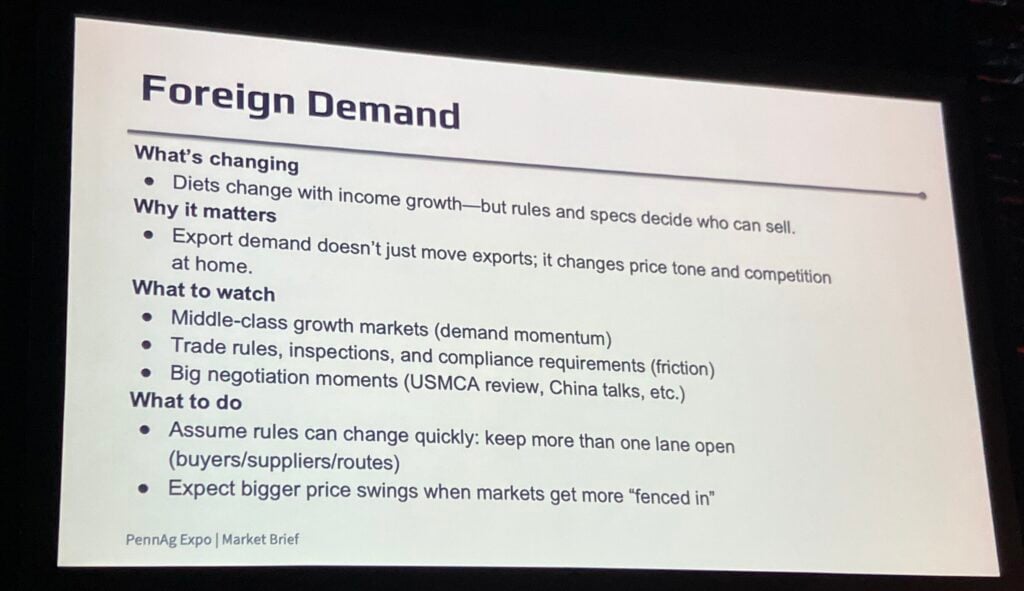
“The information we receive from them (China) is just so limited, but what we do see is that other countries are taking note of their ethics in business and trade. And so we’ve seen a lot of other countries, maybe not Brazil and Argentina, but certainly in the European Union have started to reduce their dependency on China alone,” Howell said.
Of the 131 EU member nations surveyed, about two-thirds said they were planning to shift away their long-term strategies from doing business with China, Howell noted.
“So certainly that’s a factor to watch as well. Does that open the door for U.S. trade, more U.S. trade relationships to grow?” she asked. “And, of course, other countries to watch include the EU, Japan, India and Indonesia with such booming populations. Again, that rising middle class that we see playing out there in Vietnam are all countries to watch. And there are also certainly ones that we’re seeing active trade negotiations happen in as well.”
U.S. agricultural trade deficit
The U.S. is the world’s second largest agricultural exporter in the world and one in every $5 can be traced to export markets, Howell noted.
“In fact, if you were to look at your balance sheet and you had all of that information compiled and knew where your products were going in the end market, about one in $5 on the average balance sheet can be tracked directly back to agricultural trade,” she said.
Despite its standing as the second largest ag exporter, the U.S. still runs a trade deficit of about $29 billion, Howell said.
“In 2025, we saw the largest trade deficit on record for U.S. agriculture, meaning that we imported quite a bit more product than what we exported beyond our borders,” she said. “As we look from where we were in ’25 to where we’re going in ’26, the picture is starting to take a little bit of a rosier shape. In 2026 we’re still anticipating a fairly large trade deficit compared to previous years. … So that is certainly still not where we want to be with so much of our revenue tied to exports, but it is trending in the right direction.”
She said the ag trade deficit is driving the Trump administration to make changes in trade policy.
“I had the opportunity to hear Secretary Rollins speak to a room full of farmers, and then she also did a private media gaggle for those of us reporters that were in the audience. And it was really interesting to note because she and the Trump administration are very obviously focused on improving the trade relationships,” Howell said.
LebTown asked Howell after her presentation if it was fair to compare the nation’s ag trade deficit to what it exports since it imports many products that can’t be grown here.
“Since the 1990s, we’ve placed this heavy emphasis on being a global trading partner with other countries. So we’ve worked really hard to build a system, whether that’s infrastructure around freight and shipping, relationships, etc.,” she said. “And we’ve put a lot of energy into building that global system. And what I think the Trump administration is in a roundabout way trying to do is bring that back in house, so to speak. So, de-globalization, if you will, so less reliance on other countries to bring in products. Yes, I recognize we can’t produce everything in house, so to speak, but I think it’s less about exporting more and it’s more about producing and using what we have in the country.”
U.S. tariffs
LebTown asked Howell, whose family runs a farm in Iowa, how tariffs – which were not discussed during her presentation – have impacted agricultural trade and costs.
“A lot. I mean, just like in our input for operating costs alone, not two times, but maybe one and a half times higher than what it was before,” Howell said. “And then that’s coupled with high inflation. So our operating costs are more expensive.”
Howell was the keynote speaker at an event that has an emphasis on education.
Producers can receive up to three credits for attending the various manure management sessions and another provided certification in pork quality assurance. An additional focus for 2026 centered on biosecurity on poultry operations given the ongoing issue with avian influenza.
Questions about this story? Suggestions for a future LebTown article? Reach our newsroom using this contact form and we’ll do our best to get back to you.
Support Lebanon County journalism.
Cancel anytime.
Monthly Subscription
🌟 Annual Subscription
- Still no paywall!
- Fewer ads
- Exclusive events and emails
- All monthly benefits
- Most popular option
- Make a bigger impact
Already a member? Log in here to hide these messages
Free local news isn’t cheap. If you value the coverage LebTown provides, help us make it sustainable. You can unlock more reporting for the community by joining as a monthly or annual member, or supporting our work with a one-time contribution. Cancel anytime.