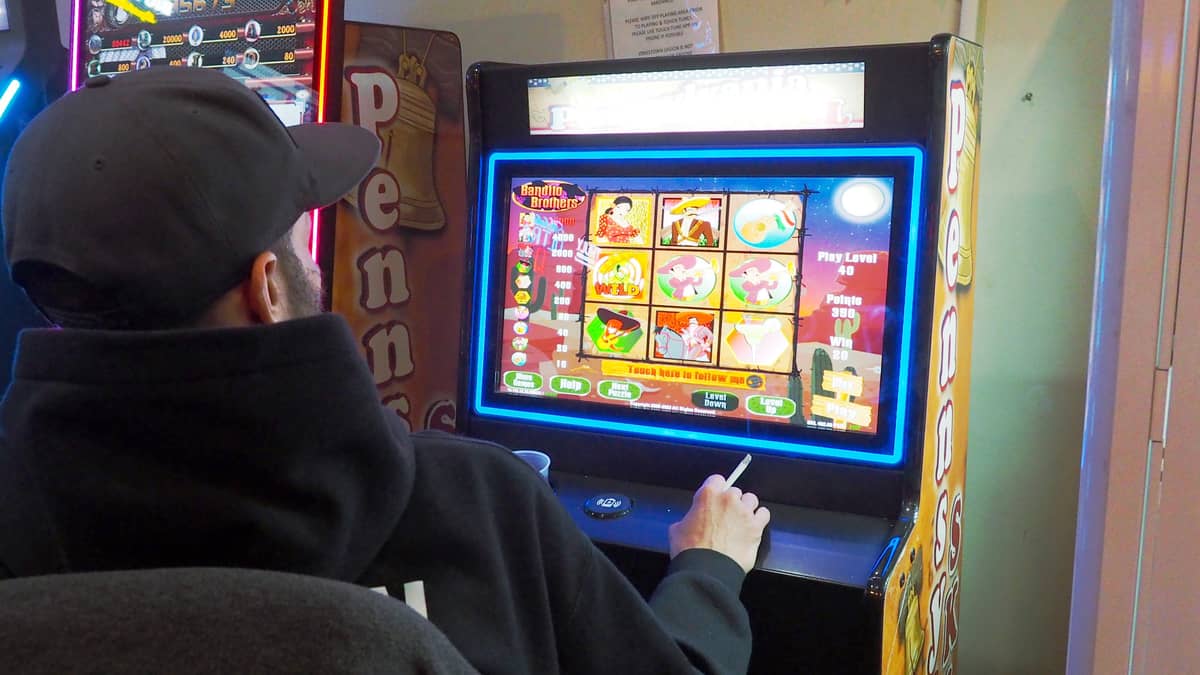

You can find them in bars, VFWs, fraternal organizations, and social clubs throughout Lebanon County and statewide. At first glance, they look a lot like casino video poker games and slot machines, gambling devices that depend completely on luck to pay cash prizes.
But proponents of “skill games,” backed by a well-funded lobbying campaign headed by Pace-O-Matic, the Georgia-based software company that makes their electronic brains, and Williamsport-based Miele Manufacturing, builder of the actual machines, say they are not gambling devices because they require an element of skill to win and can theoretically be beaten every time they are played.
Some Pennsylvania appeals courts have agreed, leaving skill games in an untaxed and unregulated gray area, much to the displeasure of Pennsylvania’s casino industry, which pays a 54% tax on slot machine revenue.
Unlike casino and race track slots, skill games are found mostly in neighborhood bars and small nonprofits that say they depend on the devices’ reliable revenue to keep their lights on and doors open. Skill game advocates say they aren’t competing with casinos for players and money because they cater to a different type of patron.
And while it may sound counter-intuitive, the Pennsylvania skill game industry and its small business customers say they welcome regulation and taxation to counter what they see as confusion and improper enforcement activity on the part of the Pennsylvania Gaming Control Board, as well as an influx of illegal gambling devices disguised as skill games. They also point to instances where skill games have been mistaken for illegal gambling devices and improperly seized.
While all stakeholders are generally in favor of some sort of skill game taxation and regulation, a legislative solution looks to be boiling down to three big questions: What’s a proper tax rate on skill game revenue? What state agency should regulate them? And where should the machines be allowed?
Read More: Local stakeholders rally for regulation, fair taxation of popular ‘skill games’
Pennsylvania Governor Josh Shapiro has floated a 52% tax rate, just 2% below what casino slot operators pay. Republican state Senator Eugene Yaw (R-23) of Lycoming County, where Miele Manufacturing is located, has introduced Senate Bill 626, which sets a 16% tax that appears to have widespread industry acceptance.
But the legislation that’s creating a stir, especially with a local amusement company that has a vested interest in skill game legislation, has been co-introduced by local state Senator Chris Gebhard (R-48) and four senate colleagues, including senate Republican leader Joe Pittman (R-41) and senate president pro tempore Kim Ward (R-39).
Gebhard’s Senate Bill 756 proposes a 35% tax on skill game revenue, limits their placement to businesses that have a Pennsylvania liquor license, and designates the Gaming Control Board as the regulatory agency.
Gebhard’s proposed 35% tax has drawn fire from the skill game industry and local distributors who place machines in individual small businesses. Spearheading the local opposition to Gebhard’s bill is Lebanon amusement company Shay’s Vending.
Manager Willie Shay has taken to Facebook and accused Gebhard, who he refers to as “Casino Chris,” of supporting casinos and hating small businesses and veterans’ clubs.
But in a May 30 interview, Gebhard told LebTown that he strongly supports small businesses, is committed to a fair tax rate, and that 35% is merely a starting point, not something set in concrete. “I’ve thought for a long time that the sweet spot can certainly land somewhere between the mid- to upper 20s, maybe 30%,” said Gebhard.
Where did 35% come from? “Well, it’s probably less scientific than people think,” Gebhard explained. “35% is halfway between 16 and 54.”
As far as critics of his bill, Gebhard pointed out that “really we are basically in the first three innings of the game, and we have a tremendously long way to go before we get to wherever we’re going to settle. For people to turn the conversation as negatively as they have, I think, is doing nothing to help us achieve a positive outcome.”
Matthew Urban, Gebhard’s chief of staff, told LebTown on the afternoon of June 4 that the senator had recently met with his co-sponsors’ staff to discuss SB 756 and skill game regulation. Gebhard’s bill, Urban said, “is not a finished product, there are still lots of conversations going on.”
Word of SB 756’s sponsors’ flexibility on the bill’s tax rate apparently led skill game advocates to call off a rally scheduled for Thursday evening at the Lebanon Navy Club.
If skill game legislation is taken up by the state House, there’s a good chance it will come across the desk of state Rep. Russ Diamond (R-102) of Annville. Diamond is Republican chair of the House Gaming Oversight Committee.
Diamond said he doesn’t favor any legislation designed purely to raise revenue, which he believes just encourages more and more spending and fuels bigger government.
“The whole generating revenue part of it, it doesn’t move my needle,” he told LebTown last week. “It’s the same as marijuana. Come to me with an argument that you’re going to generate revenue? I don’t care about that.”
The only skill game bill currently introduced in the House is sponsored by state Rep. Ed Neilson (D-174) of Philadelphia, and Diamond doesn’t think it has much chance of success. “[Neilson’s] tax rate is set at 49% which will put all the skill people just out of business,” he said.
Diamond would like to see a comprehensive overhaul of Pennsylvania’s gaming laws, which are largely contained in the 20-year-old Race Horse Development and Gaming Act. That law legalized racetrack slot machines with the aim of stabilizing Pennsylvania’s horse racing industry.
Diamond points out that the gaming act has had a number of amendments tacked onto it over the years in response to gaming industry developments such as table games and online wagering. He is seeking co-sponsors for legislation that would streamline what he says has become “a crazy patchwork quilt of tax rates and politically driven revenue schemes that even the keenest of minds have a hard time grasping,” and that would provide some flexibility to accommodate future developments in the industry.
Editor’s note: In an earlier version of this article, we quoted Willie Shay as accusing Senator Chris Gebhard of supporting casinos and “hating” small businesses and veterans’ clubs. Shay did not use the exact word “hating,” and we have removed the original incorrect quote marks around it. Shay’s original Facebook post, published on May 29 at 8:05 a.m., and addressed to Gebhard, said “Why you support Casinos soo much and hate small business and vetrans (sic) clubs so much.” We sincerely regret the error.
Questions about this story? Suggestions for a future LebTown article? Reach our newsroom using this contact form and we’ll do our best to get back to you.

Support Lebanon County journalism.
Cancel anytime.
Monthly Subscription
🌟 Annual Subscription
- Still no paywall!
- Fewer ads
- Exclusive events and emails
- All monthly benefits
- Most popular option
- Make a bigger impact
Already a member? Log in here to hide these messages
Trustworthy local news is built on facts. As Lebanon County’s independent news source, LebTown is committed to providing timely, accurate, fact-based coverage that matters to you. Support our mission with a monthly or annual membership, or make a one-time contribution. Cancel anytime.