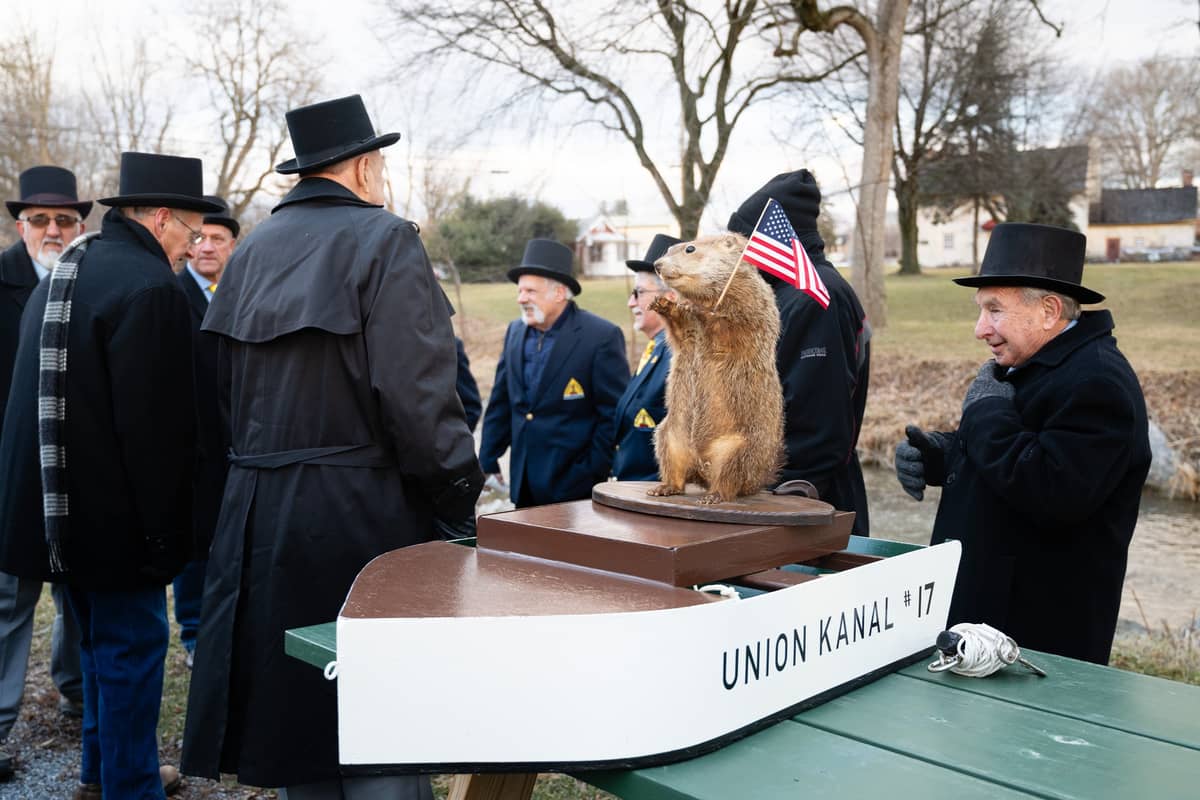

Uni, eastern Lebanon County’s prognosticating whistlepig, will return to Myerstown for his annual forecast on Groundhog Day, Monday, Feb. 2.
The event will take place at 8 a.m. at the Myerstown Recreation Park on South College Street, Myerstown. The Union Kanaal Grundsau Lodsch #17 of Eastern Lebanon County has hosted this event since 1981, making this year the 45th annual forecast.
The event regularly draws a crowd to watch Uni float stoically down the Tulpehocken Creek before giving his prediction. Uni’s methodology is simple: If he sees his shadow, we’re due for six more weeks of winter, otherwise it’s an early spring. According to lodge members, Uni has never been wrong.

Uni is short for Union Canal — Tulpehocken Creek once being part of the titanic transportation corridor that coursed for a time through Lebanon County, its imprint still visible at numerous sites, including the historic hand-hewn tunnel just north of Lebanon city.
Uni is the ward of the Eastern Lebanon County chapter of the Grundsau Lodsch, one of 17 groundhog lodges in eastern Pennsylvania, all of which are dedicated to preserving the region’s Pennsylvania Dutch roots. A big part of that preservation is carrying forward the Pennsylvania Dutch dialect, which grew out of the language of German, French, and Swiss immigrants to the region in the 1700s and 1800s.
Fittingly, the yearly forecast is delivered first in Pennsylvania Dutch, and then translated for the rest of us.

Some historical perspective
Groundhog Day – although observed throughout North America and popularized by the 1993 movie starring Bill Murray and Andie MacDowell – has deep roots in the Pennsylvania Dutch tradition.
According to an article collected by the Library of Congress for its American Folklife Center project, Groundhog Day “is celebrated in many places in the United States and Canada, with an emphasis on tongue-in-cheek humor and ceremonious proclamations. It is best known among people whose ancestors spoke German, especially the Pennsylvania Dutch.”
The holiday sprouted from an ancient European pagan holiday known as Imbolc, which was later Christianized as the feast of the Purification of the Virgin Mary, the Irish feast of St. Brigid, and Candlemas. “But the tradition of predicting the weather persisted through many of the holiday’s variations,” the article notes.
“Unfortunately, we don’t know that much else about how ancient Celts celebrated Imbolc, but its importance as the first day of spring persisted to living memory,” it states. “Weather prognostication, then, became associated with the beginning of February during ancient times, and the tradition persists until today. But this still leaves us in the dark as to the groundhog and his role in the process!”
In Europe, the forecasting tradition belonged to the humble badger, rather than the groundhog, “but the traditions are otherwise almost identical.” The European badger, like the American groundhog, is “a small, hibernating, forest-dwelling mammal known for being very shy, and it was only natural for German-speaking immigrants to America to substitute the groundhog for the badger.”
Groundhog Day customs have led to “a fascinating development in Pennsylvania Dutch country: the ‘Groundhog Lodges,’ a loose organization of social clubs focused on the maintenance of Pennsylvania Dutch language and culture. The lodges, which hold meetings called ‘versammlinge,’ at which participants speak only Pennsylvania Dutch, have existed since the 1930s.”
There are plenty of groundhogs marking the occasion throughout Pennsylvania. Punxsutawney Phil, in western PA, has garnered the most fame. Lebanon County also boasts a second furry meteorologist: Mount Gretna’s Grady, who has been making forecasts since 2018.
Questions about this story? Suggestions for a future LebTown article? Reach our newsroom using this contact form and we’ll do our best to get back to you.
Join our community of local news champions.
Cancel anytime.
Monthly Subscription
🌟 Annual Subscription
- Still no paywall!
- Fewer ads
- Exclusive events and emails
- All monthly benefits
- Most popular option
- Make a bigger impact
Already a member? Log in here to hide these messages
Trustworthy local news is built on facts. As Lebanon County’s independent news source, LebTown is committed to providing timely, accurate, fact-based coverage that matters to you. Support our mission with a monthly or annual membership, or make a one-time contribution. Cancel anytime.
Uni, eastern Lebanon County’s prognosticating whistlepig, will return to Myerstown for his annual forecast on Groundhog Day, Monday, Feb. 2.
The event will take place at 8 a.m. at the Myerstown Recreation Park on South College Street, Myerstown. The Union Kanaal Grundsau Lodsch #17 of Eastern Lebanon County has hosted this event since 1981, making this year the 45th annual forecast.
The event regularly draws a crowd to watch Uni float stoically down the Tulpehocken Creek before giving his prediction. Uni’s methodology is simple: If he sees his shadow, we’re due for six more weeks of winter, otherwise it’s an early spring. According to lodge members, Uni has never been wrong.
Uni is short for Union Canal—Tulpehocken Creek being once part of the titanic transportation corridor which coursed for a time through Lebanon County, its imprint still visible at numerous sites, including the historic hand-hewn tunnel just north of Lebanon city.
Uni is the ward of the Eastern Lebanon County chapter of the Grundsau Lodsch, one of 17 groundhog lodges located in eastern Pennsylvania, all of which are dedicated to preserving the region’s Pennsylvania Dutch roots. A big part of that preservation is carrying forward the Pennsylvania Dutch dialect, which grew out of the language of German, French, and Swiss immigrants to the region in the 1700s and 1800s. Fittingly, the yearly forecast is delivered first in Pennsylvania Dutch, and then translated for the rest of us.
Some historical perspective
Groundhog Day – although observed throughout North America and popularized by the 1993 movie starring Bill Murray and Andie MacDowell – has deep roots in the Pennsylvania Dutch tradition.
According to an article collected by the Library of Congress for its American Folklife Center project, Groundhog Day “is celebrated in many places in the United States and Canada, with an emphasis on tongue-in-cheek humor and ceremonious proclamations. It is best known among people whose ancestors spoke German, especially the Pennsylvania Dutch.”
The holiday sprouted from an ancient European pagan holiday known as Imbolc, which was later Christianized as the feast of the Purification of the Virgin Mary, the Irish feast of St. Brigid, and Candlemas. “But the tradition of predicting the weather persisted through many of the holiday’s variations,” the article notes.
“Unfortunately, we don’t know that much else about how ancient Celts celebrated Imbolc, but its importance as the first day of spring persisted to living memory,” it states. “Weather prognostication, then, became associated with the beginning of February during ancient times, and the tradition persists until today. But this still leaves us in the dark as to the groundhog and his role in the process!”
In Europe, notably, the forecasting tradition belonged to the humble badger, rather than the groundhog, “but the traditions are otherwise almost identical.” The European badger, like the American groundhog, is “a small, hibernating, forest-dwelling mammal known for being very shy, and it was only natural for German-speaking immigrants to America to substitute the groundhog for the badger.”
Groundhog Day customs have led to “a fascinating development in Pennsylvania Dutch country: the ‘Groundhog Lodges,’ a loose organization of social clubs focused on the maintenance of Pennsylvania Dutch language and culture. The lodges, which hold meetings called ‘versammlinge,’ at which participants speak only Pennsylvania Dutch, have existed since the 1930s.”
There are plenty of groundhogs marking the occasion throughout Pennsylvania. Punxsutawney Phil, in western PA, has garnered the most fame. Lebanon County also boasts a second furry meteorologist: Mount Gretna’s Grady, who has been making forecasts since 2018.
Questions about this story? Suggestions for a future LebTown article? Reach our newsroom using this contact form and we’ll do our best to get back to you.
Join our community of local news champions.
Cancel anytime.
Monthly Subscription
🌟 Annual Subscription
- Still no paywall!
- Fewer ads
- Exclusive events and emails
- All monthly benefits
- Most popular option
- Make a bigger impact
Already a member? Log in here to hide these messages
Trustworthy local news is built on facts. As Lebanon County’s independent news source, LebTown is committed to providing timely, accurate, fact-based coverage that matters to you. Support our mission with a monthly or annual membership, or make a one-time contribution. Cancel anytime.


![[Column] No thanks, we don’t need a Pace-O-Matic Senator](https://images.lebtown.com/cdn-cgi/image/width=1200,slow-connection-quality=50,quality=70,format=auto/uploads/2026/03/IMG_0818.jpg)