
This article was funded by LebTown donors as part of our Civic Impact Reporting Project.
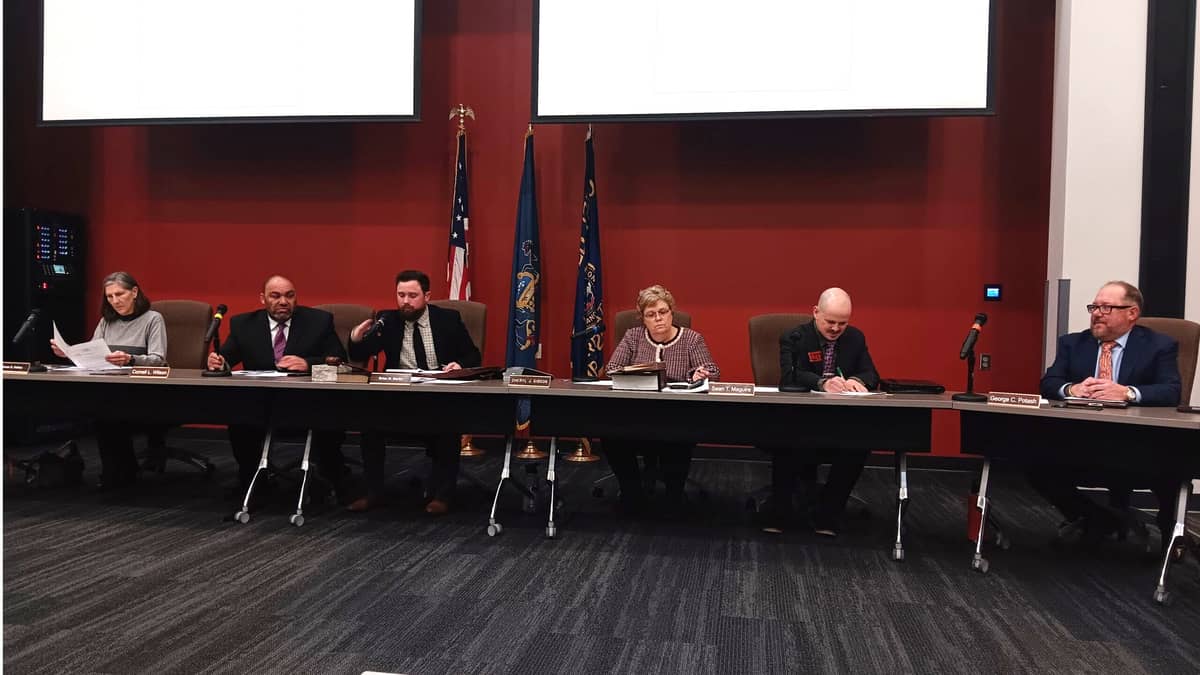
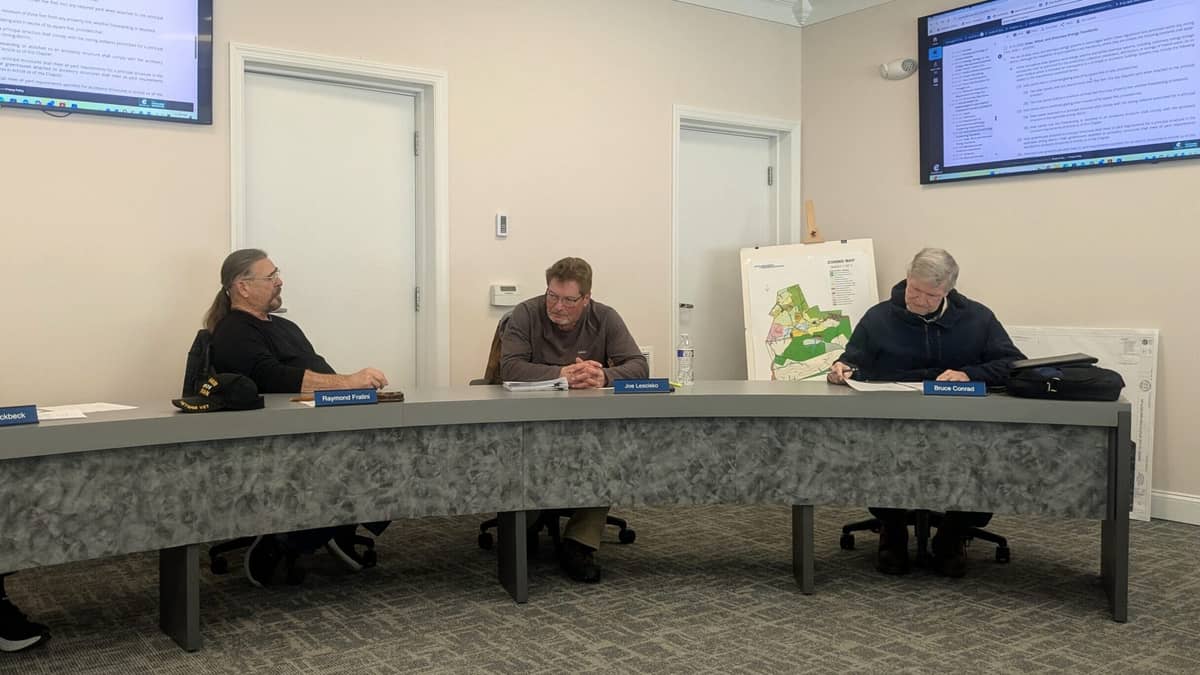
Cornwall Borough’s Planning and Zoning Commission unanimously agreed to pass on draft ordinances concerning data centers, solar and wind farms, camping, and blasting to council at a special meeting Monday morning.
The ordinance concerning data centers and solar/wind farms is an amendment to an existing zoning ordinance, which adds both uses as permitted uses in the general industrial (GI) and limited industrial (LI) districts by special exception.
Special exceptions are uses that are guaranteed by right, but a zoning hearing board must determine whether the use fulfills certain criteria. This also allows the borough to take a position for or against the special exception, as opposed to conditional uses, which are judged by a governing body that is expected to stay impartial.
The draft ordinance defines both uses and lays out specific requirements for both.
Zoning amendment concerning data centers, energy uses
Solar and wind farms
Windmills
The draft ordinance includes the following requirements for windmills as principal uses:
- Turbines must be located 1 and 1/10 the turbine height from any inhabited structure, property line, street right-of-way, or overhead utility line.
- Facilities must conform to industry standards.
- Operation cannot exceed 60 decibels at property lines.
- Associated electric and utility lines must be buried underground.
- Operations must include clearly visible warning signs and gated access.
- A certificate of insurance of no less than $1,000,000 must be provided to the borough.
The draft ordinance includes the following requirements for windmills as accessory uses:
- Setback distance increasing incrementally with maximum windmill height, with setbacks of 60, 65, 70, 100, and 125 feet for 35, 40, 45, 75, and 100-foot maximum windmill heights. The P&Z also discussed possibly requiring a minimum setback of double windmill height.
- Associated electric and utility lines must be buried underground.
- Operation cannot exceed 55 decibels at property lines.
- A certificate of insurance, of no less than $300,000, must be provided to the borough.
Solar energy systems
The draft ordinance includes the following requirements for large solar energy systems as principal uses:
- Documentation must be provided to the zoning hearing board for the hearing, including a site plan and decommission plan.
- Minimum lot size of 5 acres.
- Must be at least 50 feet from property lines and 115 feet from the centerline of public streets.
- Must be designed to prevent reflective glare toward inhabited buildings and streets.
- A certificate of insurance of no less than $1,000,000 must be provided to the borough.
The draft ordinance includes the following requirements for small solar energy systems as accessory uses:
- Ground-mounted panels must be at least 15 feet from side or rear property lines, following front-yard setback in accordance with zoning district plus 15 feet from the centerline of the street.
- Roof-mounted panels cannot extend above the peak elevation of the top of the roof, or in the case of a flat roof, the max height requirements for the zoning district.
- Permitted in any zoning district as an accessory use, subject to other requirements.
- Must only power principal use, excess power may be sold to a public utility in accordance to regulations.
- Mechanical equipment must be screened from view with a 6-foot fence or evergreen plantings.
Data centers
The draft ordinance lays out the following requirements for data centers, which are defined as buildings occupied primarily by computers and/or telecommunications equipment “where digital information is processed, transferred and/or stored, primarily to and from offsite locations.”
- Minimum lot size of 70 acres.
- Buildings and structures must be located at least 750 feet from any existing residential dwelling.
- Must include an at least 300-foot-wide landscape strip along all property lines, with no structures, storage, parking, or operation activity.
- Maximum height of 60 feet, though P&Z recommended this be changed to 45 feet.
- In the case of accessory uses, the height of the building must not be larger than the height of the principal building.
- The submission of documentation for the zoning hearing board including a sketch plan, traffic impact study, and water feasibility study if applicable.
- Must have certification that required electric and water capacity is available and permitted for the project.
- Sound must be limited to 67 decibels at property lines from 7 a.m. to 8 p.m. Monday through Friday and 57 decibels at all other times, determined via a sound study.
Lists of requirements above are not extensive.
The P&Z discussed the need to set requirements in a way that they could be met somewhere in the borough, because if requirements cannot be met, it is considered a form of exclusionary zoning and can be challenged by prospective developers. Board members used a property viewer to ensure the 750-foot required distance from residential dwellings for data centers could be met in LI or GI, and found that this could be met in the parcel next to Miners Lake.
However, this could change if the parcel is developed into a lakeside resort community (as has been proposed), as Pennsylvania’s Fair Share Doctrine requires there to be available developable land for uses.
The amendment also adds regulations concerning the removal and conservation of woodlands, including that developments located on woodlands must include a buffer zone of 20 feet, with no more than 25% of existing trees removed.
The P&Z has been working on this and other ordinances to prepare for the possibility of the submission of these types of use, which are not already accounted for by zoning. When a use is not included in zoning, a developer can attempt to push that use through in a zoning district legislators would not have wanted.
Camping ordinance
Another draft ordinance unanimously passed to borough council by the P&Z lays out regulations for activities included under camping.
It prohibits camping on any public or private property, except for “overnight camping on private residential property by friends or family of the property owner, so long as the owner consents and the overnight camping is limited to not more than two consecutive nights.” It also lays out an exception for historic encampments at the Cornwall Iron Furnace and storage of equipment in certain cases on the Lebanon Valley Rail Trail.
Commission member and councilman Bruce Conrad questioned the two-night limit, mentioning that some senior citizens who live in mobile homes will stop to stay with family for a week or two.
Chairman Ray Fratini said those people are not who he is concerned about, adding that he is more worried about campers who make a lot of noise.
Attendee Jeremy Zimmerman said he has relatives who do this, and said that if the ordinance will be enforced based on complaints, two-day limits could be abused by neighbors with a personal vendetta regardless of noise made by campers.
The draft ordinance notes that longer camping periods could be allowed by permit by the borough through the borough manager.
Borough manager Cody Rhoads noted that the ordinance could be made illegal if Pennsylvania House Bill 2028 passes, which requires municipalities that prohibit outdoor sleeping to provide sufficient indoor sleeping spaces before being allowed to enforce those ordinances. The bill posits that this type of legislation effectively criminalizes homelessness.
Rhoads added that the bill is unlikely to pass, which several committee members agreed with.
Blasting ordinance
The third draft passed on to council lays out specific regulations for blasting in the borough. Requirements include the following (non-extensive list):
- Contractors must retain a geologist to determine whether properties over 1,000 feet from the blasting location may be affected by the blasting.
- The developer must notify property owners within 1,000 feet of the blasting location (or the distance recommended by a geologist, whichever is greater), and offer them inspections before blasting begins conducted by a qualified independent professional.
- A permit will last 90 days and can be renewed for another 90 days by extension request.
- Contractors must tell the borough and residents (as applicable) the day before a blasting event.
- Contractors must follow state and federal laws concerning blasting, and provide the borough with documentation.
Mike Swank, representative of Cornwall Properties, questioned the process for extensions on permits. He asked whether an extension could be denied on basis of complaints received, noting that some complaints may be found not to be valid.
Borough engineer Jeff Steckbeck said that he would not withhold the permit on this basis as long as he had a response from the geologist. Complaints would be handled by state or federal processes, which include mechanisms to shut down blasting if it is found to be dangerous.
The board agreed to add the phrase “which shall not reasonably be withheld” for extensions.
Steckbeck said he was fine with the overall requirement of 1,000 feet, but said he recommended that the borough reduce requirements for utility trench construction to 200 feet, which Conrad said he had no problem with.
These ordinances, before being up for passage by council, must be advertised and subject to public hearings.
P&Z also briefly discussed several other items, including EV charging station regulation, blight ordinances, and an amendment to warehousing, though none of these items saw action. The commission also briefly discussed Airbnbs, which are generally not allowed in residential districts, but no action was taken.
They heard that Cornwall Properties has submitted a warehouse plan in its LI tract by Miners Lake, which Swank said was a fallback in case the Lake Resort Community does not go through. Discussion on the amendment, which creates a mixed-use overlay for “lakefront communities” and has been combined with language moving the warehousing use from LI to GI, has been paused while the borough is in talks with Elizabethtown Area Water Authority.
The borough is looking to acquire several small parcels of land around Miners Lake to allow for a bypass to accommodate additional traffic, though talks are still in progress. More information is forthcoming as talks proceed, Conrad said.
Cornwall P&Z meets the first Monday of each month at 6:30 p.m. It has also been holding a special meeting the second Monday of each month at 10 a.m. to discuss draft ordinances and legislation. These meetings are open to the public and do not require prior registration.
Questions about this story? Suggestions for a future LebTown article? Reach our newsroom using this contact form and we’ll do our best to get back to you.
Keep local news strong.
Cancel anytime.
Monthly Subscription
🌟 Annual Subscription
- Still no paywall!
- Fewer ads
- Exclusive events and emails
- All monthly benefits
- Most popular option
- Make a bigger impact
Already a member? Log in here to hide these messages
You know us because we live here too. LebTown’s credibility comes from showing up, listening, and reporting on Lebanon County with care and accuracy. Support your neighbors in the newsroom with a monthly or annual membership, or make a one-time contribution. Cancel anytime.