
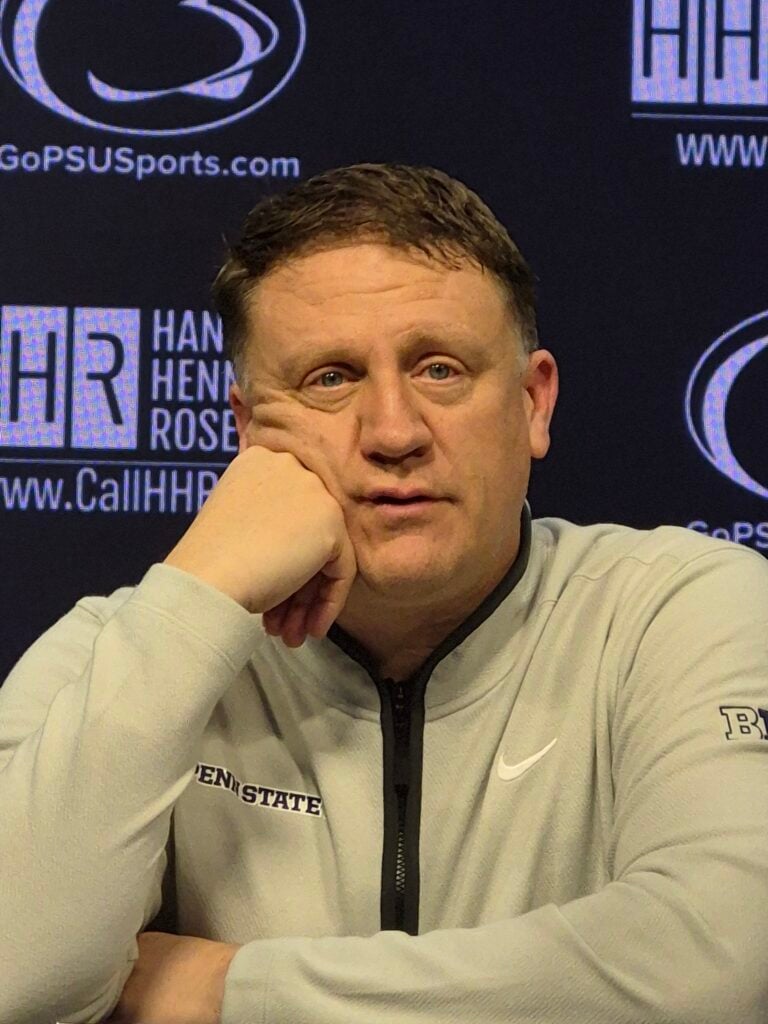
A recent Wednesday night in State College had proven to be another lost night in a lost season. And now Penn State men’s basketball coach Mike Rhoades trudged toward the Bryce Jordan Center interview room, looking exactly how he might be expected to look.
Which is to say, like a man headed toward the gallows.
Behind him was a ragged home defeat to Rutgers – a team just ahead of his own cellar-dwelling club in the Big Ten standings, but one that had proven to be shockingly superior on this night. Ahead of him were questions that would be spoken and unspoken – the former involving youth and execution and turnovers and defense, the latter the thorny overarching issue of whether any hoops coach is capable of finding consistent success in Happy Valley.
And then there was the one about his mood. About how the former Lebanon Valley College point guard – a guy who won a Division III national championship there, and before now had won everywhere he had coached – is handling a wretched season like this one, which to date finds his team 11-17 (2-15 in the Big Ten).
Read More:
- (Oct. 2024) LVC grad Mike Rhoades, a man on the run, tries to get Penn State up to speed
- (Oct. 2024) Sellout at LVC as Dutchmen great Mike Rhoades brings D1 hoops to Annville
- (Sept. 2023) Unveiling ‘The Dutchmen’: Documentary reveals untold stories of Lebanon Valley College’s 1993-94 championship run
- (April 2023) Here’s how the LDN covered new PSU men’s basketball coach Mike Rhoades while he was a standout player at LVC
“It’s hard,” he said. “It’s frustrating. It hurts. But nobody’s coming to save us. You’ve just got to keep plugging away.”
Nobody’s coming to save us – that single sentence carried a lot more meaning than Rhoades intended. A day earlier, a five-star backcourt recruit named Dylan Mingo – brother of PSU point guard Kayden Mingo – had announced on ESPN that he intends to play next year at North Carolina, having chosen the Tar Heels over Penn State and his other finalists, Washington and Baylor.
And, well, of course that was his choice. UNC is UNC, the bluest of the blue bloods. And PSU is PSU. A football school. Also, in the winter time, a wrestling school. And a hockey school.
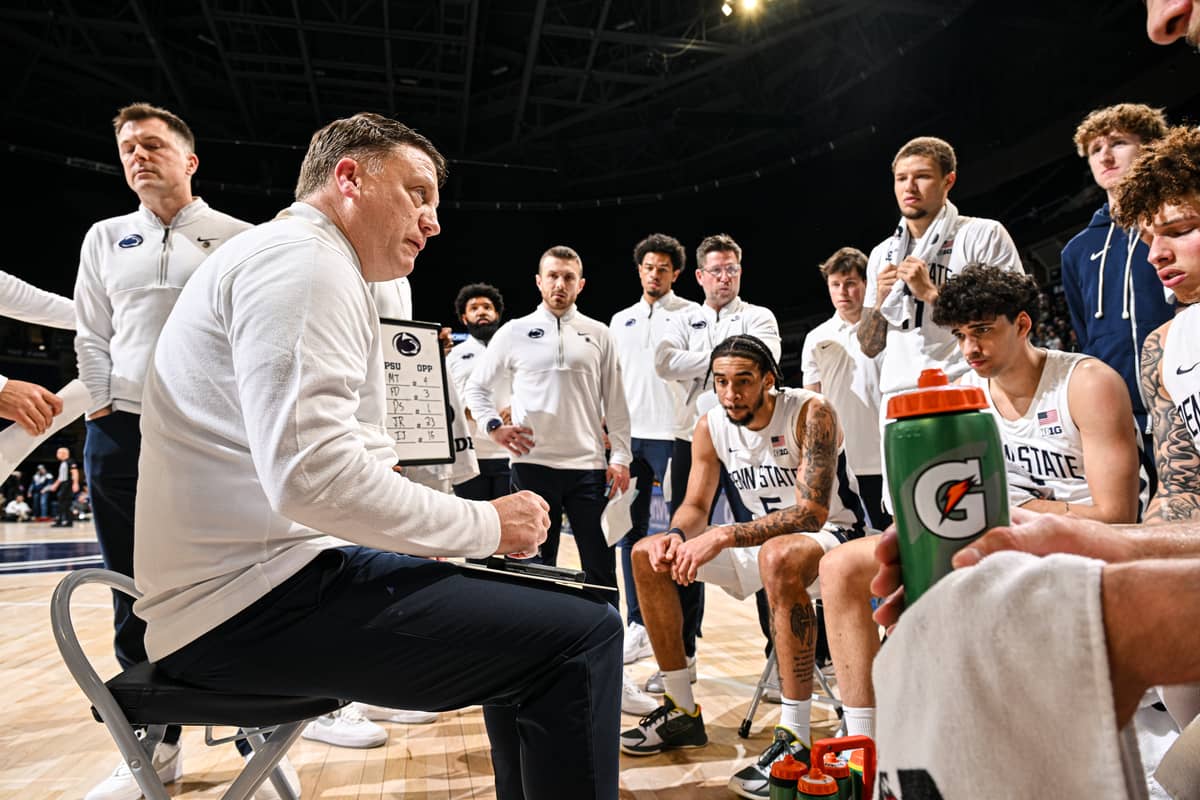
Basketball? Meh. Rhoades, 53, is another in a long line of coaches who was brought in to improve the Lions’ fortunes, only to discover just how difficult that can be. He is in the third year of a seven-year contract, one that will ultimately pay him $25.9 million. And PSU, 16-17 and 16-15 his first two seasons, is now spiraling downward, having followed up that 85-72 defeat to the Scarlet Knights with an 87-64 embarrassment at Nebraska.
That was the seventh game this season the Lions have lost by 21 points or more, three of them to sub-.500 teams. While it’s true that they were competitive in losses to top-tier teams like Michigan and Michigan State, there have been far more nights like the one against Rutgers, where PSU fell behind 11-0 and 16-2 and was down by 20 early in the second half.
The Lions tried to make a game of it, but after narrowing the gap 11 later in the half they allowed Knights guard Darren Buchanan Jr. to weave 60 feet through their press for an uncontested layup. And with PSU again within 11 moments later, the Lions forced the Knights’ Harun Zrno to hoist a contested 3-point attempt with the shot clock ticking down, only to see his teammate, Dylan Grant, reclaim the miss and score.
PSU finally cut the margin to eight with 2:54 to play, but could get no closer.
“We had a couple possessions on defense that really hurt us,” Rhoades said.
The Lions are in fact young. Two of their best players, Mingo and center Ivan Juric, are freshmen. And the team does have glaring weaknesses. The Lions are ranked 357th among the nation’s 361 Division I teams in field goal percentage defense (.498), 354th in rebounding (29.7 a game) and 302nd in 3-point percentage (.318). But their biggest shortcoming might be funding, a fatal flaw in the era of Name/Image/Likeness (NIL), revenue-sharing and the like.
Everybody bankrolls their rosters now, but the playing field is hardly level. While the exact dollar amounts funneled into each program remain a closely guarded secret, CBSSports.com’s Matt Norlander dug deep last April in an attempt to ascertain what kind of cash is being thrown around.
What he discovered was that 10 Division I teams, including Michigan and Indiana of the Big Ten, are investing at least $10 million into payroll. Fourteen other schools have around $8 million at their disposal. Such Big Ten teams as Purdue, USC and UCLA are on that list.
Penn State, meanwhile, has around $3 million, according to Pennlive.com.
This has all come in the wake of a 2021 Supreme Court ruling that allowed players to be paid for the use of their name, image and likeness, and a 2025 ruling that enabled schools to share revenue with athletes. But as an anonymous coach told Norlander, the result is a system that doesn’t involve “real NIL.”
Rather, the coach said, “It’s donors just paying out there to get the best team.”
It was an open secret that athletes received under-the-table payments for years, of course. But the running joke these days is that NIL stands for “Now It’s Legal.”
Pardon Rhoades if he isn’t laughing. But neither can he talk publicly about the dollars-and-cents aspect of college sports. Rather, he just has to address the on-court issues as best he can, by doing what he has always done – rolling up his sleeves and putting in the work.
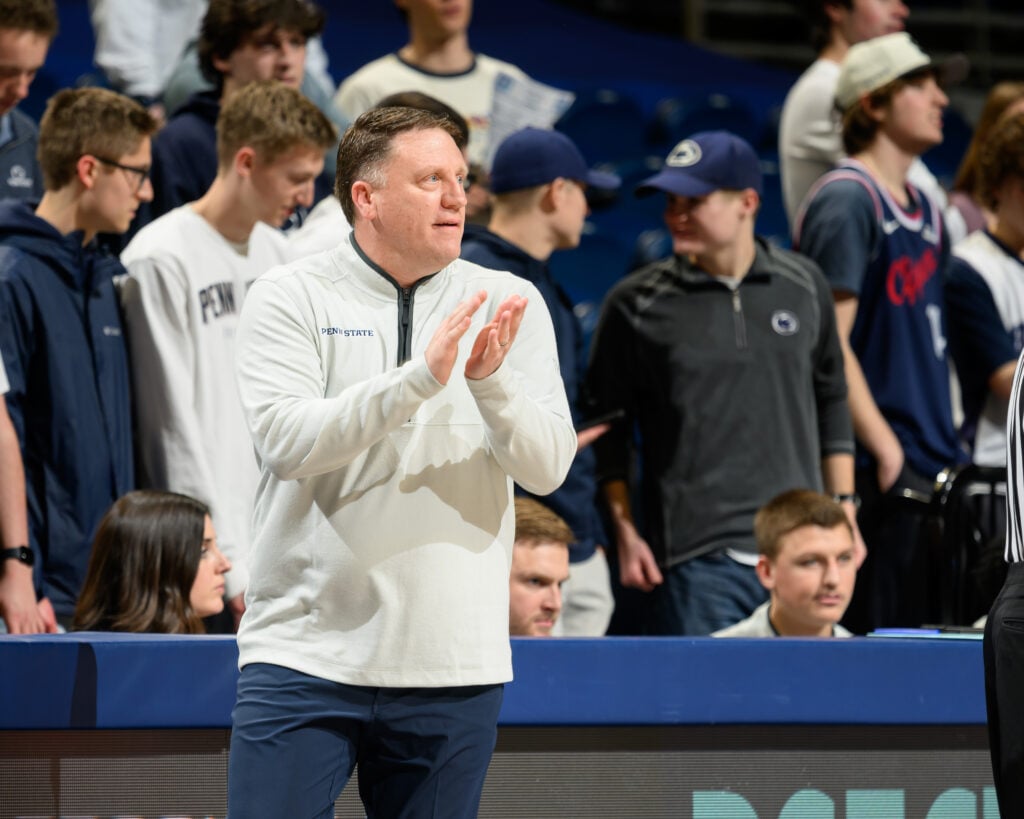
This is a guy who while playing at LVC would routinely go on night-time runs that took him through the cemetery that abuts the campus. Also a guy who would leave his teammates shaking their heads when he interrupted his weekend revelry to go work out.
So now, he said after the Rutgers game, “You keep hammering away on the rock.”
While that’s laudable, it only takes a coach and a team so far. You’ve still got to have the horses, and you have to have the resources to bring them into the stable. In other words, somebody is in fact going to have to come and save them, preferably with checkbook in hand.
Former Annville-Cleona boys’ basketball coach Scott Pera is in his first year as Penn State’s general manager, and according to his official bio, his job includes the “development of NIL networks.” While he didn’t disagree with the above assessment, he quickly steered the conversation elsewhere.
“You just look at the youth of our team, it tells you all you need to know, in terms of where we are with that,” he said. “We are optimistic that they will be better this spring. Now it’s imperative that we keep the core of this group together.”
Which underscores another challenge – the transfer portal. Kids flee all the time now, whether for greener pastures or bigger paydays. That being the case, Pera was asked how much Rhoades and Co. have to re-recruit their players every year.
“You would hope how you treat them and what your culture is, is a recruitment,” Pera said. “But yeah, it’s so hard to build relationships, but Mike has done a great job of that with Kayden Mingo and the other freshmen that you hope that somewhere if they would get offered some more money, that that stuff matters.”
And indeed, Rhoades believes that if nothing else, he has surrounded himself with players who are good people. His guys show up on time, he said after the Rutgers loss. They’re coachable. They put in the extra work, and take care of their bodies.
“They do it right,” he said. “I commend them on that, because usually when this happens, things fray.”
It falls on Pera, meanwhile, to keep the head coach from fraying. He and Rhoades have known each other since the mid-’90s, when Rhoades was playing at Lebanon Valley and Pera was an assistant at Palmyra. That was his last stop before his five-year stint as the head coach at A-C, which included a state-title run in ’98-99.
They reconnected when Rhoades hired Pera as his associate head coach at Rice in 2014, and worked in concert through the 2016-17 season, when the Owls won 23 games, second-most in program history.
Before that, Rhoades had won 72% of his games in 10 years at Randolph-Macon. Afterward, he won 68% of his games in six years at Virginia Commonwealth. (He had begun his coaching career as an assistant at R-M, and spent time as the associate head coach at VCU as well.)
When Penn State came calling in 2023, it seemed like a perfect fit. Besides being a proven winner, Rhoades was a Pennsylvania guy, from Mahanoy City. Surely, the thinking went, he would awaken this long-dormant program.
But reality has slapped him in the face this year, and Pera does his best to foster him through the tough days.
“As my friend, I just worry about his state,” Pera said. “I know how passionate he is about this place.”
He also knows how driven Rhoades is, and how losing gnaws at him. So Pera said he tries “to keep him in a good frame of mind.” Sometimes that means being a good listener. Other times that means being “a truth-teller,” as Pera put it.
Pera knows whereof he speaks, having served as a head coach not only in Annville but at Artesia High School in California, where future NBA star James Harden was among his proteges. He also succeeded Rhoades at Rice – another challenging situation – and went 96-127 over seven seasons.
“I feel his pain, literally,” Pera said.
He believes the two of them are similar in many ways – that every loss weighs on them, that falling short leaves them feeling as if they are letting people down. So Pera finds himself giving pep talks, too.
As he put it, “I try and tell him, ‘If people love you, they love you. You didn’t become a worse coach, Mike, overnight. You’re a damn good coach, and you didn’t get worse coaching this year.’”
Nice of him to say, but it might be difficult to believe on nights like that recent Wednesday. While heaping praise upon his players afterward, Rhoades veered elsewhere for a moment.
“Just not good enough,” he said, “and it’s on me, man. I’m the coach. I’m the leader of this program. We’ve got to find a way to keep getting better.”
A short time later he headed out the door and down a corridor, trailed by two staffers. Rhoades walked past several framed basketball jerseys that hung on a wall to his right, honoring not former players but the entertainers who had performed in the Jordan Center – Bruce Springsteen, Taylor Swift, Jay-Z, and the like.
Then he opened a door and headed down another hallway, toward his office. There was work to be done. There were answers to seek. And more than anything else, there was a truth to ponder, about the financial realities that loom over every coach and every program.
Questions about this story? Suggestions for a future LebTown article? Reach our newsroom using this contact form and we’ll do our best to get back to you.
Support Lebanon County journalism.
Cancel anytime.
Monthly Subscription
🌟 Annual Subscription
- Still no paywall!
- Fewer ads
- Exclusive events and emails
- All monthly benefits
- Most popular option
- Make a bigger impact
Already a member? Log in here to hide these messages
Strong communities need someone keeping an eye on local institutions. LebTown holds leaders accountable, reports on decisions affecting your taxes and schools, and ensures transparency at every level. Support this work with a monthly or annual membership, or make a one-time contribution. Cancel anytime.