
This article was funded by LebTown donors as part of our Civic Impact Reporting Project.
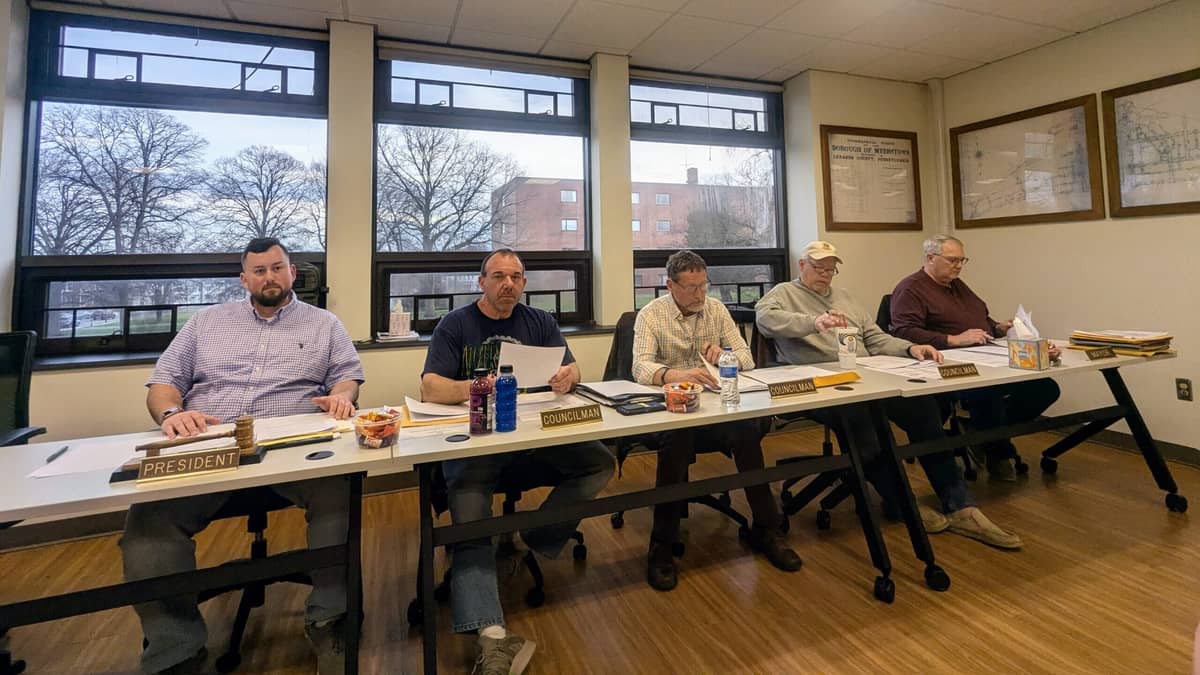
Myerstown Borough Council discussed a potential ordinance change to allow chickens in more of the borough and discussed a coverage offer from Lebanon County Regional Police at a 3 1/2-hour, non-voting workshop March 25.
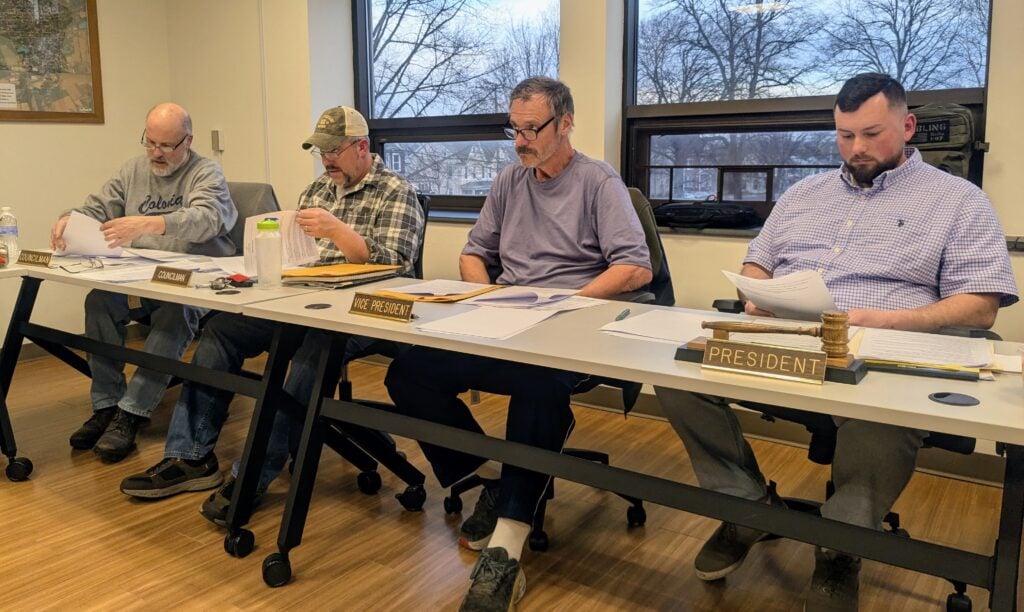
Council members reviewed a memo from solicitor Amy Leonard concerning possible amendments to the zoning ordinance expanding chicken allowances in the borough.
As of now, chickens are only allowed in Myerstown lots over an acre in size. Councilman Mark Kirsch said he ran for council two years ago after the restriction on chickens was passed and he was told to get rid of his chickens. At that time, he said, he met with a constitutional lawyer who told him the ordinance was unconstitutional.
“You can’t keep people from growing their own food; it’s a constitutional, God-given right to grow your own food,” said Kirsch. “If anyone takes [the current ordinance] to federal court, nobody’s gonna be able to put anything against them because they’re not considered non-domesticated anymore. They’re backyard chickens, they’re the same as a rabbit. People have rabbits in the borough.”
Councilman Matt Mulvaney said the ordinance protects borough residents who do not want to deal with smells, sounds, or other issues, such as chickens hopping fences and wandering onto neighbors’ property. He also said he is concerned about avian flu, though Kirsch said the risk is not substantial for residential chickens.
Kirsch said good chicken-keepers can dispose of manure without creating long-lasting smells, and said many other issues are no different than can those caused by dogs, which can also leave a property and generate excessive noise.
He said the borough would still need to regulate chickens to ensure residents keep coops clean (with proposed regulations including sanitation, setback and distance from waterway requirements, adequate coop space, and roosters prohibited in lots smaller than an acre). Free-range would only be allowed in large lots.
Councilman Bryan Rittle responded that “nobody is gonna keep them clean.” Councilman Todd Kahl replied that “not everybody is a slob who lives in Myerstown.”
Mulvaney asked if borough residents actually want chickens, to which council president Daniel Ebling said they heard the request frequently while door-knocking prior to last year’s primary. Mulvaney said he could not confirm that, and Todd Kahl said he could if he had knocked on doors alongside the other candidates.
Mulvaney said chickens could decrease property values. Ebling said he felt it could increase property values.
Mayor Dane Bicher said he talked to his nephew who keeps seven chickens in Richland Borough, who told him that after the first year he ran out of places to put manure. Bicher said he is concerned about improper disposal of manure on small properties in town, which he said could cause problems for people nearby. He also said he is worried about residents who do improperly store chicken food and attract wild animals.
He said he felt the allowance of roosters on one-acre lots was not strict enough, and said Richland’s ordinance only allows them in three-acre lots due to noise. Kirsch said he agreed with Bicher’s concerns about roosters.
Kirsch said improperly stored dog food also attracts pests. When he had chickens, he said, he had far fewer mosquitos on his property and they deterred feral cats.
A resident asked if she would be held responsible if a chicken wandered onto her property and her dog killed it, and Kirsch said she would not.
In an informal roll call, councilmen Ebling, Bradley Kahl, Robert Fullenlove, Todd Kahl, and Mark Kirsch said they are interested in continuing discussions at a future meeting. Mulvaney and Rittle said they are not. Ebling said he will direct Leonard to attend their next workshop to advise on the topic.
Council also discussed a $300,000 offer for contracted services with Lebanon County Regional Police Department, following a town hall on policing options Feb. 21.
Read More: (Feb. 2026) Myerstown Borough Council hears public input on police coverage options, costs
At that meeting, meant to gauge public opinion, Ebling laid out his cost estimates for options including the formation of a police department in Myerstown or an Eastern Lebanon County regional department. Most resident perspectives expressed at the meeting were in favor of LCRPD’s proposal, which includes 20 weekly hours of patrol time and 24/7 calls to service in a three-year contract.
LCRPD said if the offer is taken, 24/7 coverage will start immediately, though they will need time to hire new officers for patrols. Kirsch said he wants more information from the department on costs before patrol time is added before coming to a vote. He also said he wants to ask if the three-year contract was set in stone.
Ebling has since said he feels some residents may have felt intimidated from speaking at that meeting, and the meeting only represented around 2% of the borough’s population. He said he wants to pursue a feasibility study for the establishment of a local one-officer department or an ELCO department.
Rittle said feasibility studies have already been conducted, including a 2021 Richland Borough study that examined potential costs for a Richland-Myerstown department (estimated cost for 24/7 coverage ranging from $507,000 to $647,000 annually) and a study by Northern Lancaster County Regional Police Department. He questioned the possible cost of conducting another study.
This study, borough manager Michael McKenna said, estimated costs for a regional department (including Myerstown Borough, Jackson Township, and Richland Borough) at $2,682,042 for the first year for all participating municipalities, including start-up costs. The study estimated that re-establishment of the Myerstown Borough Police Department would cost $1,234,952 for full-time coverage (eight full-time officers including a chief and sergeant) or $761,852 for a chief, two full-time officers, and four part-time officers, start-up costs included.
Mulvaney asked if Ebling had read both studies. Ebling at first said he had not, then said he may have. Mulvaney questioned the estimates Ebling provided at the public hearing and why he had not consulted the feasibility studies.
Ebling said the old studies were both out of date and did not study the specific structure he would like to implement. He said the study does not estimate costs beyond year one or take into account possible grant funding. He also said prices were at a peak in 2021, to which Kirsch responded that prices have increased since then.
Ebling said the goal of police coverage is largely to enforce ordinances (which the state police is often unable to enforce), and that speeding could be successfully addressed by one officer.
Rittle said no officers would be interested in serving on a one-officer department, both due to lack of promotion opportunities and lack of backup. Ebling said the goal would be expand to more officers as time goes on, and bring other municipalities on board once the department is established.
Mulvaney said Jackson Township is not interested, and said most residents he has talked to want to go with LCRPD. He said that, as other municipalities come on board with the department, costs may go down or increase less term-to-term than expected.
“I just don’t understand why it’s so obvious to everybody else, but you are just hell bent on doing it your way,” Mulvaney told Ebling.
Ebling said he is worried about risks involved with the LCRPD’s offer, including the possibility of a rate increase after three years and the inability to pull out mid-term.
“They told us, in the meeting that you were at, the reason that they’re giving us a discounted price under what it’s going to cost, so that Jackson jumps on board,” said Ebling. “We are the guinea pig for Lebanon County Regional, and then once they sign on board, guess what? If we go Mark’s way (paying LCRPD costs out of reserves without raising taxes) and we spend all of our money and four years comes? We won’t have enough to start up our own force, and if they jack our price from $300,000 to $600,000, well, they can do whatever they want.”
Bradley Kahl said the LCRPD’s plan would leave the borough with three hours of patrolling per day (20 hours per week). Bicher said the borough would still receive 24/7 coverage of calls, though Ebling said LCRPD will not guarantee response time, which could be 10 or 15 minutes. Kirsch said the department originally estimated a 5- to 7-minute response time, and Mulvaney said the department said response time would be “tops, 10 to 15.”
Bicher said one full-time officer would leave the borough with state police coverage 16 hours a day, which residents have complained is inconsistent and slow.
Todd Kahl said his grandson was threatened at knifepoint, and state police responded the next day. Bicher said this would not be fixed with a one-officer force.
McKenna responded to a question about whether the state police will begin charging for services by noting the question is tossed around by state lawmakers every few years. In 2021, he said, the proposed charge would cost the borough $43,737 annually, though this was not ultimately adopted.
Mulvaney said general consensus among residents is that the borough should go with the LCRPD offer.
“We did have that meeting, Daniel, and I think we should go the way the residents want to go,” said Todd Kahl, though he added he felt the LCRPD agreement would ultimately fail.
Ebling said he was looking to renegotiate with LCRPD to ensure event coverage, guarantee attendance of council meetings, place requirements on response times, and address the price point. He said he felt new councilman Fullenlove should be involved in these discussions, as he has no background on the topic. Bradley Kahl said he felt the conversation was being “shoved down [his] throat” as a new councilman, and he felt pressured to make a decision without time to consider options.
No action was taken, but council plans to continue discussions.
Background on policing in Myerstown
Myerstown Borough has relied on services from the state police since 2014, when it dissolved its department.
Rittle, the only current member of council to have been on council at the time, said the three-officer full-time department was dissolved in part due to the officers’ contract, which he said was skewed in favor of the officers and did not benefit the borough. Active officers at the time retired and continue to receive pension benefits from the borough to this day.
Five years ago and receiving community push for a police department, the borough increased real estate taxes by .42 mills with the intent of saving toward a police department.
Former council president Park Haverstick said that, though the intent was to save $160,000 (based on 95% collection, $165,000 base expectation) each year, the borough set aside more than that some years and less in others. Pool renovation expenses have led to less being saved the last three years. These savings are stored in the general reserve fund. These are the amounts that have been added to this fund since 2021:
- 2021: $200,000
- 2022: $180,000
- 2023: $180,000
- 2024: $135,200
- 2025: $135,200
- 2026: $135,200
As of Nov. 30, 2025, the general reserve fund held a balance of $1,120,232, with council stating this fund is primarily to be saved for police coverage. Since that time, the borough has explored various options, including coverage from an existing department or starting a new one.
However, previous councils maintained that start-up costs for creating a new department were prohibitive for a borough of Myerstown’s size.
Rittle said Saturday that a 2021 study by North Lancaster Regional Police estimated that, to create a precinct in Myerstown with five officers to provide full-time coverage, the borough would have $1.3 million in start-up costs. Rittle said if this were adjusted for a part-time department, he would expect start-up costs to decrease to between $700,000 and $800,000.
Since 2021, borough conversations with other police departments have led to similarly high cost estimates.
Rittle said South Heidelberg Township estimated, for full-time coverage of Myerstown and Richland boroughs (four officers, a station supervisor, and 24-7 coverage), the boroughs would share $780,000 in annual costs, which would leave Myerstown with between $507,000 and $647,400 in cost depending on method. These numbers were detailed in a 2021 email exchange shared by Rittle after the meeting, which also noted there would be additional start-up costs.
However, previously conducted feasibility studies are not considered public record or shared with members of the public, so these numbers cannot be confirmed.
Following the official merger of North Cornwall and North Lebanon into the Lebanon County Regional Police Department at the start of 2025, council began discussions with the department on possible coverage.
Read More:
- (Dec. 2024) Officers sworn in for service with new regional police department [photo story]
- (Sept. 2025) Myerstown Borough explores coverage from Lebanon County Regional Police
- (Oct. 2025) PA Lt. Gov. Austin Davis meets with reps of Lebanon County Regional Police
- (Jan. 2026) Myerstown reorganization gets heated as four new members are sworn in
A previously proposed offer for coverage, not released to the public, was above what council was willing to pay, and the department’s governing commission asked Myerstown to present a number it was willing to pay annually toward policing.
The proposal detailed by Knight above was developed by the commission in response to a borough response that it could pay $300,000 per year.
In other news, council:
- Agreed to cancel this year’s Easter Egg Hunt, which was planned for March 28, after approving it at last month’s meeting but deferring discussions as to who would prep it. The event is typically planned and enacted by council members, including time spent filling around 4,000 eggs with candy, and council members said they did not have time to do all the preparation in two days. Council plans to discuss the event earlier in the year next year to ensure it is planned.
- Discussed multiple event requests and potential policy decisions, which will be further discussed in future workshops and at their regular monthly meeting.
- Unanimously approved minutes of their Feb. 21 and 25 meetings.
Council holds its regular meeting the second Tuesday of each month at 6:30 p.m. and a workshop the fourth Wednesday of each month at 6:30 p.m. These meetings, held at 101 S. Railroad St., are open to the public and do not require prior registration.
Questions about this story? Suggestions for a future LebTown article? Reach our newsroom using this contact form and we’ll do our best to get back to you.
Be part of Lebanon County’s story.
Cancel anytime.
Monthly Subscription
🌟 Annual Subscription
- Still no paywall!
- Fewer ads
- Exclusive events and emails
- All monthly benefits
- Most popular option
- Make a bigger impact
Already a member? Log in here to hide these messages
An informed community is a stronger community. LebTown covers the local government meetings, breaking news, and community stories that shape Lebanon County’s future. Help us expand our coverage by becoming a monthly or annual member, or support our work with a one-time contribution. Cancel anytime.