We’re celebrating Lebanon County’s role in American history. Read more here.

They may be called Kentucky long rifles, or Kentucky rifles for short, but some of those firearms were crafted during the 1700s and 1800s in Pennsylvania, including by several Lebanon County gunsmiths.
Historian Henry Kauffman credits German immigrant Martin Mylin with producing the first Pennsylvania long rifle in Lancaster in the early 1700s. The weapon’s rifled barrel made it the most accurate and longest-range firearm in early American history.
Three of the most prominent local gun makers of that style of weapon – John Philip Beck, Nicholas Beyer and Peter Berry – lived in areas that would one day become Lebanon County, according to Kentucky rifle expert Steve Hench.
At that time, most of the areas that would become Lebanon County in 1813 were still part of Lancaster County.
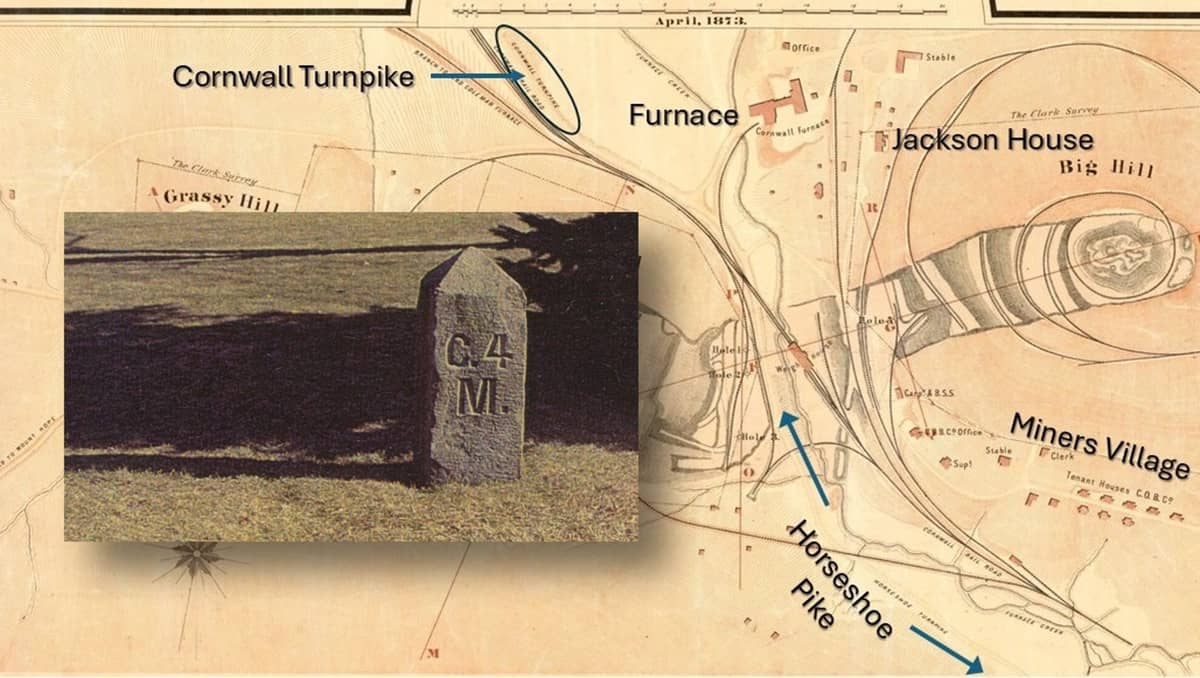
“In fact, one of the most famous Kentucky makers was John Philip Beck, and he signed his guns J.P. Beck. He lived in the area of Coleman’s Furnace in the Cornwall area. Peter Berry worked in the Annville area. Lebanon County was part of Lancaster County in the very beginning,” according to Hench. (Historians say Beck was from Lebanon.)
Beyer was also based in the Annville area, and Martin Shell Jr. of Shellsville (near Grantville in East Hanover Township) was another prominent gunsmith who lived near the county line in modern-day Dauphin County.
Hench said Pennsylvania rifles, which later became widely known as Kentucky rifles, were initially created around the area of Bethlehem by Moravian sect members.
Local Moravian member John Klahr of Fredericksburg said all he knows about the Moravian ties to the firearms is a school in Bethlehem taught the craft to its students.

Hench said the firearms were first developed in that part of the state and that the movement drifted westward as colonists settled in what is now the Lebanon Valley.
“There were other gun makers, of course. But those are the most prominent in the area,” Hench said.
J.P. Beck & family
“I would consider Beck to be the Rembrandt of the Kentucky rifle makers,” Hench said.
Hench said Beck long rifles, also known as Beck flintlocks, are a work of art – especially since he put different designs on every gun that he created along with his signature. A common trait for many gunsmiths was to put their own designs on the firearms they made since they were expert craftsmen.
“John Philip Beck was a master engraver. So sometimes the hardware on his brother’s guns, which would not be signed, would have J.P. Beck’s engraving. In other words, he had a style of engraving. like anybody who has a skill or a certain aptitude, and you recognize them by their handiwork,” Hench said.
The Beck family lineage is quite extensive and a number of the family members were involved in the firearms industry, according to the website beckflintlocks.com.

J.P.’s father, Johann Christian Beck, was a gunpowder maker whose two sons, J.P. and John Christian Beck II, were either involved in gunsmithing or whose children kept the family tradition alive.
According to the Beck flintlock website, “John Phillip Beck (1751-1811) was a master gunsmith in Lebanon, PA. J. P. Beck took the oath of allegiance to Pennsylvania in 1778 and was paid to repair arms in Lancaster County for the militia from 1777-1781. J.P. Beck trained his son Christian, Beyer and Simon Lauck in the art of gunsmithing.”
J.P. Beck’s son Christian was among many Beck family members who worked in the industry.
“Born in 1782, Christian Beck was the son of J.P. Beck, from whom he learned the trade of gunsmithing. He died in Jonestown in 1861 at the age of 79. He continued the style of gunsmithing as he was taught. Except for the signature on the barrels his rifles are nearly identical to the work of J.P. Beck.” The Beck website indicates that while tax records for Christian are incomplete, it is believed that he lived most of his life in Jonestown.
A Lebanon County Historical Society spokesman said historic records concerning local Pennsylvania rifle gunsmiths are limited to short biographies.
Another Beck family member, Christian Beck III, was the nephew of J.P. Beck, and was born in 1787. He apprenticed in the trade of gunsmithing from John Bonewitz in nearby Womelsdorf, Berks County. He worked in the Womelsdorf area until about 1808 when he briefly relocated to Adamstown, Lancaster County, where his first son was born.
An article by Van Pitman that was published by the Kentucky Rifle Association titled “Christian Beck of Jonestown” contains a great deal of research on Christian Beck.

Pitman confirms that Christian Beck studied under father J.P. and adopted many of his styles.
“The rifles of Christian Beck retained the characteristics of his father’s JP Beck’s rifles. He used the same hardware as his father utilizing the butt plates, side plates, trigger guards, and ramrod ferrules,” writes Pitman, adding that “several common features found on Beck’s rifles, including the style of patch box, with the side plates extending beyond the hinge, the butt plate extension molding, using a double line at the end, the single rivet towards the upper corner of the patch box lid, and finally the style of engraving that J.P. Beck used on his rifles.”
Christian’s craftsmanship mirrored his father’s in other ways, too, according to Pitman.
“Another similar feature that Christian Beck of Jonestown carried from J.P. Beck is the style of the trigger guard, using the double raised half octagon at the junction of the bow and rail and two slashes at the end of the front of the trigger guard extension,” he wrote. “Another major feature shown between father and son is the side plates. You can generally share a similar outline and they have a beveled edge on the perimeter of the plate.”
Christian was consistent in his craftsmanship.
“The architecture of Christian’s rifles varied very little over time, some having a small Roman nose profile to the comb and typically they were reasonably straight. The carving, though well executed, didn’t show a lot of deviation with only a few examples that varied from a common inverted C scroll he used. One characteristic thankfully is that his signature didn’t change which helps in identifying his rifles. He signs his barrels C back in script with a four-pointed star in the middle. His engraving work is excellent, generally hard to distinguish from J.P. Beck’s work.”

Nicholas Beyer
The Kentucky Rifle Association states Nicholas Beyer (c.1780-1850) is regarded today as one of the grand masters of the late golden age of flintlock riflebuilding. Beyer was most likely an apprentice of J.P. Beck.
Beyer worked near Annville at the dawn of the 19th century and produced many fine guns. His patchboxes often feature a bird finial, and his general style suggests strong “Pennsylvania Dutch” folk influence.
Beyer rifles are in some of today’s best collections, and specimens can be found with either full-octagon or octagon-to-round barrel configurations.
Many of his barrels are inscribed boldly on the top facet “N. Beyer.” Along with J.P. Beck, Beyer occasionally marked “INRI” or “DEO” on the underside of his barrels. He was a masterful woodcarver and capable engraver.
The federal census of 1850 lists, “Nicholas Beyer, age 70, among those dwelling at the almshouse in South Lebanon Township. As no death or burial records have been found for Beyer, it is probable that the old master was buried in a Potter’s Field.”
Long rifle uses
Hench said the weapons were created to hunt game and for shooting contests, a popular way to be entertained in the 1700s. They weren’t, however, a primary weapon used during the Revolutionary War.
“They were an adjunct weapon,” Hench said. “In other words, rifle companies could fire at the British soldiers at a long distance. The only problem was the British soldiers had bayonets on their weapons. Until the riflemen could reload, let’s say a second or a third shot, the British regulars were upon them. So they (long rifles) were ideal in a defensive position. They were not an offensive weapon.”

What’s in a name?
Hench said the story of how Pennsylvania rifles became known as Kentucky rifles is attributed to settlers who moved west from Pennsylvania on the Ohio River.
“Immigrants poured into the country and they headed one of two ways, either south down through Hanover and on down to North Carolina, or most of them headed west, out towards Pittsburgh, to get on the Ohio and go to the Ohio country,” Hench said. “Well, at some point in time, these families were on these flat boats that might have had cabins on them, and the people referred to them as Kentucky boats.”
Kentucky’s name was not just reserved for those boats.
“Then they noticed that these immigrants were carrying rifles that were primarily made in eastern Pennsylvania, primarily in Lancaster, Lebanon, and Dauphin County,” Hench continued. “Somebody said ‘Look, they’re carrying their Kentucky rifles with them.’ So that’s how that got started. The fact that they were headed down river, the Ohio River into Kentucky, when Daniel Boone was one of the forerunners of the colonists that went down there.”
Questions about this story? Suggestions for a future LebTown article? Reach our newsroom using this contact form and we’ll do our best to get back to you.

Support Lebanon County journalism.
Cancel anytime.
Monthly Subscription
🌟 Annual Subscription
- Still no paywall!
- Fewer ads
- Exclusive events and emails
- All monthly benefits
- Most popular option
- Make a bigger impact
Already a member? Log in here to hide these messages
Local news is a public good—like roads, parks, or schools, it benefits everyone. LebTown keeps Lebanon County informed, connected, and ready to participate. Support this community resource with a monthly or annual membership, or make a one-time contribution. Cancel anytime.