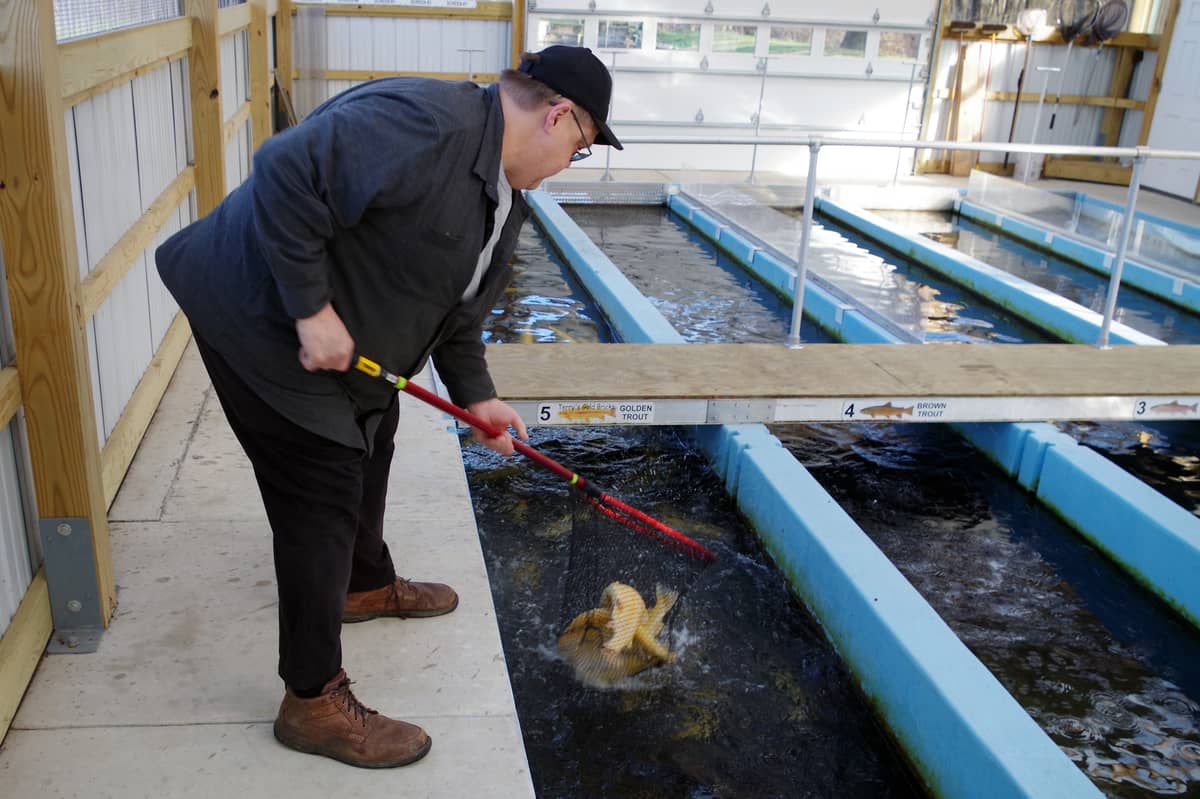

It’s not a top-secret program by any means, but that doesn’t mean it’s not a bit of a mystery nonetheless.
Pennsylvania’s trout fishing season is on the horizon, with the mentored day for youths 15 and younger on March 28 and the statewide opening day for everyone on April 4. More than 4 million trout – brooks, browns, rainbows, and goldens – will be placed in lakes and streams to support the action.

Seventy-five percent of those fish originate from Pennsylvania Fish and Boat Commission hatcheries and are delivered in familiar tanker trucks known as “The Great White Fleet.” The other 25% are “stealth” fish, and relatively few anglers know their origins.
The answer is local volunteers.
Sportsmen’s clubs mostly, but a few schools, too, raise and stock fish for public angling through the Fish and Boat Commission’s cooperative nursery program statewide. The agency provides them with roughly 3-inch-long “fingerling” trout each summer, between June and September. The clubs raise those at their own expense and in their own facilities for nearly a year before releasing them in waters open to public fishing.
“It’s really good for communities and helps all anglers out,” said Josh Keslar, cooperative nursery unit leader for the commission. “Our sponsors do a wonderful job. But their work doesn’t seem to be widely known, always.”
That’s not because it’s new. The co-op nursery program has been around since 1932, begun as a federal effort and adopted by the commission in 1965.
It’s not that it’s small, either. Keslar said there are 143 sponsoring clubs operating 160 nurseries across 49 counties. It’s just often under the radar, he said.
There are three cooperative nurseries raising trout in Lebanon County, run by Mill Creek Rod and Gun Club in Newmanstown, Fort Indiantown Gap Fish and Game Conservation Club, and Palmyra Sportsmen’s Association. All are long-time members of the program – Mill Creek’s been at it for 75 years, Fort Indiantown Gap 55, and Palmyra 45.
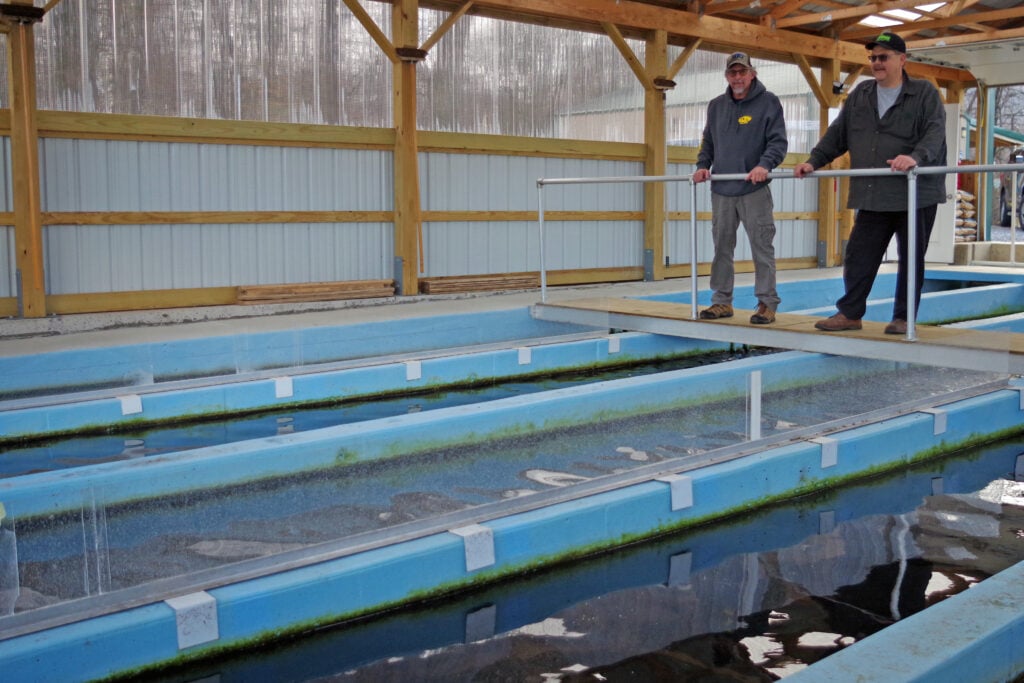
Talk to the people at each about what motivates them and the answers are largely the same. They all cite wanting to give back in ways that keep future generations of people interested in fishing and outdoor recreation.
“We do this because we like to see the happy faces of anglers and listen to their stories and see everyone enjoying the outdoors,” said Nicholas Hoffman, spokesman for the Fort Indiantown Gap club.
Then, too, it’s just fun. Trip McGarvey, who heads up the nursery program for Palmyra Sportsmen’s Association, said club volunteers who stock fish go above and beyond. Rather than just dumping the fish in places like Quittapahilla Creek at one of two convenient spots, they float stock the creek, wading with a giant barrel of fish in tow, to more equally distribute them across a greater stretch of water. It’s more work to do things that way, he said.
“But the volunteers love doing it,” McGarvey said. “There’s something about it. They seem to do it because it’s fun to do.”
Make no mistake, though, raising fish takes time, commitment, and money. Mill Creek and Fort Indiantown Gap produce roughly 8,000 trout each year; Palmyra turns out about 5,000 to 7,000.
Scott Adams, who runs the nursery effort for Mill Creek, said the fish must be fed twice a day, seven days a week. That’s year-round, too, since Mill Creek – like Fort Indiantown Gap and Palmyra – holds a portion of its fish back each year, to have some larger 2-year-olds to release later.
“I want to tell you, we have a really, really good group of guys that help out with the everyday operations,” Adams said. “They’re hard to come by sometimes.”
Clubs fund their own operations, too, paying for fish food, building and maintaining raceways – the long trough-like tanks that hold the fish – and whatever else they need.
Those costs can add up fast. Mill Creek, for example, has invested loads of money in its nursery in recent years, replacing concrete block raceways with ones covered in a polymer, putting the whole operation under roof, installing new and separate valves for each raceway, and more. The result is a top-notch facility that produces lots of quality fish.
“We get really good growth with our fish and really great results in terms of our output,” Adams said. “The anglers who know about what we do really seem to appreciate that.”
The Fish and Boat Commission co-op unit visits each club nursery multiple times a year to offer technical guidance, do health inspections, and check on the fish, Keslar said. The commission has a grant program that can help pay for nursery maintenance and improvements, too.
But clubs of necessity do a lot on their own, he added.
Some of the fish they raise go to support events. Mill Creek, for example, stocks some of its trout in the club pond for an annual children’s fishing rodeo. Palmyra donates fish to a similar event in Hershey. Co-ops across the state supported about 160 such events last year, Keslar said.
But the vast majority of the trout all three clubs raise go into local streams for everyone to enjoy.
What’s especially notable, here and across the state, is that those co-op fish often wind up in streams that don’t get trout otherwise. That’s not a hard-and-fast rule. Palmyra puts fish in parts of Quittapahilla Creek – the section that flows across club grounds, as well as the portion managed under special regulations in Quittie Creek Nature Park – that the commission also does, for example.
“But the benefit of the co-op program is that their fish don’t need to be stocked in the same locations the Fish and Boat Commission stocks,” Keslar said. “So they are able to provide additional fishing opportunities for their community.”
In that vein, Mill Creek Rod and Gun stocks Mill Race, which doesn’t get commission trout, as well as Mill Creek, which does. Likewise, Fort Indiantown Gap stocks Indiantown Run and – until the Marquette Lake dam rehabilitation project is complete – Shuey Lake. The commission also stocks the former, but not the latter.
That leads to lots of fish in lots of places.
“The first stocking, we’ll put 2,000 trout out,” Adams said. “And it’s not a really big area. A mile and three quarters, maybe two miles of stream. But it really is a great stream for trout because it’s all spring fed coming down the mountain, so the water’s usually pretty cool and holds fish. Guys fish that later on and find plenty of trout sticking around.”
The timing of co-op stockings is noteworthy, too. The Fish and Boat Commission starts putting fish out in February for opening day. It continues through May, but later stockings get smaller and less frequent.
Palmyra doesn’t start stocking fish until late April, then continues until about a week before Memorial Day.
“We begin putting our fish out about the time the state is winding down,” McGarvey said.
That leads to more good fishing later into the year. And that’s what the co-op program is all about, Keslar said. It lets people with a passion for fishing – who want to share that and pass it along to new generations in particular – pitch in and do so in their own backyards.
That’s why the commission remains committed to the program long term, he added, even if there’s room for more people to learn about it.
“It’s really good for the community and helps all anglers out,” he said.
Trout season details

As large as the Pennsylvania Fish and Boat Commission’s Cooperative Nursey Program is, there’s always room for more participation. Unit leader Josh Keslar said any club or organization interested in starting or supporting a nursery can contact him at 814-353-2239 or jokeslar@pa.gov.
In the meantime, trout season starts at 8 a.m. on April 4. Anglers 16 and older who plan to fish for stocked trout – be they fish released by the Fish and Boat Commission or a co-op – need both a fishing license and a trout permit. They’re available from more than 700 license vendors across the state or online at HuntFish.pa.gov.
The daily harvest limit is five fish per day, all of which must be at least 7 inches long.
The state’s mentored youth trout day, meanwhile, runs from 8 a.m. to 7:30 p.m. on March 28. Children 15 and younger must have a mentored youth permit or a voluntary youth fishing license from the commission and be accompanied by a licensed adult angler. Youths can keep two fish of at least 7 inches. Adults 16 and older can fish with them but cannot harvest any trout.
Questions about this story? Suggestions for a future LebTown article? Reach our newsroom using this contact form and we’ll do our best to get back to you.
Support Lebanon County journalism.
Cancel anytime.
Monthly Subscription
🌟 Annual Subscription
- Still no paywall!
- Fewer ads
- Exclusive events and emails
- All monthly benefits
- Most popular option
- Make a bigger impact
Already a member? Log in here to hide these messages
Local news is disappearing across America, but not in Lebanon County. Help keep it that way by supporting LebTown’s independent reporting. Your monthly or annual membership directly funds the coverage you value, or make a one-time contribution to power our newsroom. Cancel anytime.