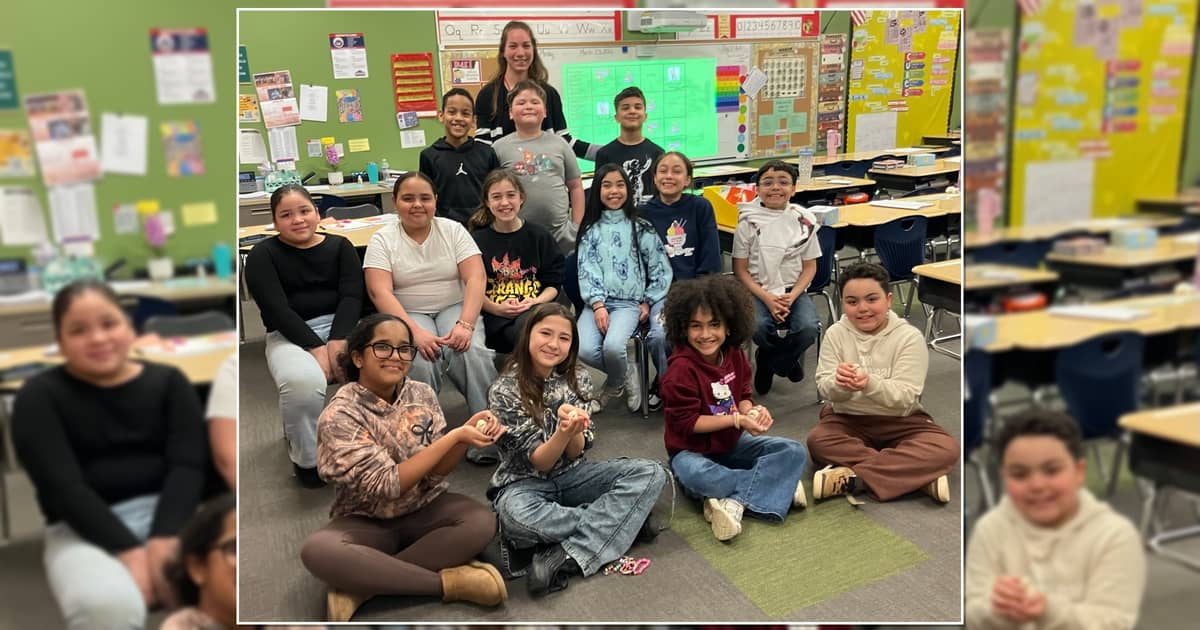

There was excitement, enjoyment and even tears of joy over the birth of a brood of baby chicks in Jennifer Hemperly’s 4th-grade class at Northwest Elementary School in Lebanon earlier this week.
Her classroom is one of 20 within Lebanon School District’s five elementary schools – with another 15 classes in Eastern Lebanon County and Palmyra school districts and New Coventry Christian School – participating in Lebanon County Cooperative Extension’s embryology program this school year.
About 750 students in those districts in 35 classrooms in the 3rd and 4th grades are learning by participating in the hands-on program, according to Martha Gregory, Lebanon County extension educator with the Penn State Cooperative Extension.
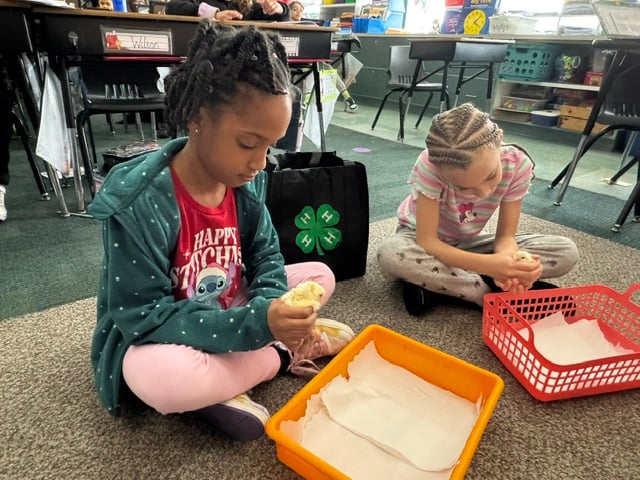
Monday was an especially important day in Hemperly’s classroom. That’s when the chicks were born, which led to plenty of “egg-citement” with students and faculty alike.
“Every time they squeak, my students squeak, so it’s been a little rough today, teaching-wise, just because they’re a bit of a distraction, but they are so excited,” Hemperly said.
“This project was really fun and just the first time that I had ever seen chicks before. So I was excited to see these chickens hatch out of their eggs and finally come to see the world,” said Eliezer Tirado-Alvarez.
He was not the only student to be thrilled by the wonder of the hatching process and seeing the classroom lessons come to life.
Yarieliz Rivera Gonzalez said her excitement over seeing the small, yellow chicks made her cry. Classmate Avianna Negron said there was one thing she learned about an egg when a chick is still within its shell.
“I didn’t even know that they had an air cell, so they could breathe in it,” Negron said. “’Cause it’s really tight in there and the air cell helps them breathe.”
Hemperly immediately responded to that comment by telling her students, “That’s where they get their first breath from, right?” Her charges answered affirmatively.
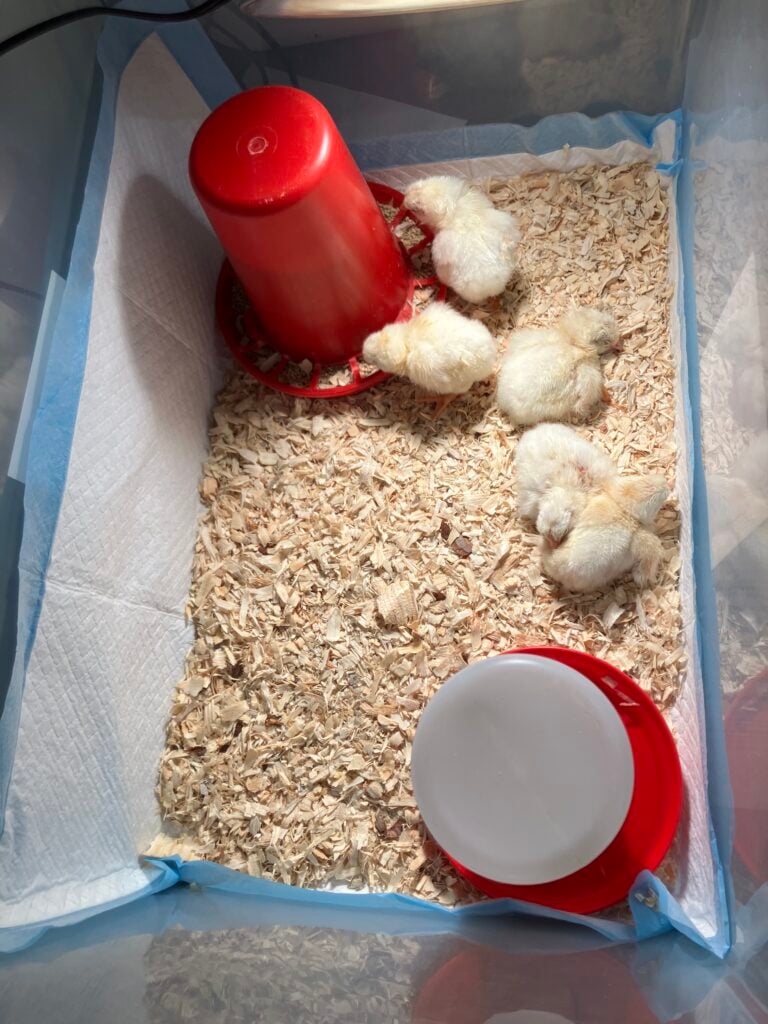
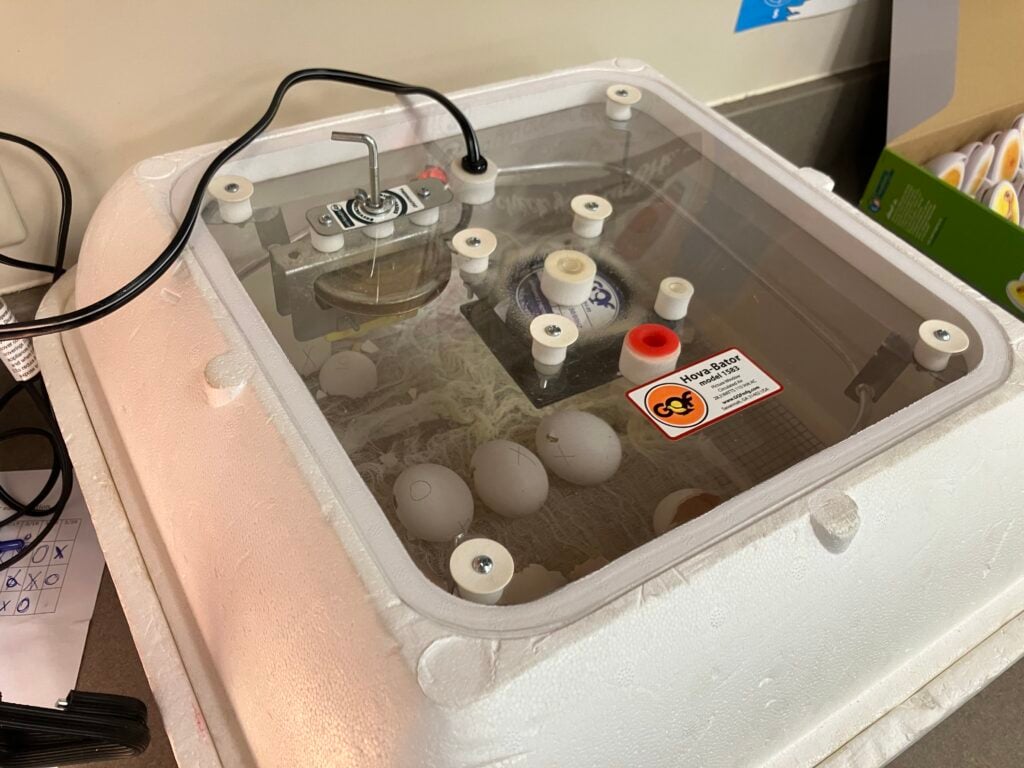
Shaniellys Rosado Vazquez said seeing the chicks when she came to class Monday morning surprised her, thinking they may have waited until later to hatch. As of Monday afternoon, nine of the 12 eggs in the incubator in Hemperly’s classroom had emerged from their shells, the only set to do so at Northwest Elementary.
Gregory told LebTown the other schools enrolled in the program will be conducting their studies in April.
“I’m excited, and they’re so happy,” Hemperly said. “As soon as the kids come in in the morning, we always put our phones in the bin. So as soon as the first kid came in, put the phone in, and I was like, (gasps) and then everybody swarmed. I said, ‘They need space and need to be able to breathe.’ So yeah, I backed ’em up a little bit, gave them room, so they (the students) come over in small groups at a time to come and watch them.”
It was uncertain when the first set of chicks may have hatched. What was known, however, was that the incubation period was set to end on Monday, and the little furry babies did not disappoint when they made their individual entries into the world.
After hatching, much like any newborn animal, they were taking turns resting or sleeping, eating, or drinking water when LebTown visited the classroom Monday afternoon. Meanwhile, three remaining eggs were well on their way to hatching since they had begun the pipping process.
“It’s a 21-day incubation period, and then we hope that they’ll hatch on a Monday,” Gregory said, adding that pipping entails a chick breaking out of its shell. “And then the chicks will be here in the classroom until Friday.”
The students had learned that the eggs, which were provided by Highline Hatchery in Elizabethtown, were White Leghorn layers, meaning these chicks will be used to produce eggs for human consumption. Broilers are a meat chicken that go to market to be sold in grocery stores.
Another lesson learned during their studies was the difference between supermarket eggs and eggs that produce chickens.
“My students are all worried about eating eggs for breakfast and like, ‘Oh my gosh, I don’t want you to eat a chicken!,’” Hemperly said about their responses. “And that’s when they (were told) that they are raised separately because you need a male rooster to fertilize to make the opportunity for chicks versus where your breakfast eggs are coming from.”
Penn State Cooperative Extension supplies the course materials, along with the incubators, heating lamps, etc., to help make each program successful, according to Gregory.
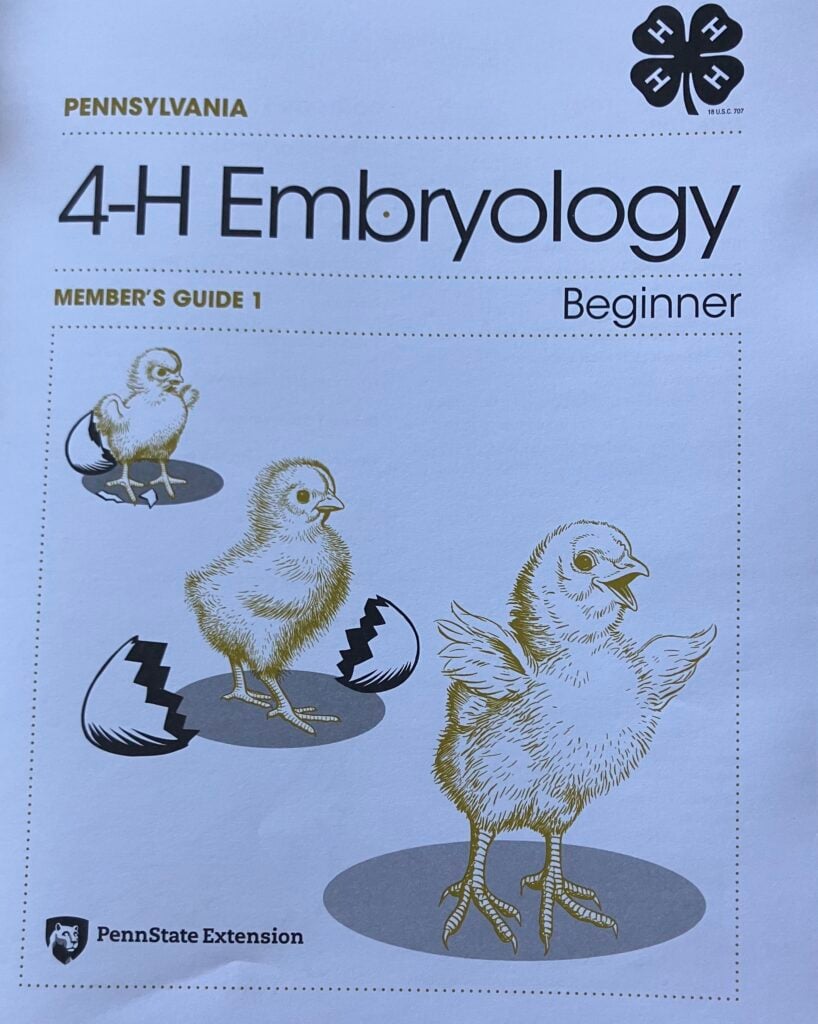
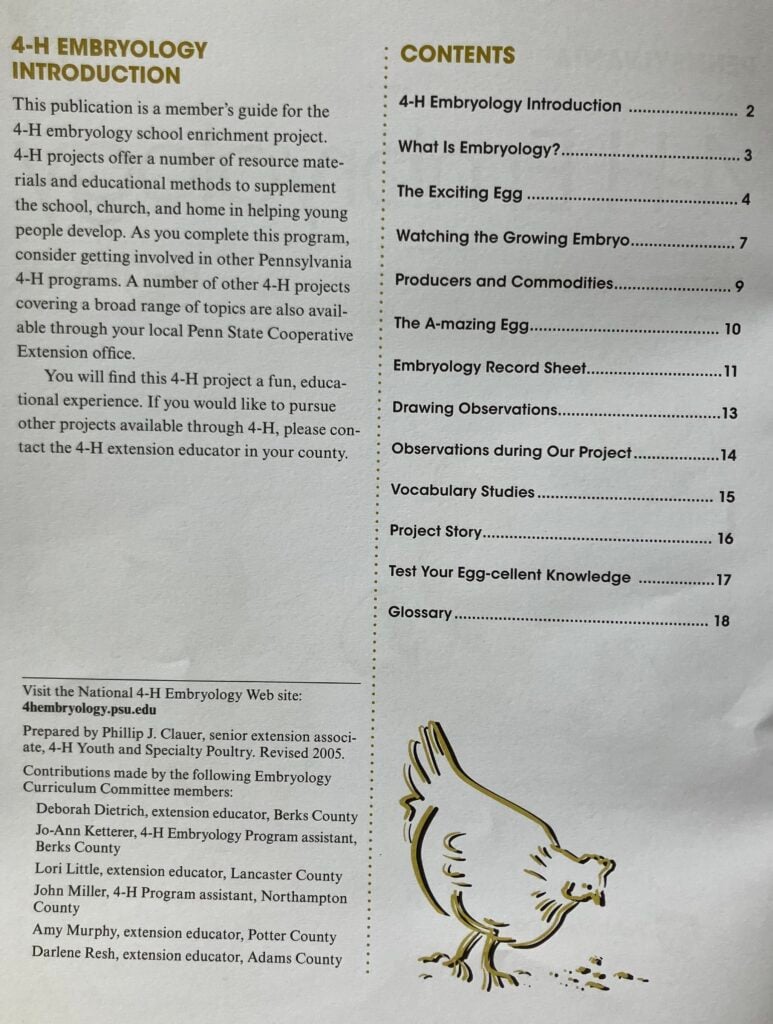
An 18-page, hands-on activity booklet produced by the extension contains information on embryology is, vocabulary studies, a glossary, and information on how to watch the embryos grow. Two pages of a workbook titled “Embryology Record Sheet” asks questions that help teach students “a dozen facts about our project.”
A hands-on approach with the lessons, the eggs and eventually the chicks is key to the learning experience.
“During the process, they’ve been turning the eggs three times a day. And then the second week of the project, Matt and I came into the classroom and we did a visit with candling, where we use a flashlight that shines through the egg and they’re able to actually see the embryo moving and developing inside the egg,” Gregory said. “So that’s the second week. And then the third week is more turning. And then today is a big payoff, or the hatch.”
“Even when you guys aren’t here, I do a couple of candlings outside of that. It’s not great to candle the eggs every single day, so I only candle like one,” Hemperly said. “And they’re (the eggs) numbered, so I make sure we don’t do the same one. … I normally use my phone flashlight, and I set up my iPad so I can display onto my screen so that it gets them back into the (incubator) warmth sooner, so then you can show it as a video, and everybody gets to see it, and then you can put the egg back (quicker).”
Candling is defined as “observing the shell and the contents of the egg (blood vessels, embryonic development, blood or meat spots, air cell, and so on) through the shell by holding the egg up to a bright light that is shined on and behind the egg shell.”
A fact sheet provided to LebTown says the students explore these lessons:
- Daily tasks essential to incubation
- Chicken reproductive anatomy
- Life cycles
- Food and fiber systems
- Science enquiry skills: observation, comparing, measuring, and data recording
- Ethical responsibilities of animal care.
Matt Lash, STEM coordinator for Lebanon School District, said the program is one way to fulfill that curriculum for students in those grade levels. STEM is an acronym for Science, Technology, Engineering and Math.
“We’re definitely looking at life cycles,” Lash said. “So seeing something from starting with the embryo all the way through the entire stage to the point where these chicks are able to go forward to farms in our local area, so I think it’s connecting back to our roots here in Lebanon County.”
There are other educational goals that are achieved as well.
Animal husbandry, animal stewardship, cell division, all parts of the egg’s development, and the different pieces of an egg’s structure or just a few of the lessons learned by the students.
In calling the program a partnership between the district and cooperative extension, Lash said the initiative is a win-win for the students and extension.
“It’s a partnership, and when we talk about community partnership, it’s an outreach not just for myself and Martha, but it also incorporates all of our students now across the district, which is really, really cool,” Lash said. “She gives us all the incubators and the equipment. It’s not like we have to run out and purchase anything to really do this. So she makes it very easy for us for a minimal fee to join in, and it’s 40 bucks per class. You can’t beat it for the experience that the kids get.”
Questions about this story? Suggestions for a future LebTown article? Reach our newsroom using this contact form and we’ll do our best to get back to you.

Keep local news strong.
Cancel anytime.
Monthly Subscription
🌟 Annual Subscription
- Still no paywall!
- Fewer ads
- Exclusive events and emails
- All monthly benefits
- Most popular option
- Make a bigger impact
Already a member? Log in here to hide these messages
Local news is disappearing across America, but not in Lebanon County. Help keep it that way by supporting LebTown’s independent reporting. Your monthly or annual membership directly funds the coverage you value, or make a one-time contribution to power our newsroom. Cancel anytime.