This article was funded by LebTown donors as part of our Civic Impact Reporting Project.
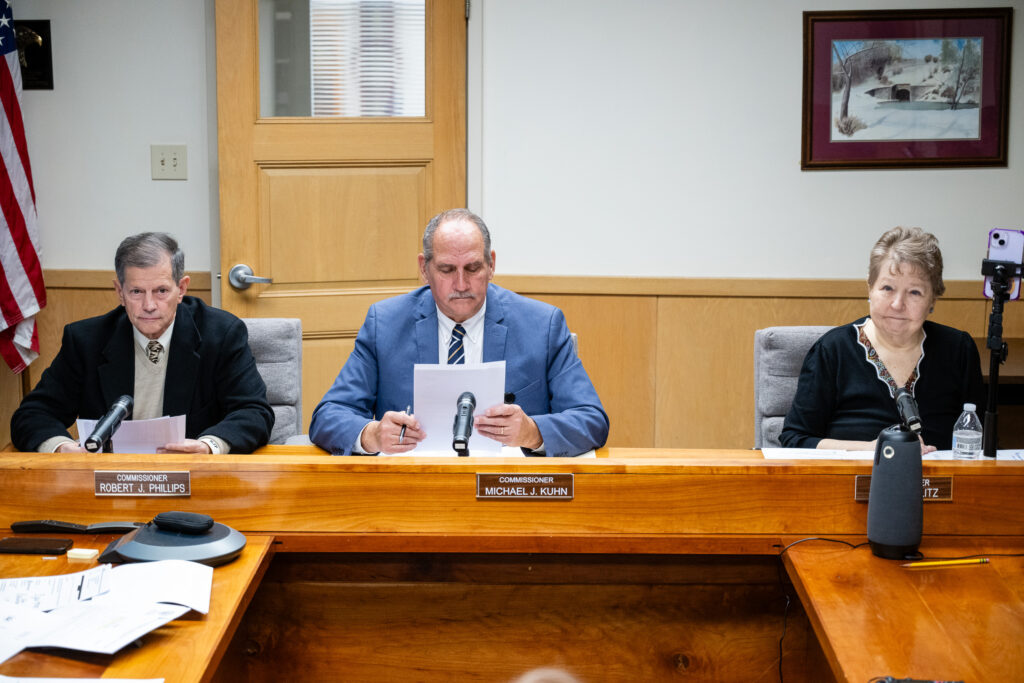
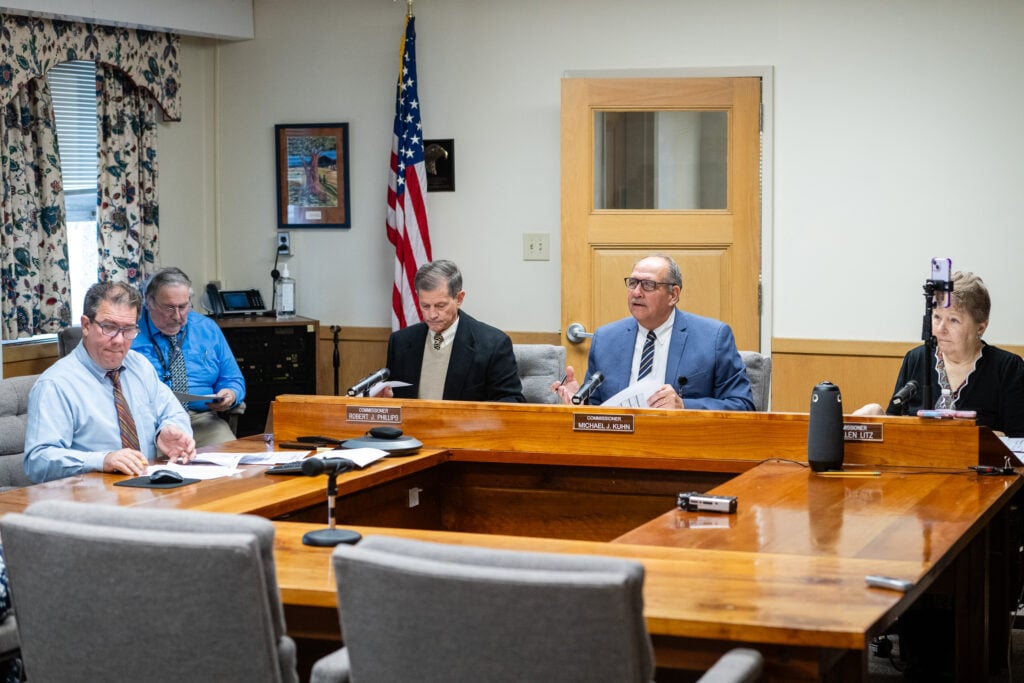
Citizen concerns about 287(g) immigration enforcement agreements again dominated public comment during the May 7 meeting of the Lebanon County Commissioners, as it has for the past several meetings.
On Thursday, citizens again expressed opposition to the county’s involvement, with questions and concerns about liability with the pending end of coverage through the insurance offered by the County Commissioners Association of Pennsylvania (CCAP). Lebanon County is a participating member and gets insurance through the Pennsylvania Counties Risk Pool (PCoRP).
(The county also conducted other business, including the possible creation of an ordinance governing the Lebanon Valley Rail Trail. That article can be read here.)
CCAP offers its member counties insurance coverage through PCoRP, but that organization’s governing body recently clarified that it does not include 287(g)-related liability coverage beginning June 1.
In February, the Lebanon County district attorney’s and sheriff’s offices signed agreements with U.S. Immigration and Customs Enforcement (ICE) to provide services in the Lebanon Valley. (These two agencies are among others in Lebanon County to enter into 287(g) agreements, and those agreements are available on ICE’s website.)

South Annville Township resident Michael Schroeder read a letter he prepared for commissioners and provided to LebTown that listed two main points about the end to this coverage, including:
- Liability – what are the true risks pertaining to civil rights, immigration law, other compliance issues, and potential conflicts between federal and state/local laws?
- Insurance costs – what would the county consider self-insuring? Would the county appeal to ICE to indemnify us? What about securing additional excess liability coverage, and at what cost?
He also said that the same group of concerned citizens have previously expressed other misgivings about delayed and limited reimbursements after local participation in federal enforcement actions, including detention, transport, booking, or warrant services.
“Butler County has been waiting for one year without seeing a single dollar,” he said.
Additional addressed areas include hidden costs after several other jurisdictions reported unreimbursed overtime, administrative burdens, equipment use, and training expenses. Another point involves mission drift, meaning local law enforcement agencies “may be diverted from core public safety duties.”
There is also a reputational cost, he said.
“Tying our local law enforcement agencies to federal immigration enforcement risks eroding community trust without clear evidence of a local need,” Schroeder read. “By Sheriff Marley’s public accounts, the undocumented individuals in our county’s criminal system are limited in number and are already effectively tracked. He has essentially denied any evidence of local gang activity or other ‘worst of the worst’ criminality that is beyond the capacity of local law enforcement to manage.
“In short, these agreements appear to expose the County to cost, risk, and community harm without a commensurate public safety benefit. And now add to that uninsured liability.”
He requested several calls to action in ending his statement.
“I respectfully ask our elected officials’ response to PCoRP’s impending policy amendment. I further encourage the commissioners to pass a resolution declaring that they strongly discourage county agencies, offices, and officials from entering into 287(g) agreements with ICE,” Schroeder said. “Relatedly, I urge County officials and agencies to rescind the 287(g) agreements previously agreed to and instead focus resources on local policing priorities.
“Finally, I urge County officials and agencies to consider whether this development underscores the principle that immigration policy is best addressed at the federal level, not through ad hoc local law enforcement partnerships with federal agencies.”
Later in the discussion, county administrator Jamie Wolgemuth answered Schroeder’s question about corresponding with PCoRP, saying there is no response because the insurance coverage is “a captive insurance product.”
“Essentially, they’ve communicated this to member counties. It wasn’t a change, in terms of excluding this coverage, suddenly. As the sheriff alluded, there are other parts of liability that PCoRP has excluded,” Wolgemuth said. “The action that was recently taken was to clarify it by further defining the exclusion to include 287(g). It wouldn’t have been covered a year ago or two years ago, but with this much attention on it and so on… it was coming up in a lot of counties as it is here. And so PCoRP took the action to further define it. So there really isn’t a response.”
Immediately upon the conclusion of Schroeder’s reading of the letter, county Sheriff Jeffrie C. Marley Jr., who attends the meetings as head of his department and to provide security, commented on several of Schoeder’s statements.
“That is true with PCoRP, okay? But what also wasn’t released with that statement was they no longer cover school resource officers that sheriff’s offices had in the school districts. There’s also other places that the sheriff’s office provides services to, like self-protection. Those services have no longer been covered. So it’s more than just the 287(g) program,” he said.
Marley added that alternative insurance coverage is being explored for participating local law enforcement agencies.
“So we still are able to, if we would have to go to a school and provide services there or something along that line. So that way we do have that coverage for the liability. Secondly, the money that is reimbursed from the government we can use towards that program. So again, there would be alternative coverage for the sheriff’s office and the district attorney’s office. It’s just that it wouldn’t be through PCoRP,” Marley said. “Also, the agreement that we signed with the federal government, again, when you’re doing the work for them, they assume the risk.”
However, there appear to be gray areas when you read the 287(g) agreement contract. Documents signed by participating agencies and posted on ICE’s website state that insurance coverage may be provided.

LebTown noted the gray areas of liability, with Wolgemuth and commission chairman Mike Kuhn agreeing with that assessment.
“I think anything like that starts off gray and is sorted out through the process of civil litigation, through discovery, through analyzing the facts, etc. It may not be initially obvious whose claim that is to defend until it basically pans out,” Wolgemuth said.
“For example, if something occurs where, let’s say, the moment someone is discovered to be here illegally and now ICE gets involved, is there a telephone call, for example, to or from ICE to say, ‘Detain them?’ Well, if the DAs or the sheriffs detains them, it seems that that was a point in time at which the liability shifted away and onto the federal government’s defense. But they’re not all going to be crystal clear if they happen at all. So it is gray, I’d agree with that. It’s gray until it’s clear.”
Kuhn said he’s had discussions with federal officials to get clarity on the agreements.
“None of us like gray areas. So I’ve already made an initiative with some of our federal legislators’ offices to notify them that this is an issue that needs to be addressed at the federal level to remove that gray area,” Kuhn said. “So that’s not going to happen tomorrow, but I’ve already started that initiative.”
County solicitor Matt Bugli provided insight into the legal side of this issue pertaining to insurance.
“The terms of the agreement do state that when a local official is working under the direction and control of ICE, and as Jamie indicated, it’s going to be determined on a case-by-case basis when somebody’s operating in a district attorney or sheriff operation, at what point does it then become a federal investigation?” Bugli said. “The agreement does clearly state that when they are working under the direction and control of the federal government under ICE, that they are considered a federal employee for purposes of, and it’s included in the agreement, something called the Federal Tort Claims Act.”

Bugli noted that the act establishes when an individual can be sued and the parameters for a lawsuit, among other matters. “It also specifically includes workers’ compensation. So there is certain protection that is extended from the federal government. But as Jamie indicated, it is on a case-by-case basis,” he added.
He also noted what the word “may” means as stated in the 287(g) agreements quoted by LebTown.
“I think maybe where you were referencing was in the section where it talks about representation. If there is a lawsuit that’s filed, the agreement says they may provide representation,” Bugli said. “The agreement is somewhat clear, however, in the sense that when they are operating under the course and scope of their federal authority, they are considered a federal employee for Federal Tort Claims Act purposes.”
Dr. Tom Overholt of Cornwall, who spoke about the need for parameters to measure ICE involvement by county officials, made a statement in reference to Bugli’s comment about the federal government providing legal representation during a lawsuit.
“As an aside, I think (about) the past as a federal employee. I’ve been defended by the U.S. Attorney under the Tort Claims Act, and when they say ‘not our responsibility,’ you’re at a tough spot going up against the U.S. Attorney’s office trying to establish that it was their responsibility and you were doing what they told you to do. So that’s a long story. A lot of fun, though.”
Overholt noted he had attended the last meeting to ask who’s getting federal money, who’s spending the money, and where’s it going, basically the need for accountability in areas involving ICE interactions.
“I haven’t seen any outline of the accountability for these 287s and I would request that again that the commissioners pay attention to this money…” Overholt said. “I think that the commissioners should establish some parameters upon which you were going to look at the effectiveness of this money and the enforcement actions and the things that are happening and what’s actually going on. How many events, what kind of people, what happens to those people, how many people are determined to be innocent.”
Following his statement, he asked commissioners if they had a response. Phillips and Kuhn both said commissioners are in the process of addressing his concerns. They made no additional comments, however, about what specific steps had happened over the past two weeks that addressed the issues that had been raised.
Questions about this story? Suggestions for a future LebTown article? Reach our newsroom using this contact form and we’ll do our best to get back to you.

Support Lebanon County journalism.
Cancel anytime.
Monthly Subscription
🌟 Annual Subscription
- Still no paywall!
- Fewer ads
- Exclusive events and emails
- All monthly benefits
- Most popular option
- Make a bigger impact
Already a member? Log in here to hide these messages
Free local news isn’t cheap. If you value the coverage LebTown provides, help us make it sustainable. You can unlock more reporting for the community by joining as a monthly or annual member, or supporting our work with a one-time contribution. Cancel anytime.