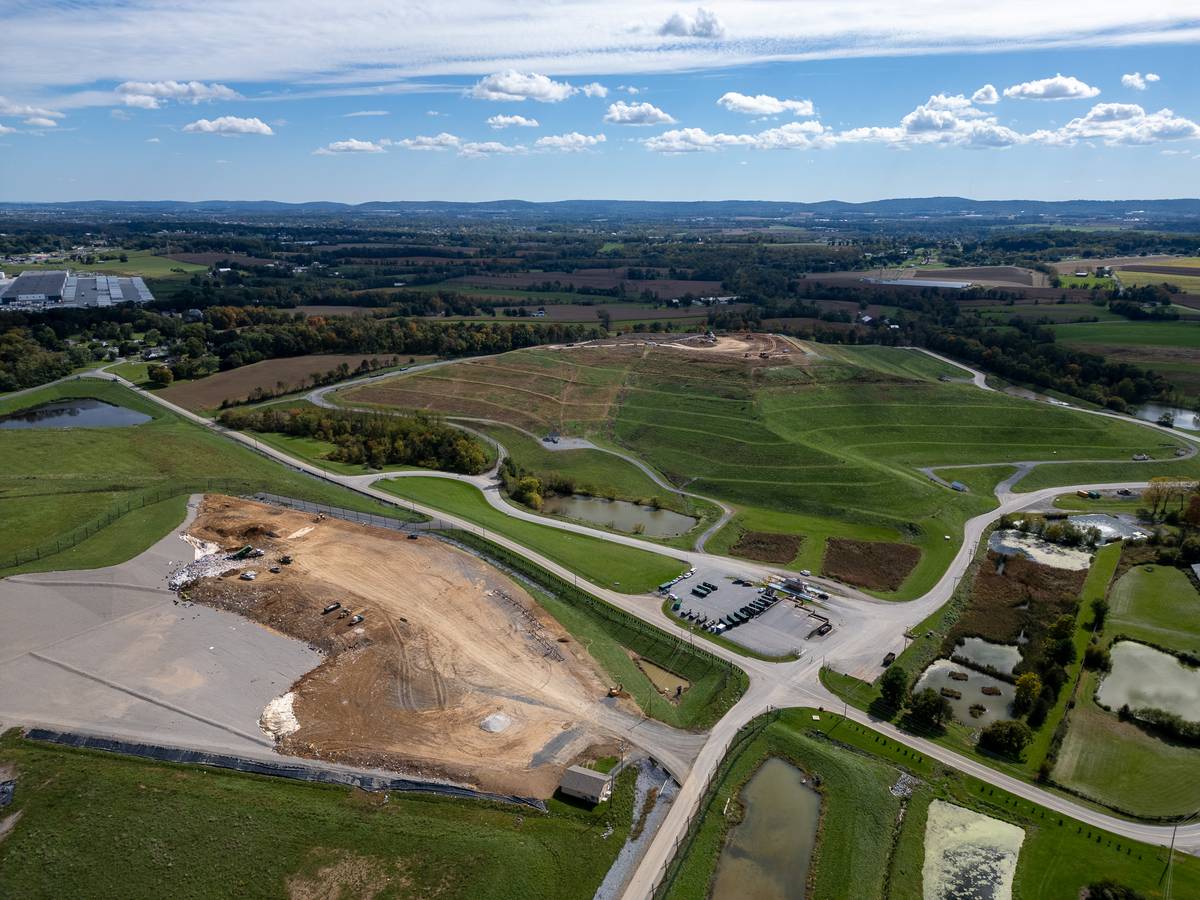
The Greater Lebanon Refuse Authority recently wrapped up a project to add 13 more vertical wells to capture the gas produced by the decomposition of organic waste buried in the Schilling landfill.
With the addition, Schilling has 30 vertical wells and 61 horizontal wells. Each well collects landfill gas, a combination of methane, carbon dioxide, and other organic compounds in low concentrations. Methane is the primary chemical component of natural gas.
“We are always watching for where we think we are having less than adequate gas collection,” said GLRA engineering manager Jim Zendek. “We thought more gas could be collected from Schilling.”
This is GLRA’s second round of adding vertical wells to the Schilling landfill. In 2019, the first 17 were drilled at a cost of $300,000. The most recent drilling had an estimated price tag of nearly $452,000, according to GLRA board minutes.
GLRA began collecting landfill gas (LFG) in 1986, making it the first in Pennsylvania with a LFG recovery project, according to the state Department of Environmental Protection.
“Gas production on our site began in the landfill where the current Heilmandale expansion is being constructed,” said Zendek in an email.
That predated federal mandates to monitor and manage the gases produced during the decomposition of waste. Landfills are the third largest source of methane emissions, according to the Environmental Protection Agency, so capturing the gas eliminates it from going into the atmosphere.
Additionally, LFG capture enables electricity generation.


“If our site was running at full capacity, we have the potential to power more than 2,000 homes,” said Zendek, basing that on an estimate of 10,500 kilowatt-hours of electricity usage per household, per year. “The fact that we’re not currently running at full capacity is why we are adding extra vertical wells to our site.”
When GLRA began collecting LFG, drilling horizontal wells into landfill cells was the accepted practice. But as waste settles, pipes can become crushed, limiting the amount of gas captured.
Vertical wells are often drilled into horizontal ones to open them up, enabling gas to be collected from both kinds of wells and from a radius of about 30 feet.
Two engines essentially vacuum the gas from the collection pipes into GLRA’s methane-to-energy facility. That gas then becomes the fuel for two more engines that produce electricity. While GLRA owns the powerplant, it contracts with NextEra, a power company, to sell the electricity generated to MetEd.
In April, GLRA received $170,913 in sales of carbon credits for the electricity generated by LFG from October 2023 to June 2025, according to board minutes.
A GLRA gas technician routinely checks gas flow and composition at the wells to ensure the right levels of methane, oxygen and other gases, Zendek said. This is done with a handheld gas analyzer.
GLRA also must maintain emissions within permitted levels, Zendek said. There is always some methane that is emitted as the system is not 100% efficient, he added.
While the Schilling landfill, which opened in 1991, has reached capacity, it still is producing gas.
“The older the waste, the less gas produced, but there’s never nothing — just less,” Zendek said.
Questions about this story? Suggestions for a future LebTown article? Reach our newsroom using this contact form and we’ll do our best to get back to you.

Support Lebanon County journalism.
Cancel anytime.
Monthly Subscription
🌟 Annual Subscription
- Still no paywall!
- Fewer ads
- Exclusive events and emails
- All monthly benefits
- Most popular option
- Make a bigger impact
Already a member? Log in here to hide these messages
An informed community is a stronger community. LebTown covers the local government meetings, breaking news, and community stories that shape Lebanon County’s future. Help us expand our coverage by becoming a monthly or annual member, or support our work with a one-time contribution. Cancel anytime.