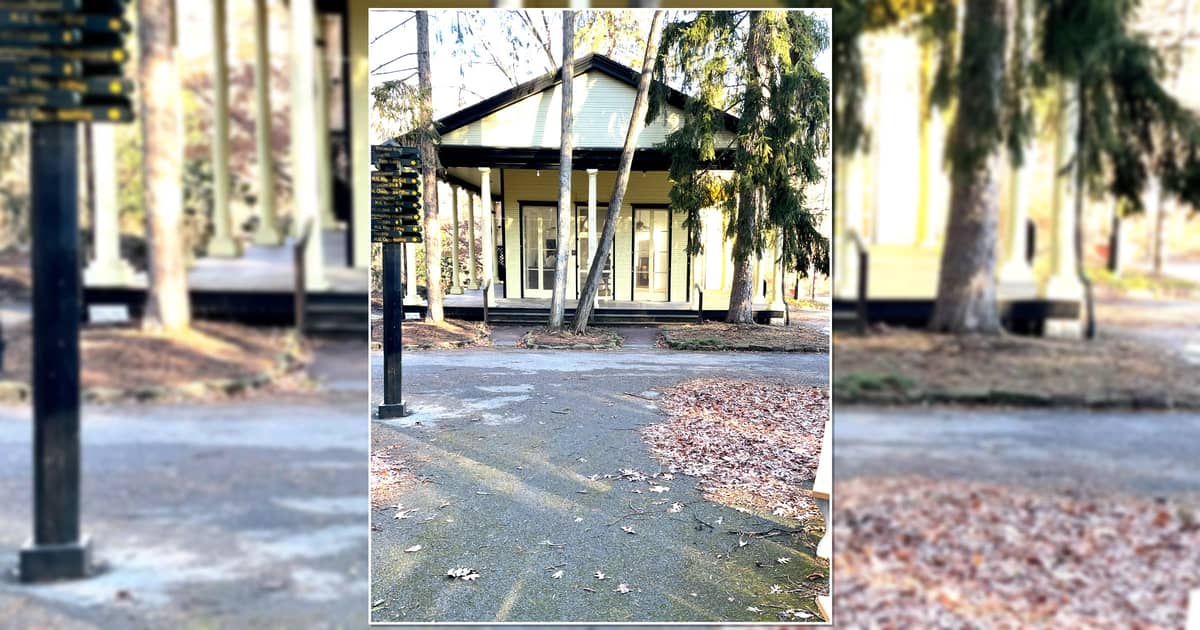
In June 1902, the Pennsylvania Chautauqua in Mount Gretna opened the Chautauqua Literary Scientific Circle hall devoted to CLSC members living in or visiting Pennsylvania.

That hall, known today as the circle building, served multiple purposes — instructional classroom, mini-lecture hall, reading room, and meeting space for roundtable discussions — all of which were hallmarks of the CLSC.
Developed by John Vincent and Lewis Miller, the founders of the New York-based Chautauqua Institute, the CLSC was a four-year program of required readings and rigorous examinations that sought to emulate the college experience. Neither Vincent nor Miller had formal education beyond what today is 8th grade, but both valued learning.
They saw membership in the CLSC as a means of providing education to people whose social and economic circumstances kept college out of reach.
Vincent and Miller’s advocacy for expanding access to education broke new ground in its focus on adults. In doing so, the two planted the seeds of the field of adult education and its corollary, lifelong learning.
“Show people no longer young, that the mind reaches its maturity long after the school-days end, and that some of the best intellectual and literary labor is performed in and beyond middle life,” wrote Vincent in his 1885 history of the Chautauqua Movement. “Between the ages of twenty and eighty lie a person’s best intellectual and educational opportunities.”
More than a book club

Because of its emphasis on reading, the CLSC is sometimes referred to as one of the first book clubs, but it was much more. The four-year course of study aimed to “promote habits of reading and study in nature, art, science, and in secular and sacred literature,” Vincent wrote.
To create the program, he recruited nationally known scholars and educators to develop the themed readings, assignments and examinations. The theme for 1892 — the year the Pennsylvania Chautauqua was founded — was “The American Greek Year,” according to the Lebanon Daily News. Assigned readings covered Grecian history, classic Greek, Greek architecture, and Greek sculpture.
But Vincent wanted the CLSC to also provide a comprehensive education. To that end, The Chautauquan, a monthly magazine of required readings that members purchased, included an eclectic mix of articles.
The October 1892 issue, for instance, contained papers on “Municipal Gas Works,” “Improvements in the Science of Warfare,” “The National Banking System,” “Adulterated Foods in the U.S.” and philosophical poems by the Norwegian playwright Henrik Ibsen. Each edition of The Chautauquan typically ran more than 100 pages and included definitions of terms, explanations of concepts and questions for students to answer.
In some ways, the CLSC foretold today’s online, asynchronous courses that allow students to complete assignments wherever and whenever.
“I am going to college, my own college, in my own house, taking my own time; turning the years into a college term; turning my kitchen, sitting-room and parlor into college halls, recitation rooms and laboratory,” imagined Vincent of what those in the CLSC program might say.
The CLSC also foretold today’s hybrid courses. Even as he championed “college in one’s home,” Vincent encouraged CLSC members to organize local circles where they could engage in face-to-face discussions, listen to lectures and share resources.
A year after its founding, the Pennsylvania Chautauqua started the “Hall of the Grove” CLSC. At least four other circles were organized in the county: the Twentieth Century Circle of the CLSC and Rembrandt Circle of the CLSC, both in Lebanon city; the CLSC of Annville; and the Excelsior Literary Society of Myerstown. One or more of these met from 1897 through at least the 1920s, according to local news reports.
“The present is essentially an era in which education is emancipating humanity from error and the environment of ignorance,” began a Sept. 22, 1897, front-page story in the Lebanon Courier and Semi-Weekly Report.
“To succeed one must know; to know one must study; and to study aright we must know what to study … we know of no surer and better way … than by taking up the studies of the Chautauqua Literary and Scientific Circle….”
Poems, badges, processions
Throughout his writings on the CLSC, Vincent celebrated members for engaging in the hard intellectual work of studying, reading and thinking. But he wanted others to recognize members’ effort and achievements as well.
To that end, he introduced a host of activities and events into Chautauqua’s annual, multi-week public assemblies. These not only gave CLSC members a sense of being “part and parcel of a great institution,” Vincent asserted, but also identified them to anyone visiting the assemblies for a day or a particular lecture or concert.
“The members of the ‘Circle’ stand on a higher plane than the visitors to the Assembly because they put will into the work,” Vincent insisted. “They read what they ought, for months and years, everywhere, getting larger views of the world….”
Each class, for instance, composed a class song as well as wrote a class poem, both of which were performed throughout the assemblies. CLSC members commemorated prominent historical individuals or literary characters they had studied with recitations by members on occasions termed “Memorial Days.”
Receptions for graduates-to-be and alumni reunions also were held annually.
But the main event was Recognition Day when members would receive diplomas and degrees. The Pennsylvania Chautauqua’s first Recognition Day in July 1892 involved a processional of board members, invited guests, and CLSC members who paraded on a path with flowers strewn by 20 flower girls.
The processional also passed through a series of decorated arches, the final of which was the “Golden Gate.” Only CLSC graduates could pass through the Golden Gate, a symbol of their entering the land of knowledge, according to the Lebanon Daily News.
Subsequent Recognition Day exercises followed that pattern. The July 1893 day added responsive readings, poems, and songs, and 1894 saw the addition of music by the Chautauqua Chorus.
Recognition Day exercises became as much of an attraction to Chautauqua visitors as the scheduled speakers and concerts, as evidenced by frequent front-page stories in Lebanon newspapers.
Recognition Day ceremonies continued into the first decades of the 20th century, but by the 1920s, the building is more often referenced for uses other than the CLSC.
A community building
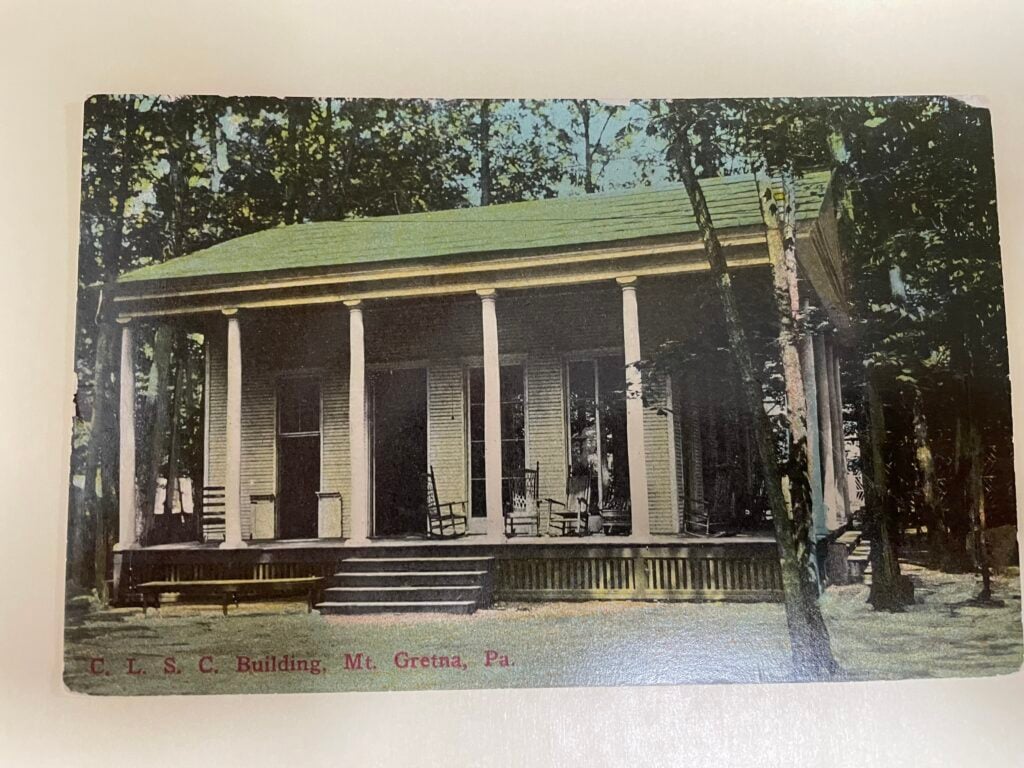
While initially built for CLSC members, the building evolved into a gathering place for the broader community. The Chautauqua board, for instance, frequently conducted its monthly meetings in the CLSC building when temperatures allowed.
In the early 1920s, the building became a community library, and for at least one summer, the Chautauqua board employed a librarian.
Starting in 1926, the Chautauqua Women’s Auxiliary relocated its Oriental Shop with “interesting novelties and many other things for a typical tourist’s collection” to the CLSC building, according to a July 1926 story in the Daily News. A fundraising project for the Chautauqua, the shop sold gifts from glassware and dishware to jewelry and toys.
Since then, use of the building has largely stayed commercial with a mix of retail gift, clothing and antique shops. These operated typically from May through September as the building has no heat.
This year, the circle building will welcome the Mount Gretna Coffee Cottage offering coffee and other drinks and baked goods. Hershey-based Desserts, Etc., will open the offshoot of its popular bakery on Friday, May 22.
While the building’s use has changed over the years, the hall itself has not. With its three side-porch and stately columns, it remains “a very handsome building of Greek architecture where every comfort will be provided for members and strangers visiting the grounds,” as the Lebanon Daily News reported in June 1902.
Questions about this story? Suggestions for a future LebTown article? Reach our newsroom using this contact form and we’ll do our best to get back to you.

Become a LebTown member.
Cancel anytime.
Monthly Subscription
🌟 Annual Subscription
- Still no paywall!
- Fewer ads
- Exclusive events and emails
- All monthly benefits
- Most popular option
- Make a bigger impact
Already a member? Log in here to hide these messages
While other local news outlets are shrinking, LebTown is growing. Help us continue expanding our coverage of Lebanon County with a monthly or annual membership, or support our work with a one-time contribution. Every dollar goes directly toward local reporting. Cancel anytime.