This article was funded by LebTown donors as part of our Civic Impact Reporting Project.
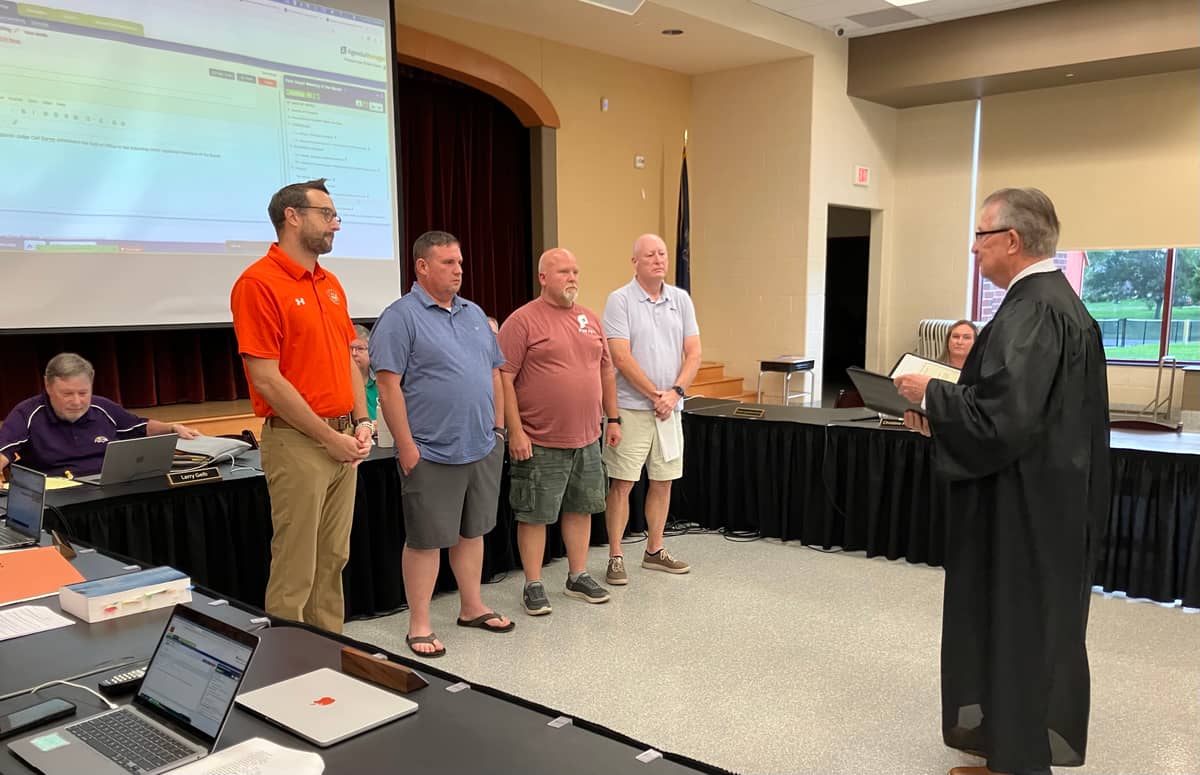
Lebanon County Commissioners signed two Memorandums of Understanding (MOU) with the district attorney’s office concerning department vehicles and 287(g) funds at a meeting Thursday, June 18.
A third MOU establishes a freelance grant coordinator position within the department at a cost not to exceed $12,000 annually. All three MOUs were approved by a 2-1 vote with commissioner Jo Ellen Litz voting no on each measure.
In a separate matter involving the county court system, commissioners unanimously agreed to purchase new software for the court system to, among other functions, pay jurors for their services.
287(g) financial account/purchasing
The MOU for financial account and purchasing covers payments issued to the county detectives and/or DA’s office pursuant to its 287(g) agreement with the federal government.
In February, the DA’s office and detective bureau signed an agreement with Immigration and Customs Enforcement (ICE) to participate in federal enforcement efforts involving illegal immigration.
Per the 287(g) agreement, the federal government issues payments for hours worked under ICE authority, training costs associated with the agreement and issues payment if illegal alien detentions occur during the fiscal quarter.
ICE promotional materials indicate that participating agencies may receive federal reimbursements, including $100,000 for vehicles, $7,500 per trained officer for equipment, and partial salary coverage for local law enforcement agencies that cooperate with the federal government.
The first financial account opened by the DA’s office occurred without prior notice to commissioners, who became aware of it after county administration raised concerns about funds destined for the credit union account. County administrator Jamie Wolgemuth flagged it due to regulatory differences between banks and credit unions.
A federal SAM account was then created with a county-approved depository, Northwest Bank, and $145,015 was deposited on April 3, as previously reported by LebTown following a Right-to-Know request for financial documents related to 287(g) agreements with the DA’s and sheriff’s offices.

The sheriff’s department went through county commissioners to establish a 287(g) bank account at a public meeting and was praised by commissioners for being transparent.
The MOUs signed Thursday are a reflection of ongoing conversations between the commissioners’ and DA’s offices for the handling of all 287(g) funds and protocols concerning the purchase of county assets using those dollars, according to Wolgemuth.
This agreement notes that the DA shall work with the county and county treasurer’s office to “transition all 287(g) accounts under the county’s umbrella.” The county agreed to create a line item in the revenue section of the DA’s office titled “287(g).”
This agreement notes that 287(g) funds must be “spent on vehicles, training, equipment and other items to increase law enforcement’s ability to assist the Department of Homeland Security with the deportation of illegal aliens.”
The agreement states that while the DA’s office has sole discretion as to how funds are spent, all expenditures must “comply with any federal, county and/or municipal codes” and the DA “shall work with the county for purchases and utilize the county purchasing agent when appropriate.”
Read More: (May 2026) County commissioners, controller send letters to DA about fiscal affairs
Vehicle agreement
The agreement notes that the DA’s office possesses several vehicles that are insured by the county and sets in motion the transfer of all vehicle titles under Lebanon County via the provisions set forth in the MOU.
On April 10, the DA’s office bought a used 2025 Chevrolet Tahoe for nearly $47,000 and traded in another vehicle, all without the commissioners’ knowledge.
Letters concerning the handling of fiscal matters by the Lebanon County District Attorney’s office were then sent in early May to District Attorney Pier Hess Graf by county commissioners and the county controller.
On May 8, commissioners issued a letter titled “Fiscal Matters” to Graf noting that the Pennsylvania County Code “broadly establishes that the county commissioners shall be the responsible managers and administrators of the fiscal affairs of the county.”

The letter noted the purchase of the Tahoe and quotes from Section 15101 of the county code, with emphasis included in the original letter, that “the county commissioners shall contract for and purchase the services referred to in section 12508 (relating to office supplies) and personal property for county officers and agencies.”
Commissioners also said in the May 8 letter that the county code delineates a process by which county property is to be acquired, including a requirement for bids on purchases greater than $24,500 – or, as an alternative, any such purchases can be made through the state’s cooperative purchasing program, COSTARS.
The letters were prompted by the vehicle purchase and trade-in. Commissioners previously told LebTown that their letter was sent “in the spirit of cooperation among our departments and to ensure full compliance with the provisions of the Pennsylvania County Code.”
Wolgemuth previously told LebTown that the DA’s office has 13 vehicles in its possession, and that the used vehicle purchased in April is a 2025 model.
The DA’s office agrees in this MOU to “consult with the county administrator and/or county solicitor about any future sales, auctions, or vehicular maintenance to ensure compliance with any applicable codes or statutes.”
Although the district attorney maintains the ability to purchase vehicles with 287(g) funds, that individual will consult with the county administrator or county solicitor to “ensure compliance with any applicable codes or statutes.”
The final paragraph under asset value and/or future purchases notes that “when appropriate, the parties agree to executive a lease for future District Attorney Office vehicles in lieu of additional purchases” and that the “County would be the approving entity for a lease agreement.”
Given existing state law in the county code and provisions within the county handbook concerning the use of its purchasing agent, LebTown asked why these two MOUs were necessary.
“The purpose of the memorandum on each document is labeled under the paragraph entitled ‘Purpose.’ I would note that every county does things slightly differently,” said Graf, who added a majority of counties have their forfeiture vehicles titled to their DA’s offices. “I verified that prior to offering this memorandum. We entered into the memorandum in the interest of transparency. I think we have a wonderful working relationship with the county and the board. And I think everybody wins as a result of the memorandum.”

LebTown asked Graf if her office would be willing to share with the public information about individuals who have been detained as part of the work with ICE.
“I think it’s somewhat of a misnomer to say the public has asked, the general public has asked, that people are out crying. I think you have a certain number of individuals that come to these meetings that post online and they have the same issue every time,” Graf said. “I don’t know that any comment from my office is going to address those issues or make them feel comfortable with the fact that my office continuously engages in deporting illegal criminals, only criminals.”
Read More:
- County residents express ongoing concerns over 287(g) agreements
- Commissioners decline request for ICE stance, open account for federal funds
Graf further stated her office has only dealt with individuals who have come into the criminal justice system and are here illegally. In response to a question about how many people had been detained for ICE agents in Lebanon County, the estimate was “about 10.”
In voting against the MOUs, Litz said Lebanon County should not accept federal funding from ICE since other counties have returned theirs, and she cited a lack of accountability among other reasons for her opposition.
Grant coordinator position
Commissioners gave approval for the DA’s office to hire Lebanon resident and former mayor Jackie Parker to write grants at a rate of $200 per hour. The role is for the sole purpose of continued work on three existing grants for the agency and requires the coordinator to seek out additional grants, among other duties.
Jury Program
Stephanie Axarlis, court administrator, presented a plan to replace the Jury Program at an initial start-up cost of $30,095 since the current system is near the end of its life cycle. The jury management software program, which has been in service since 2017, assists with summoning, selecting and compensating jurors.
It was noted a recent attempted upgrade of the current system resulted in performance issues, including an inability to print from the program. Initial solutions were found to not be viable since the program’s end of life is approaching and the vendor will no longer be supporting this version.
The courts requested a downpayment of $11,915 for the new software system, which is half of the county’s shared cost with the courts for the purchase of a new X-ray system for the municipal building, which cost $23,830 but was paid totally by county courts.
It was noted that the courts will utilize existing funds of $3,180 for a downpayment of $15,095 for the new software and would request the balance of the payment through the 2027 budget.
Next meeting
Lebanon County Commissioners meet the first and third Thursday of the month at 9:30 a.m. in Room 207 of the Lebanon County Municipal Building, 400 S. 8th St., Lebanon. The next meeting will be held Thursday, July 2.
Questions about this story? Suggestions for a future LebTown article? Reach our newsroom using this contact form and we’ll do our best to get back to you.

Join our community of local news champions.
Cancel anytime.
Monthly Subscription
🌟 Annual Subscription
- Still no paywall!
- Fewer ads
- Exclusive events and emails
- All monthly benefits
- Most popular option
- Make a bigger impact
Already a member? Log in here to hide these messages
An informed community is a stronger community. LebTown covers the local government meetings, breaking news, and community stories that shape Lebanon County’s future. Help us expand our coverage by becoming a monthly or annual member, or support our work with a one-time contribution. Cancel anytime.